Layered wall finish planning
Plaster Coverage Calculator
Estimate the plaster area, volume, dry mix, and water needed for walls, ceilings, skims, and base coats by combining room size, thickness, substrate pull, and waste.
Each preset loads a different wall set, coat build, substrate, and plaster system so you can compare typical jobs quickly.
Coverage breakdown
Typical dry mix consumption and water ratios vary by manufacturer. These planning values help compare broad plaster families before you open product sheets.
To calculate the amount of plaster needed for a room, you must calculate the net surface area of the wall and the ceiling. To calculate the perimeter of the room, measure the length of each of the walls and add those length together. Multiply the perimeter of the room by the height of the walls to calculate the gross area of the walls.
If you are also plastering the ceiling, multiply the length of the room by the width of the room to calculate the area of the ceiling, and add that area to the gross area of the walls. Subtract the area of any opening in the walls (such as doors or windows) from that total area. Do not subtract the area for small openings like electrical sockets; the amount of plaster that will be lost to cutting and shaping plaster to fit around these openings is negligible.
How to Calculate Plaster Needed for a Room
The resulting number is the area of the walls and ceiling that will require plaster. The volume of plaster that are required to cover the area of the walls and ceiling is dependent upon the thickness of the plaster layer. Plaster may be applied in layers whose thickness is measured in millimeters.
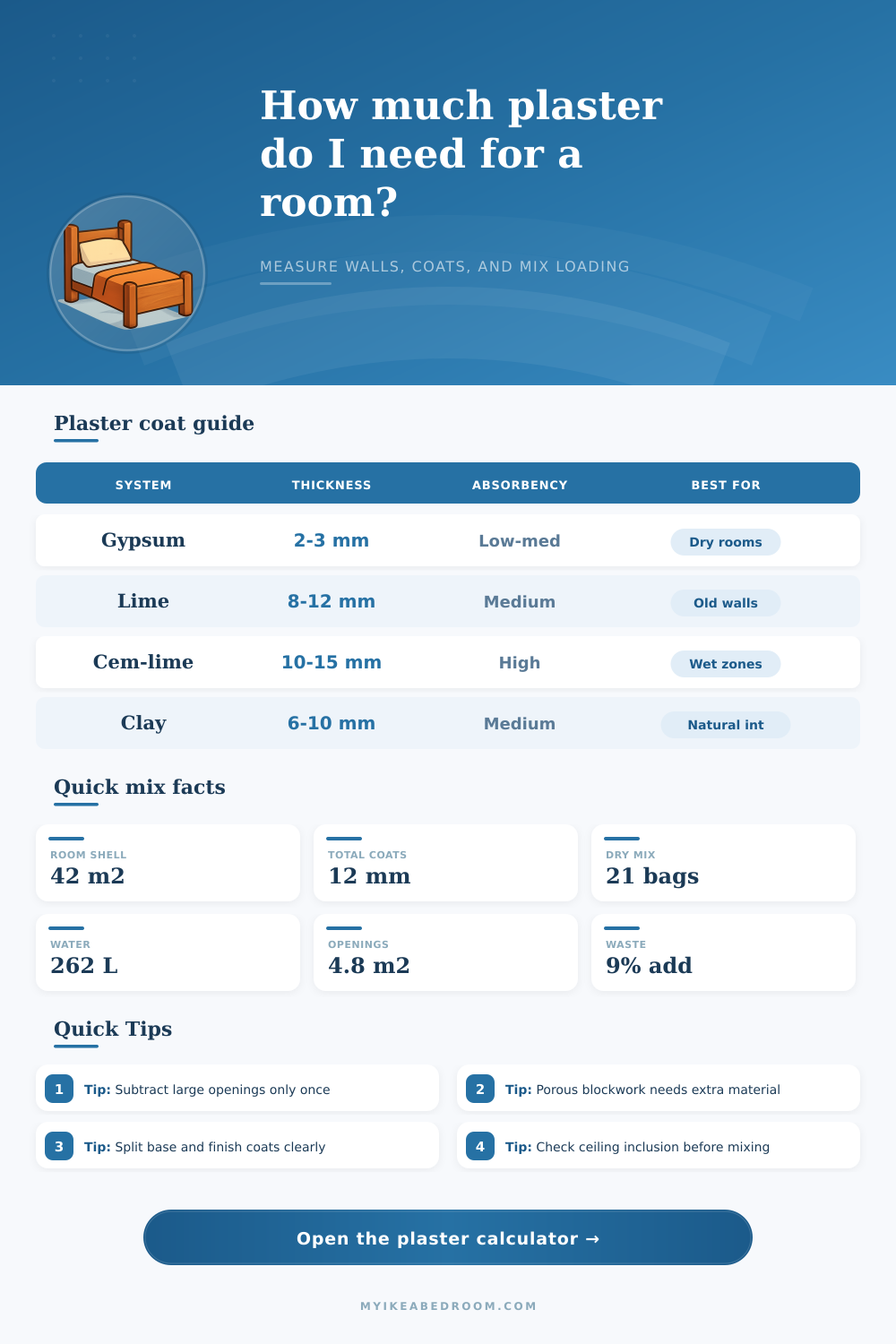
The thicker the layers of plaster that you apply, the more bag of plaster that will be required to provide enough plaster for the job. For instance, gypsum plaster may be only two millimeters in thickness, but cement-lime plaster may need to be five to fifteen millimeters thick. Additionally, you may apply multiple coats of plaster to achieve a flatly painted surface, so the thickness of each of those coats will factor into the total volume of plaster that is needed.
The substrate upon which the plaster will be applied will also impact the amount of plaster that is needed. For instance, if the substrate that is to be plastered is sealed plasterboard, it will absorb very little water from the plaster. However, if the substrate is open brick or timber lath, the substrate is porous and will absorb water from the plaster.
Because of this, the substrate will consume more plaster to hydrate the pores in the substrate than if it were a nonporous substrate. To combat this, you may dampen the substrate with water before you apply plaster to the substrate. Additionally, the texture of the plaster will impact the amount of plaster that is required.
For instance, if the plaster is to have a smooth finish, less plaster will be consumed than if it were to have a textured finish. In either case, it is a common practice and recommendation to add nine to ten percent to the total amount of plaster to account for any plaster that may fall to the floor during the plastering process or that becomes stuck in the mixing bucket of the mixing tool. There are different types of plaster that may be used for different purpose within a home or construction site.
For instance, people often use gypsum plaster within interior surface of a home because gypsum is a light material. Lime plaster is often used on older homes whose walls were constructed with lime-based plaster because plaster allows the walls to breathe, but lime-based plaster sets slowly. Cement-lime plaster is used in areas of a home that may become damp, such as bathrooms, because cement-lime plaster resists moisture.
Each of these type of plaster has a different density. For instance, gypsum has a density of approximately nine hundred kilograms per cubic meter of plaster, but cement mixes has a density of approximately fourteen hundred and eighty kilograms per cubic meter. Plasterers use these densities to calculate how many bags of plaster will be required to cover the area that needs to be plastered.
For instance, consider a bedroom whose dimension are four meters in length and three meters in width, with walls that are two hundred and forty centimeters in height, whose ceiling will also be plastered, and that has four square meters of doors and windows that will not be plastered. Additionally, consider that two-millimeter gypsum plaster will be used for the bedroom, and that nine percent of the total amount of plaster will be wasted in the plastering process. According to these parameter, it will be possible to calculate how many twenty-five kilogram bags of plaster will be required to plaster the bedroom.
If the material to be used is changed to lime plaster, or if there are any changes in the thickness of the plaster coats that will be applied, it will be possible to calculate the number of bags of plaster that will be required to complete the project. There are error in the calculation of the amount of plaster that will be required for a project. For instance, if the height of the walls is not measured to the ceiling, the area will be underestimated for that calculation, and extra area should of been accounted for the edges of the walls.
Additionally, you may forget the area of the ceiling in the initial calculations, which will result in an insufficient calculation of the total amount of plaster that will be required. Furthermore, if the substrates that are to be plastered are porous, those substrates will consume more plaster than on nonporous substrates. Finally, it is essential to always round the total amount of bags of plaster to the next highest whole bag in case any plaster is needed beyond the calculated amount.
External factors may also impact the setting of plaster. For instance, if the substrate that is to be plastered is porous, the first coat of plaster will harden relatively quick. Thus, it will be necessary to mix small batches of plaster at a time and plaster from one edge of a batch to the next.
Changes in temperature can impact the rate at which plaster sets. For instance, a change in temperature of only ten degrees can impact the setting of plaster. Additionally, if the area in which plaster will be applied is well ventilated, the plaster will dry quickly due to the removal of moisture from the air.