🌱 Planter Size Calculator
Find the perfect pot diameter, depth, and soil volume for any plant
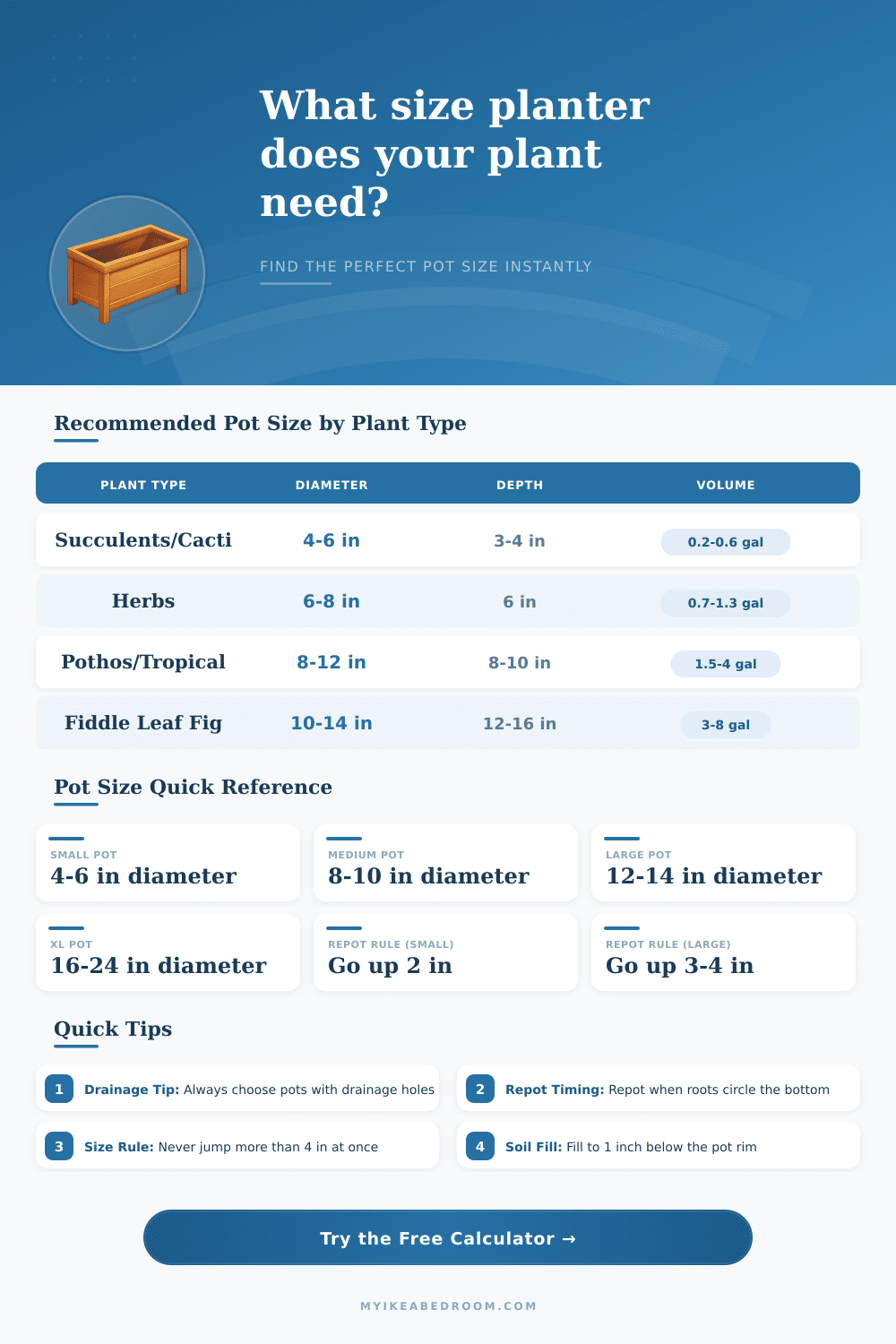
| Plant Type | Diameter (in) | Depth (in) | Volume (gal) | Notes |
|---|---|---|---|---|
| Succulents / Cacti | 4 - 6 | 3 - 4 | 0.2 - 0.6 | Shallow, fast-draining soil |
| Herbs | 6 - 8 | 6 | 0.7 - 1.3 | At least 6 in deep for roots |
| Tropical - Small | 6 - 8 | 6 - 8 | 0.7 - 1.3 | Pothos, philodendron starters |
| Tropical - Large | 10 - 14 | 10 - 12 | 2.5 - 6 | Monstera, bird of paradise |
| Fiddle Leaf Fig | 10 - 14 | 12 - 16 | 3 - 8 | Deep roots, well-draining mix |
| Snake Plant | 6 - 10 | 8 - 10 | 0.7 - 3 | Allow 2 in from root ball |
| Peace Lily | 6 - 8 | 8 | 0.7 - 1.3 | Prefers slightly snug pot |
| Orchids | 4 - 6 | 5 - 6 | 0.2 - 0.6 | Clear pot ideal, needs drainage |
| Trees / Large | 16 - 24 | 16 - 24 | 8 - 25 | Heavy pot for stability |
| Diameter (in) | Depth (in) | Volume (gal) | Volume (L) |
|---|---|---|---|
| 4 | 4 | 0.22 | 0.83 |
| 6 | 6 | 0.74 | 2.8 |
| 8 | 8 | 1.74 | 6.6 |
| 10 | 10 | 3.4 | 12.9 |
| 12 | 12 | 5.9 | 22.3 |
| 14 | 14 | 9.4 | 35.6 |
| 16 | 16 | 14.1 | 53.4 |
| 20 | 18 | 24.5 | 92.7 |
| 24 | 20 | 39.3 | 148.7 |
| Current Pot (in) | Plant Category | New Pot Size (in) | Size Increase |
|---|---|---|---|
| 2 - 4 | Seedling / tiny | 4 - 6 | +2 in |
| 4 - 6 | Small plant | 6 - 8 | +2 in |
| 6 - 8 | Small-medium | 8 - 10 | +2 in |
| 8 - 10 | Medium | 11 - 13 | +3 in |
| 10 - 12 | Medium-large | 13 - 16 | +3-4 in |
| 12 - 16 | Large | 16 - 20 | +4 in |
| 16 - 20 | XL / Tree | 20 - 24 | +4 in |
Choosing the right size of pot makes a bigger difference than you think The pot you choose determines everything: how fast the soil dries, whether your plant thrives and how healthy the root system becomes. Whether you work with a tiny 6-inch pot or a large raised bed, container plants lose moisture faster than those that grow in the ground. Adding mulch helps slow the evaporation down.
Most pots follow a standard progress, jumping by 2 inches each time. You will find them starting at 2 inches, then 4, then 6, and so on. Nursery pots, you know, those plastic tins that you buy in the store.
How to Choose the Right Pot Size
Usually start around 4 inches and climb by those same steps. The maxiumum size is almost infinite; some pots reach 60 inches.
Finding a pot that is not too big depends on the knowledge about the mature size of your plant and its kind. Whether it is a succulent, annual, perennial, shrub or tree makes a big difference for its needs. From here, you choose a pot that gives the right depth of soil and space so the roots develop properly.
For little stuff like cacti and succulents, a pot between 4 and 6 inches suffices. Flowery plants usually require something in the range of 8 to 10 inches. Then you have the bigger samples.
Monstera, Ficus, Areca palms, that generally want pots of 10 to 12 inches.
The size of the pot directly affects how much space the plant can use. It is all about the ratio between roots and foliage, basically, every leaf and branch requires enough roots to support it. Square pots have a real advantage hear.
They carry more soil for the same height and give more surface area compared with round pots. More space means more soil and better growth.
Sometimes sizing down really matters, especially if the plant is overpotted, put in a pot that is too big for its current state. The size of your pot ties directly to how air and moisture move in it. When roots become too dense, you can use a knife and remove maybe half or two thirds of them, keeping everything in the same pot size.
A big indoor plant can entirely change the feel of a room. Strangely, unlike big furniture, big plants can actually create a feeling of space in a small room. A less dense plant works best for that, because it allows light and air to flow more easily through the leaves.
Every plant comes from different places (different climates and conditions)… So there is no universal answer for the watering or light needs.
Medium pots work for a bit bigger room plants… Think about ferns, small indoor palms or flowering varieties. Small pots under a third of a quart are excellent for house plants, succulents and herbs.
Then there is the material. You have many choices: ceramic, metal, plastic, concrete, glass, jute, terracotta and muchmore.