Planter Size for Plant Calculator
Calculate planter diameter, usable depth, soil volume, drainage holes, saucer clearance, and cachepot fit from the plant rootball and growth profile.
Start with a common indoor or patio plant, then adjust the rootball, canopy, planter style, drainage, and repotting interval.
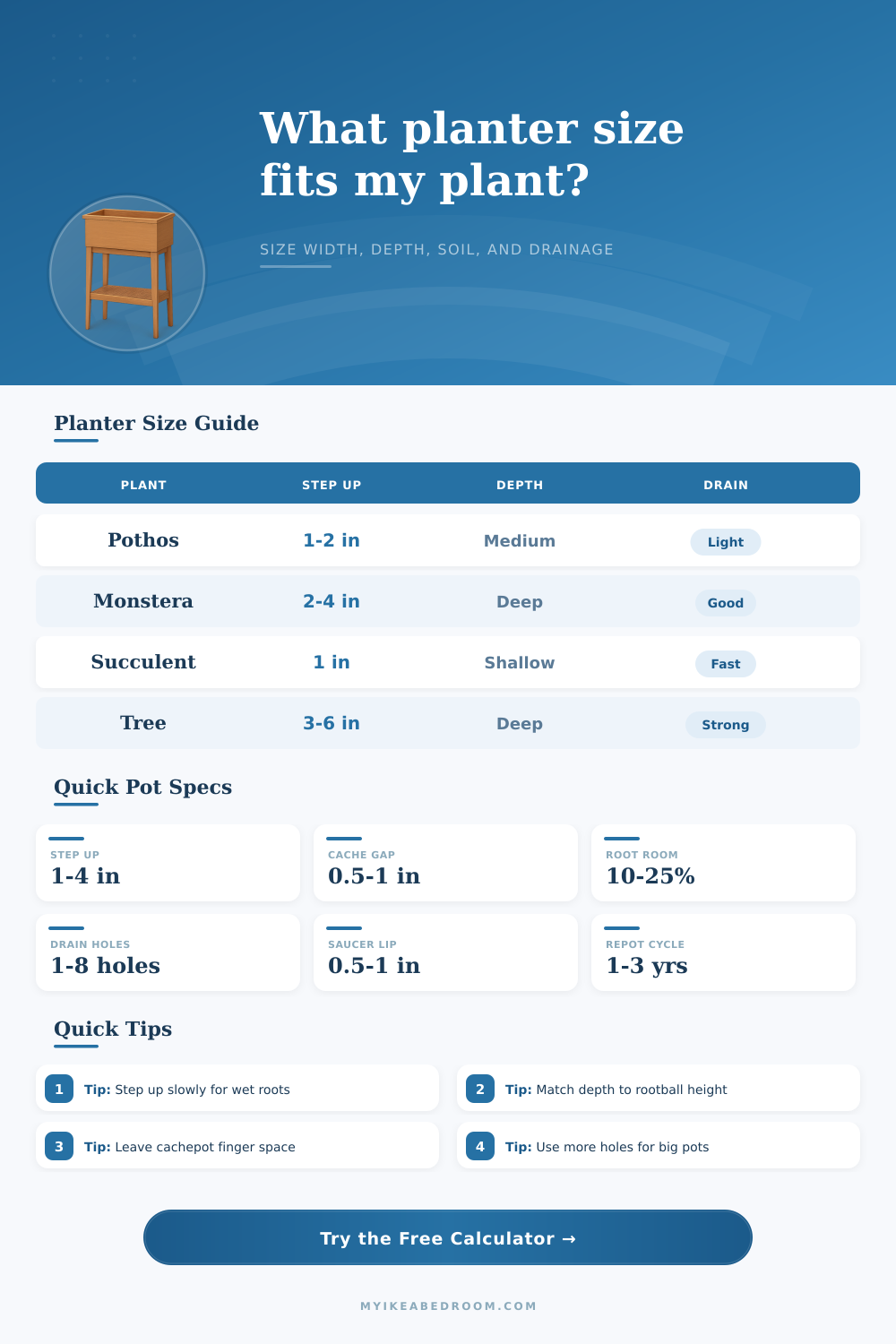
| Plant profile | Width step-up | Depth target | Watch point |
|---|---|---|---|
| Leafy houseplant | 2 to 3 inches wider than rootball | Rootball height plus 1 to 2 inches | Avoid burying the crown below soil line. |
| Aroid or climber | 2 to 4 inches wider | Moderate to deep | Leave room for moss pole or support stake. |
| Succulent or cactus | 1 to 2 inches wider | Shallow to medium | Oversized wet soil is the main risk. |
| Indoor tree | 3 to 6 inches wider | Deep and stable | Canopy weight may require extra base width. |
| Herbs or annuals | Use plant spacing rather than one rootball | 6 to 12 inches for most herbs | Rectangular length often matters more than depth. |
| Orchid cachepot | Inner pot plus 0.5 to 1 inch clearance | Do not trap the grow pot in standing water | Decorative pot should be easy to drain. |
| Inside size | Approx soil capacity | Drain holes | Typical use |
|---|---|---|---|
| 6 inch round by 5.5 inch deep | 0.45 gallon / 1.7 L | 1 to 2 holes | Starter foliage, small herbs, small succulents. |
| 8 inch round by 7 inch deep | 1.0 gallon / 3.8 L | 2 to 3 holes | Common houseplant step-up from 6 inch pot. |
| 10 inch round by 9 inch deep | 2.3 gallons / 8.7 L | 3 to 5 holes | Monstera starts, peace lily, compact floor plants. |
| 12 inch round by 11 inch deep | 4.5 gallons / 17 L | 5 to 7 holes | Indoor trees, large foliage, patio accents. |
| 24 x 8 x 8 inch trough | 6.6 gallons / 25 L | 6 to 10 holes | Herb box, window box, mixed annuals. |
| Use case | Side clearance | Bottom clearance | Practical result |
|---|---|---|---|
| Nursery pot inside cachepot | 0.5 to 1 inch total wiggle room | 0.5 to 1 inch below pot | Inner pot lifts out without scraping the rim. |
| Direct planting with saucer | No extra side gap needed | Saucer or feet below holes | Water can leave the root zone after watering. |
| Top-dressed plant | Planter width based on roots | 0.5 to 1 inch rim lip | Watering does not wash bark or stones over the rim. |
| No-hole decorative pot | Fit the inner pot, not a direct rootball | Space to empty water | Use as a cover pot unless you add drainage. |
Best for: repotting.
Uses rootball diameter, rootball height, and plant type to choose a safe step-up size.
Best for: cover pots.
Adds removable side clearance so an inner nursery pot can drain outside the decorative shell.
Best for: trees.
Compares canopy and plant height with planter width to flag top-heavy displays.
Best for: watering.
Estimates hole count from bottom area, material, moisture sensitivity, and planter size.
Use the inside planter measurement. Thick ceramic rims can make a pot look larger than the root space it actually gives the plant.
Size for roots first, then check stability. A tall plant may need a heavier cachepot even when the rootball only needs a modest step-up.
When choosing a size for a planter, a person must consider the needs of the plant that will be grown within the planter. The needs of a plant include consideration of the dimensions of the plants root system. A person may look at the leaves of a plant as a means of determining the appropriately size for the planter for that plant.
However, looking at the leaves of a plant isnt a reliable means of determining the correct size for the planter. For these reason, it is better for a person to not focus upon the appearance of the plant in determining the size of the planter for that specific plant. The size of the rootball of a plant are the most important measurement of a plant that determines the size of the planter that should be used for that plant.
How to Choose the Right Planter Size
The size of the rootball can tell a person the amount of soil that the plant has a need for. Therefore, determining the diameter of the rootball and the height of the rootball will help to ensure that the plant will have enough room for its roots to grow into the soil, as well as that the soil will not remain too wet for the roots of that plant. Furthermore, using a planter size calculator can help to determine the size of the planter necessary for the specific plant by inputting the diameter and height of the rootball.
The size of the planter can differ for different type of plants, though. For instance, the size of the planter for a succulent will be different than the size of the planter for a monstera plant. The material of the planter can also impact the size of the planter in which a plant should be grown.
For instance, terracotta and fabric planters will allow the moisture within the soil to evaporate more quick than other types of planters. For these reasons, terracotta and fabric planters will allow for the use of a slightly larger planter for the plant to avoid allowing the plant’s roots to become too wet. In contrast, glazed ceramic and plastic planters will hold the moisture within the soil for a longer period of time than terracotta and fabric planters.
For these reasons, glazed ceramic and plastic planters may pose issues for using a planter that is too large for the plant. Another factor to consider when choosing a size for a planter is the stability of the plant within the planter. For instance, if a plant is too tall, the plant may become top-heavy if it has a wide canopy of leaves.
In such cases, the plant may fall over if the planter isnt wide enough for the plant. Therefore, a person should consider the width of the plant’s canopy and the total height of the plant when determining the size of the planter for that plant. A stable planter will keep the plant upright, even when a breeze from a window hits the leaves of the plant.
Much of the time, individuals will use a cachepot. A cachepot is a decorative outer planter that contains the plain nursery pot within it. When using a cachepot, it is important to ensure that there is enough clearance between the nursery pot and the cachepot.
If there is not enough clearance between the two, it may be difficult to lift the nursery pot out of the cachepot to water the plant. In addition, if the nursery pot remains within the cachepot, the roots of the plant may remain too wet, leading to the potential for the plant to fail. One of the most common mistake in choosing a size for a plant is focusing upon the current appearance of the plant.
For instance, peace lilies tend to grow slowly, so they may remain in the same planter for several years. Aroids, on the other hand, often grow quickly, so they may need to be placed into a new planter during the same growing season. Another way to determine the length of time that a plant will remain within a new planter is to utilize the plant’s repotting interval.
This time frame will ensure that the size of the planter is appropriately accounted for the future growth of the plant. Another goal of determining the size for a planter for a plant is to provide enough soil for the plant’s roots to expand. However, the amount of soil provided to the plant should be balanced with the watering needs of the plant.
If the volume of soil within the planter is balanced with the plant’s needs for watering, the plant will take less time to settle into the new soil, as well as the risk of watering the plant too much will decrease.