Plantation Shutter Calculator
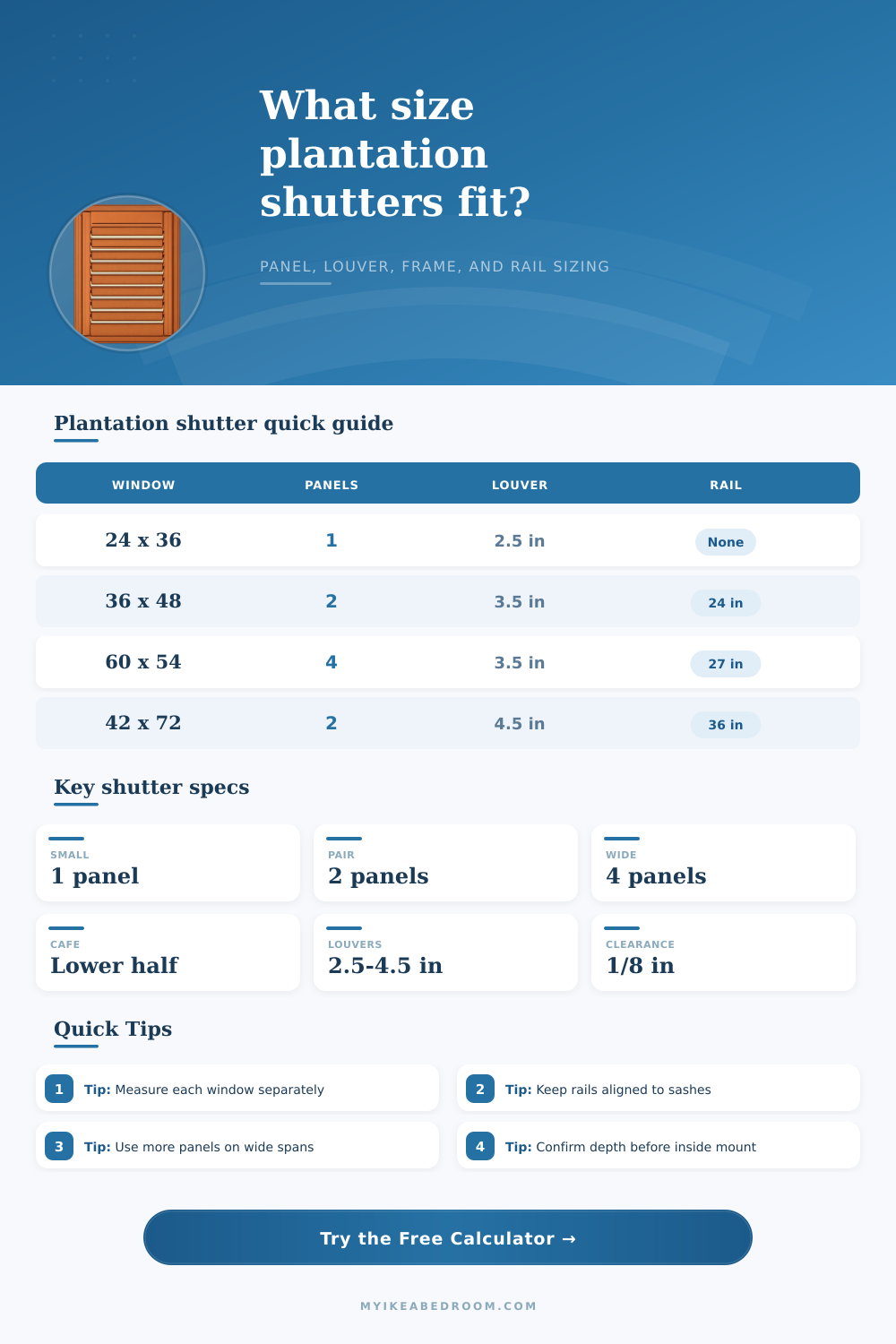
Size plantation shutter panels from window dimensions, mount clearance, frame style, louver size, rail width, divider rail position, tilt rod style, panel count, and number of matching windows.
Start with a common window style, then fine tune the exact opening, frame, louver, panel, and divider rail settings.
Best for: deep, square openings.
Uses clearance deductions, so the finished frame stays inside the opening.
Best for: shallow or uneven openings.
Adds overlap coverage around the measured window or trim span.
Best for: open views.
Uses fewer louvers with larger spacing and a cleaner modern look.
Best for: wide windows.
Keeps each panel manageable and reduces the swing width per leaf.
| Louver size | Estimator pitch | Typical feel | Best fit |
|---|---|---|---|
| 2.5 in | 2.25 in | More privacy lines, smaller reveal | Small baths, narrow windows, traditional rooms |
| 3.0 in | 2.70 in | Moderate count and compact swing | Bedrooms, closets, older trim profiles |
| 3.5 in | 3.15 in | Common balance of view and control | Most bedrooms, living rooms, and home offices |
| 4.0 in | 3.60 in | Open view with fewer louvers | Tall panes, modern interiors, wider panels |
| 4.5 in | 4.05 in | Largest view gap and bold scale | Large windows, patio doors, tall living room shutters |
| Frame type | Allowance per side | Typical mount | Calculator treatment |
|---|---|---|---|
| No frame or direct hinge | 0.00 in | Inside only | Panel opening follows the adjusted window size. |
| L-frame | 0.75 in | Inside or outside | Deducts 1.50 in from width and height for panel opening. |
| Z-frame | 1.00 in | Inside with trim lip | Deducts 2.00 in and reports lip-friendly frame size. |
| Decorative frame | 1.25 in | Outside or face frame | Deducts 2.50 in for wider frame stock. |
| Existing trim outside frame | 1.50 in | Outside over trim | Deducts 3.00 in where a broad trim-style frame is used. |
| Adjusted panel opening | Suggested panels | Per-panel target | Notes |
|---|---|---|---|
| Under 24 in wide | 1 panel | 12-24 in | Simple hinge side; common for bath and closet windows. |
| 24-48 in wide | 2 panels | 12-24 in | Standard pair with left and right leaves. |
| 48-72 in wide | 3 or 4 panels | 14-22 in | Use bifold or split stacks to reduce swing. |
| 72-108 in wide | 4 or 6 panels | 15-24 in | Wide bedrooms, sliders, and grouped windows. |
| Over 108 in wide | 6 panels or separate units | 16-24 in | Break into sections so panels stay easy to operate. |
| Shutter style | Common divider position | Why it helps | Calculator note |
|---|---|---|---|
| No divider rail | 0 in | Clean continuous louvers | Enter 0 to remove the rail from louver count math. |
| Double-hung window | Meeting rail height | Hides the sash line and improves tilt control | Use the distance from the bottom of the finished shutter panel. |
| Cafe-style lower shutter | Top of lower shutter | Covers the lower glass while leaving light above | Set window height to the shutter-covered height for cafe style. |
| Tall living room shutter | Half to lower third | Separates privacy and daylight control | The calculator clamps the rail away from top and bottom rails. |
Measure width and height in three places. Use the smallest inside opening dimension for inside mounts, especially on older windows that may be out of square.
Check louver depth before choosing inside mount. Wider louvers need more recess depth so blades can rotate without touching glass, handles, locks, or screens.
Determining the size of plantation shutters required to cover a specific window involve more than measuring the window’s area. The shutters must clear the frame and the shutters must also allow for the plantation shutters to allow the louvers to tilt without contacting the window. A small error in calculating these measurement can result in plantation shutters that either bind to the window or leave an undesirable gap between the shutters and the window.
For these reasons, many people uses a calculator to determine plantation shutters size from the raw measurements of the window. The first choice of size is whether the shutters will be mounted inside or outside the window frame. Inside mounting allows for the window frame to be hidden from view but requires that the plantation shutters be deducted from each side of the window opening.
How to Measure Plantation Shutters
Outside mounting allows for shutters to be placed over trim on the window but requires that the shutters be allowed for overlap over the area of the window. The calculator will make this adjustment for the purchaser to ensure that they dont make the common mistake of only measuring the area of the glass but finding that the shutters are either too tight or too loose for the opening in the window. Another choice involves the size of the louvers on the shutters.
Louvers that are wide open will allow more light into the area but require more depth for the shutters to rotate on their hinges without contacting the window. Louvers that are narrow will allow less light into the area but can be used in areas with shallow trim on the windows. Additionally, narrower louvers will contribute to more horizontal lines onto the window.
The calculator will factor the width of the louvers in its calculation of the number of louvers that is required for each panel. Another factor that impacts the size of the shutters is the number of panels that are to be used. A wide panel may fill the width of a 60-inch window but may be too heavy to open or may cover the area when opened.
Breaking the opening into three or four narrower panels will eliminate the heaviness of the shutters and reduce the distance that the shutters must travel to open. The calculator will factor in the number of panels that will be used and report if any panel will be too narrow or too wide for intended use. Another decision is the placement of divider rails.
On double-hung windows the divider rail for the shutters will be set to even with the meeting rail of the window since the line between the top and bottom of the sash should be hidden behind the shutters. In tall windows the divider rail may be placed lower to allow privacy to those viewing the area from eye level. The calculator will compute where the divider should be placed from the bottom of the shutters panel and verify that there is still room for louvers at the top and bottom of the panel.
The type of frame that is used for the shutters will impact the final size of the shutters. L-frames will allow the shutters to be tucked inside one of the jambs of the window opening. Z-frames will allow a lip that covers the drywall or trim on the window to support the shutters.
The calculator will account for the type of frame that is chosen to ensure that the width of the shutters will still allow for the louvers to swing open. Additionally, the calculator will report the finished outside dimension of the shutters so that the owner can verify that the shutters will be the correct size to fit within the window opening. Most windows are not perfect rectangles.
The dimensions of the windows may be off by a quarter inch or more. Therefore, the width and the height of the window opening should be measured at three different points to ensure that the measurements are even and to use the smallest measurement if the shutters are to be mounted inside the window frame. While the calculator can perform the math required to calculate the dimensions of the shutters, the person purchasing the shutters will have to physically measure the window to make sure that the shutters will not bind to the frame in which they will be mounted.
The material of the shutters will also impact the way that the shutters will function in the area. Wood shutters will expand and contract in response to changes in humidity in the area. Therefore, the shutters should have some allowance for this movement.
Other materials such as composite shutters or vinyl shutters will not change dimensions with changes in humidity in the area. Thus, composite and vinyl shutters will have less allowance for movement between the shutters and the window. While the calculator will not factor in the material of the shutters, the dimensions that are reported from the calculator are the dimensions that will be used when purchasing the shutters from a fabricator.
The total number of louvers will determine the amount of light that will enter into the room when the shutters are opened. Eight louvers will allow more light into the area than fourteen louvers of the same width. This consideration is important in areas such as bedrooms where more light is desired during the morning.
The calculator will calculate the total number of louvers that will be used in each panel and for all of the shutters in the entire house. The cost of the shutters is related to the size of the shutters. Shutters with wider louvers and more panels will be more expensive but may require fewer divider rods and rails.
Using the calculator to determine the total number of shutters of each size will allow the individual to compare the cost of shutters with different sized louvers. Finally, it is important to remember that shutters may have to be purchased for several rooms in the house. Shutters for a bathroom opening may be narrow and limited to one opening but shutters for a living room may require several panels to cover that area.
To ensure that the shutters are even in each area of the house, each opening in the house should be entered into the plantation shutters calculator. The calculator will perform the necessary mathematics for each area to create shutters that will open and close appropriately on the wall.