Plant Stand Height Calculator
Choose a plant stand height that fits the pot, foliage, window line, ceiling clearance, walking path, and platform width before you move a heavy planter into place.
Start from a real IKEA plant stand size, then tune the pot, plant, light target, and safety clearance for your room.
OLIVBLAD tall
22.75 in stand. Good for medium plants near a window or sofa.
DAKSJUS tall
23.5 in stand. Good bamboo-height alternative for upright plants.
SATSUMAS ladder
30.75 in stand. Better when the foliage needs a taller window line.
ASKHOLMEN tier
45.75 in stand. Best reserved for compact pots and tiered displays.
| Preset | Stand height | Approx. tray/platform | Best use |
|---|---|---|---|
| OLIVBLAD tall round | 22.75 in / 58 cm | About 12 in round | Medium floor plant, sofa side, indoor/outdoor |
| OLIVBLAD low round | 13.75 in / 35 cm | About 12 in round | Wide cachepot, short leafy plant, low corner |
| SATSUMAS ladder | 30.75 in / 78 cm | Tiered shelves | Window display with several small to medium pots |
| SATSUMAS low bamboo | 14.25 in / 36 cm | About 11 in platform | Low bamboo accent or compact feature pot |
| DAKSJUS tall bamboo | 23.5 in / 60 cm | About 11 in platform | Upright foliage plant in a simple bamboo stand |
| DAKSJUS low bamboo | 11 in / 28 cm | About 10 in platform | Herbs, small pots, desk-height plant grouping |
| LANGNABB compact | 10 in / 25 cm | Small round platform | Small window plant or low grouped display |
| ASKHOLMEN tiered | 45.75 in / 116 cm | 12.5 in depth tiers | Outdoor balcony tier with smaller balanced pots |
| ALPVIDE pedestal | 24.75 in / 63 cm | About 11 in platform | Feature planter, hallway corner, bright wall |
| VILDAPEL low bamboo | 11.5 in / 29 cm | About 12.5 in round | Wide low planter where stability matters most |
| Placement | Typical top-of-plant target | Stand height clue | Clearance rule |
|---|---|---|---|
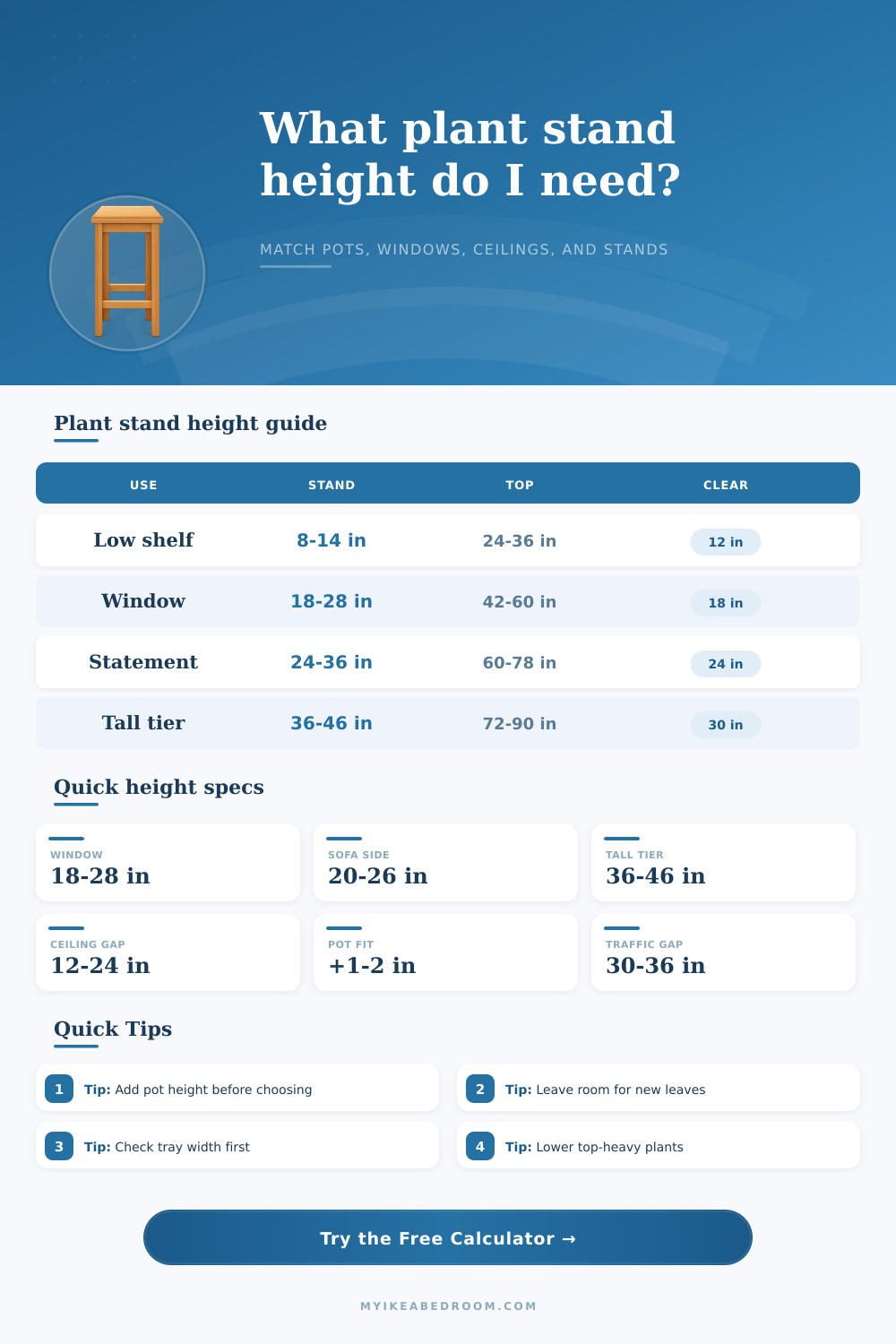
| Low shelf or cabinet line | 24-40 in / 61-102 cm | Use 8-14 in stands for short pots | Keep leaves off cabinet fronts and handles |
| Window light band | 42-64 in / 107-163 cm | Stand = bright band minus pot and plant | Keep foliage from pressing on glass or curtains |
| Sofa or reading chair side | 36-56 in / 91-142 cm | Match foliage to arm or back height | Leave space for lamps, elbows, and side tables |
| Statement wall plant | 60-78 in / 152-198 cm | Taller stand only if plant itself is compact | Keep 18-24 in below ceiling for growth |
| Balcony or patio tier | 36-72 in / 91-183 cm | Tiered stands suit smaller pots best | Account for wind, railings, and watering reach |
| Plant habit | Growth allowance | Height advice | Stability note |
|---|---|---|---|
| Upright foliage plant | 4 in / 10 cm | Use the calculated height directly | Stable if pot fits tray with at least 1 in spare |
| Trailing plant | 6 in / 15 cm | Can sit slightly higher for vines to fall | Watch hanging stems near walking paths |
| Wide bushy plant | 5 in / 13 cm | Often looks better on a lower stand | Leaf spread should clear walls and curtains |
| Top-heavy or cane plant | 8 in / 20 cm | Choose the lower acceptable preset | Avoid narrow tall stands in high-traffic areas |
| Herb or compact plant | 2 in / 5 cm | Low stands usually give enough lift | Prioritize tray width over dramatic height |
| Check | Minimum | Comfortable | Why it matters |
|---|---|---|---|
| Pot rim inside tray | 0.5 in spare | 1-2 in spare | Prevents the planter from sitting on the stand edge |
| Top clearance to ceiling | 8 in | 12-24 in | Leaves need growth room and airflow |
| Side leaf clearance | 3 in | 6-12 in | Keeps foliage away from walls, curtains, and paths |
| Walking path near stand | 24 in | 30-36 in | Reduces bumps, especially with tall or narrow stands |
| Watering reach | Shoulder height | Chest to eye height | A plant that is too high becomes hard to maintain |
Measure the whole stack. Stand height alone is misleading: add the saucer, cachepot, nursery pot lip, foliage height, and a realistic growth allowance before comparing presets.
Match height to risk. If the plant is top-heavy, near a doorway, or in a home with frequent bumps, choose the lower preset that still reaches the light target.
First there’s the look: a perfect arching frond, a leaf that seems almost plastic. That’s what gets you to buy the thing in the first place. But then you get it home and set it on the floor, and see? Nothing works quite right. If the pot sits on the ground, the light is all wrong because it’s above the level of soil. But if you try putting it on a chair, your eyeballs ache reaching up to the ceiling.
Now we’re getting into geometry rather than botany, and it presents a physical barrier to most people trying indoor plant. Next time, pick the height of the stand you want to use before you select the furniture; otherwise you’ll be toppling something heavy down a dimly lit hall. Once you know your rooms’ limitations, use the calculator (above) to enter each of your pots’ measurements. It does the rest.
How to Choose the Right Plant Stand Height
It will prevent you from guessing what vertical space remains when considering the plant itself. Everyone thinks: “Oh my God, the stand says it’s 60 inches high; that must be it.” Not true. The stated dimension is height from the ground up to level of the tray. What really matters are the total calculation. This includes the pot height, the depth of its saucer, any existing foliage height, and room for whatever leaf may sprout later. Ignoring the containers will result in an unbalanced arrangement.
A pot with a ten inch diameter on a stand whose top reaches twenty inches puts the top of soil surface at thirty inches. It is fine if you’re using it under a sofa somewhere, but it is not good if it’s destined for a window sill at thirty-four inches. Better when the plant’s bulk seems like it belongs there, not awkwardly high over, or low beneath, the lamp head.
Success hinges on knowing what is being measured. For instance, if you choose a low round pedestal or a tall bamboo ladder, what we call presets, you are picking more than just a style; you are choosing a frame that determines both appearance and sturdiness. Because its center of gravity remains close to the ground, a wide, bushy plant feels grounded on lower platform. A specimen with an upright habit, like a canelike thing, looks dramatic when up off the ground. But only if the foot it’s standing on is wide enough to support it without toppling.
This is where the tool does the math: It balances width of leaves (leaf spread) against side clearance and traffic risk. You might have pets, kids, or a narrow hall. In those situations, safety rules; and style goes out the window.
How tall are you? The answer is more complex different than it seems. Where do windows cast their light? They are not usually where your eyes are. Maybe they begin thirty inches above and extend down to sixty inches. If your plant is taller than the bright part of the window, its top leaves will stretch toward the light on soft, thin stems. Too short, and the lower ones will cook in the dark.
Measure from the soil line to the topmost leaf tip, adding extra room for further elongation, since every plant continues to lengthen after you bring it home. Eight inches is generous for something top heavy; four is fine for upright types. And you’ll have wiggle room so your Fiddle Leaf Fig doesn’t knock out the curtain rod…or hit the ceiling fan someday.
Many houseplants has met their end because of stability. An oversized cachepot atop a narrow stand becomes a lever arm…then poof! The pot-fitting calculator measures whether your pot fits on the platform with at least half an inch of spare room around the rim. If there isn’t enough room, the pot will sit on the stand’s edge, distributing weight unevenly…and then you’ll hear that telltale wobble as you brush by with your elbow or reach in to water. It doesn’t sound like much…but wobble evolves into a spill.
Another thing: How high do you have to go? Ideally, there should be at least a foot of clearance from the floor to the top of what is growing. You also need extra space on top for airflow and potential growth. Without a stand, you simply can’t fit more than that under most ceilings; but with one, you may end up creating a cramped-looking plant anyway if there isn’t enough clearance for growth.
Why are there differences between, say, a living room corner and a balcony tier? Those are just some of the reasons in the room-type reference table on the page. The table explains all the variables. These include curtain height and lamp height indoors, as well as wind, railings, and watering reach outside.
Three things matter: First, how tall does the thing need to be so that it holds up? Second, how tall should it be to stand above the canopy of other plants so that it is what you notice first? Third, how tall does it have to be to get enough light? All of those measurements are based off the total volume of what is stacked on top of each other, not just the stand itself.
Furthermore, there will be more leafy material later when the plant matures then there is now, when it looks its best. And then there’s gravity to consider. Wet soil doubles in weight. How heavy will it be once filled with water? Get those factors correct, and it’ll fit into its spot. It won’t topple over, or fight for the light. It will rest securely on its light and firm footing, allowing itself to grow and breathe.
People should of planned this well enough…until they do; and then it’s too late.