😴 Pillow Height Calculator
Find your ideal pillow loft for proper spinal alignment during sleep
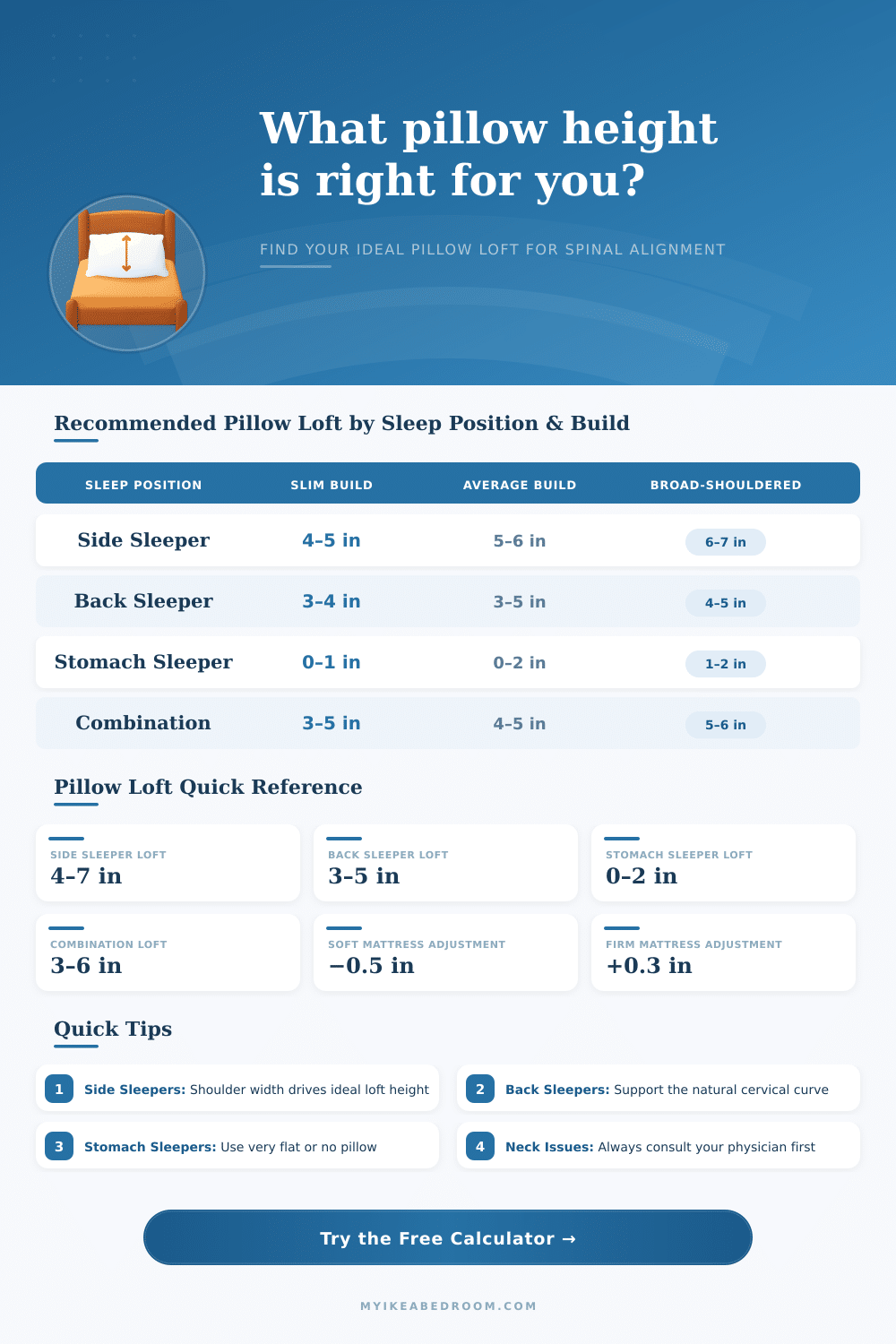
| Sleep Position | Slim Build | Average Build | Broad-Shouldered |
|---|---|---|---|
| Side Sleeper | 4–5 in (10–13 cm) | 5–6 in (13–15 cm) | 6–7 in (15–18 cm) |
| Back Sleeper | 3–4 in (8–10 cm) | 3–5 in (8–13 cm) | 4–5 in (10–13 cm) |
| Stomach Sleeper | 0–1 in (0–3 cm) | 0–2 in (0–5 cm) | 1–2 in (3–5 cm) |
| Combination | 3–5 in (8–13 cm) | 4–5 in (10–13 cm) | 5–6 in (13–15 cm) |
| Mattress Firmness | Shoulder Sink Effect | Loft Adjustment | Notes |
|---|---|---|---|
| Soft | High (shoulder sinks in) | −0.5 in (−1.3 cm) | Body contours into mattress, reducing gap |
| Medium | Moderate | No adjustment | Standard baseline loft recommendation |
| Firm | Low (little to no sink) | +0.3 in (+0.8 cm) | Body stays on surface, gap is larger |
| Loft Range | Category Name | Best For | Typical Fill |
|---|---|---|---|
| 0–2 in (0–5 cm) | Ultra-Flat / No Pillow | Stomach sleepers | Very thin foam, buckwheat, or none |
| 2–3 in (5–8 cm) | Low Loft | Stomach / petite back sleepers | Soft down-alternative, thin latex |
| 3–5 in (8–13 cm) | Medium Loft | Back sleepers, combination sleepers | Memory foam, shredded latex, down |
| 5–6 in (13–15 cm) | High Loft | Side sleepers, average to broad build | Firm memory foam, dense latex |
| 6+ in (15+ cm) | Extra-High Loft | Broad-shouldered side sleepers | Extra-firm foam, stacked fill |
Finding the right pillow height can be a hard task. The height of the pillow is an important factor that affects the position of the neck and relates directly to the mechanical state of the neck. Even so, choosing the right pillow is often complicated.
Most people need a pillow of 4 to 6 inches, depending on how they sleep. If the pillow does not match the sleep style, you commonly wake up feeling tired or with pain in the muscles
How to Choose the Right Pillow Height
The ideal height depends mostly on the position in that you sleep. For most, the goal is to keep the spine straight. Side sleepers are the most common group, and for them the pillow should be higher than for those that sleep on the back.
For side sleepers, high support is usually best, around 5 inches or more. In that position is a big space between the mattress and the head, so the neck requires more support than in other positions. A good pillow must support the neck to ensure right spinal alignment.
This creates a balnace between the head and the neck, which helps to keep the natural line.
Those that sleep on the back usually require medium support for the neck. A medium pillow works well for that sleep style. On the other hand, folks that sleep on the stomach require a pillow that would not raise their head too high to avoid neck pain.
Hence most of them favor flat, adaptable pillows. A height of 4 inches or less is best for stomach sleepers. Very low pillows (under 3 inches) help to reduce the strain of the neck.
Also the body size plays a role. The necessary height depends on the body build. Because not all folks are built the same, it is important to try different pillows.
The width of the shoulders and the sleep style both are important factors. Folks with small bodies usually favor low support under 3 inches. For medium folks a height between 3 and 5 inches works, while those with broad shoulders require high pillows of 5 inches or more.
Heavier people sink more deeply in the mattress, which means they may require lower pillows than light sleepers. When the mattress is soft, the body sinks more, and the spine stays nearer to the surface, so you require a low pillow.
The firmness of the pillow also is important. A soft and high pillow could flatten during the night, leaving the neck without support. Look for a pillow with a bit of structure that keeps its height even after several hours of use.
In pillows from microfiber or polyester fiber, the firmness depends on the amount of fill.
Here is a useful trick for some that struggle with the problem that one pillow is too low but two pillows are too high. Instead of using two pillows, lay a towel, ideally a beach towel; under the pillow. Folding or unfolding the cloth, you can very exactly correct the height without losing the comfort.
Also there are adaptable pillows that you can open with a zipper to remove layers and change the height, which is another good choice.