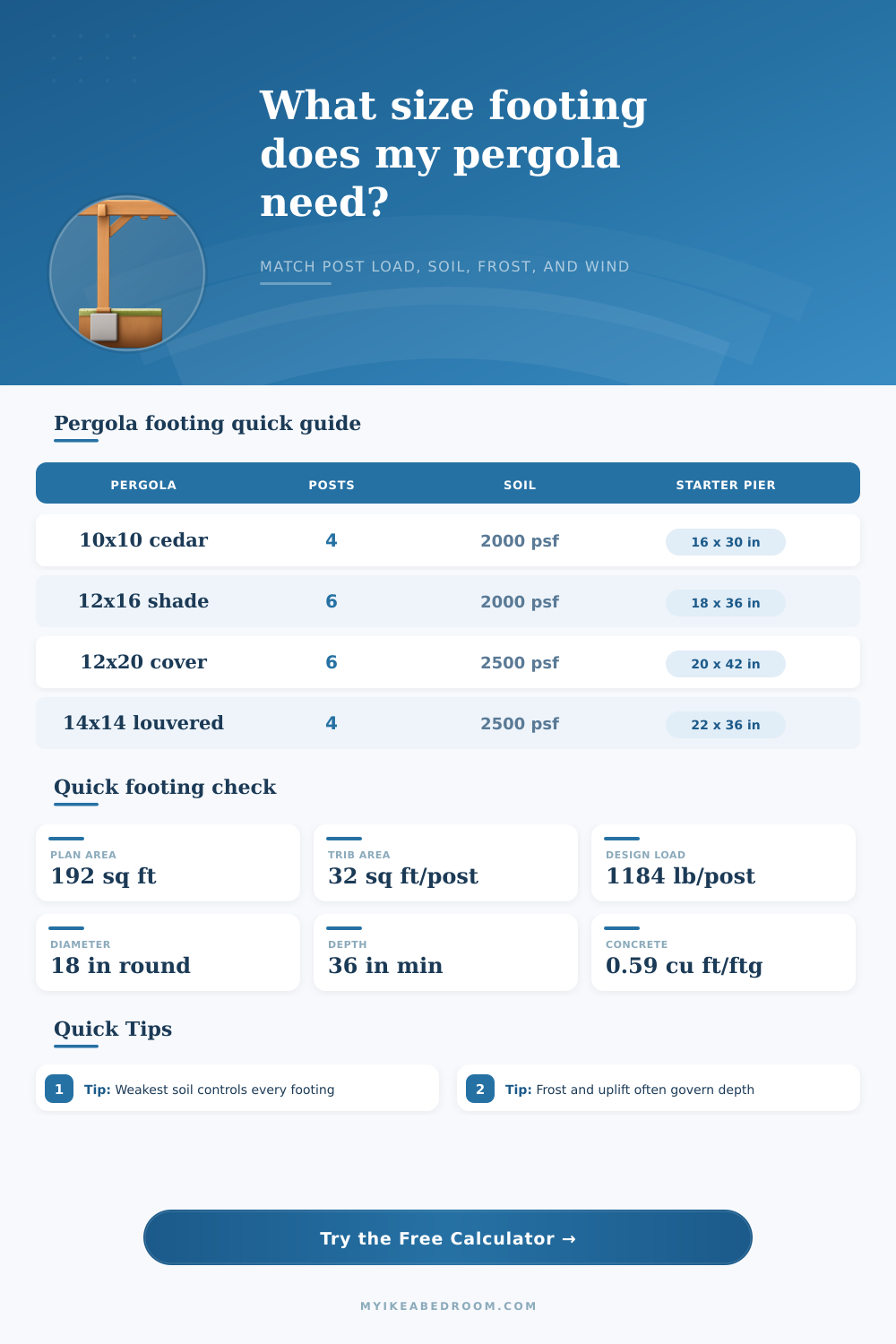
Footing diameter and embedment sizing
Pergola Footing Size Calculator
Size concrete piers for freestanding or attached pergolas using plan area, post count, roof type, soil bearing, frost depth, and wind exposure in one field-ready worksheet.
Use a real pergola scenario as a starting point, then fine-tune the dimensions, post count, roof load, soil, frost, and wind inputs for your site.
Footing breakdown
These quick comparisons show which lever changes the footing most on the current setup.
Use the tables as starting points only. Local code, soil reports, and engineered drawings always take priority.
When you build a pergola, you must consider the weight of the pergola and the effects of wind and frost on the pergola footings. If a person design the footings for a pergola to be too small, the pergola could collapse under the weight of the snow and the wind. If a person designs the pergola footings to be too large, then the person will waste money and time in pouring concrete for the footings.
The weight of the pergola must be matched to the capacity of the soil that is beneath the pergola. The capacity of the soil will determine the amount of weight that the soil will be able to support. Soil capacity is often measured in pounds per square foot.
Choosing the Right Pergola Footings
Different types of soil will have different capacities for the weight that the soil will support. For instance, clay soils tend to be soft, while gravel soils tend to be very stable. Furthermore, clay soils will become soft after heavy rains fall, while the gravel soils will remain stable.
People should always assume that soil is not uniform in it’s ability to support the weight of a pergola. Any soft spot in the ground will require each pergola footing site to be built to support that area. People may believe the soil to be uniform, but it is always a possibility that the soil at the site are inconsistent.
The roof of the pergola will impact the size of the pergola footings. If the pergola has cedar rafters, the dead weight of the rafters will be low. However, if the pergola has louvers and polycarbonate coverings, the dead weight will be more significant.
If the pergola has fabric shades, the dead weight will be very low. However, fabric shades can experience uplift with the wind. Each post for the pergola has a specific area of the pergola roof that it will support; this is referred to as the tributary area for that pergola post.
If there are more posts for the pergola, each individual footing will have to support less of the roof of the pergola. Additionally, if the pergola is attached to a house with a ledger, the house will contribute to supporting the pergola. Thus, the pergola footings will have to support less of the weight of the pergola.
The effects of the wind and frost will dictate the depth of the footings for the pergola. The depth of the footings will have to be able to resist the uplift of the pergola caused by the wind. The specific weight of the concrete will contribute to the resistance of the uplift forces.
Additionally, the footings must be buried beneath the frost line in the ground. If the ground beneath the pergola freezes, it can create frost heave which will crack the footings of the pergola. Thus, the footings have to extend beneath the frost line in the ground to avoid such damage.
Often, there are preset measurements for pergola footings for different types of pergolas. For example, a small cedar pergola with four posts may have footings that are eighteen inches in diameter and thirty-six inches deep in average soil. A larger pergola that uses heavy timber may have footings that are twenty-four inches in diameter and buried deeper into the ground.
The diameter of the pergola footings may have to be increased if the soil is noted to be softer. Additionally, if there are more posts for the pergola, there will be less individual footings for the pergola to construct; each footing will have to support less of the total weight of the pergola roof. Uplift is one of the major forces to consider for the depth of the pergola footings.
The depth of the footings may have to be increased with the total area that needs to be supported by the individual footings of the pergola. Additionally, the hardware that connects the pergolas to the footings should be proper hardware. For example, using standoffs will help connect the pergola posts to the footings.
Round piers seem to work better than square piers for the footings. Round piers are easier to drill into the ground, and you can place the rebar into the footing more easily. When building pergola footings, people can make many mistakes.
For example, they may only consider the snow load that the pergola will experience, but they do not account for the dead weight of the cedar rafters of the pergola. Additionally, they may place large posts for the pergola but place the posts on small footings for the pergola. Such a construction will crack the footings at the edges.
Finally, many people may not consider there local building codes and regulations for their area; these codes may require a depth for the footings to account for specific conditions. To find the amount of concrete that is required for the footings for the pergola, calculate the cubic yardage that will be required for each pier of the pergola. The amount of concrete for each footing should be increased by ten percent; there may be unexpected needs for extra concrete for the footings.
Thus, if the load of the pergola roof can be matched with the capacity of the soil and the depth of the frost line beneath the pergola, then the pergola will remain stable for many years. You should of checked the soil density first. It is alot more important than you think.