🏠 Peel and Stick Tile Calculator
Estimate tile count, box count, coverage, waste, and weight for backsplashes, accent walls, floors, and custom decorative layouts.
📋Project presets
🔧Calculator inputs
📊Material weight grid
📋Reference tables
💡Practical tips
📈Calculation results
To install peel and stick tile, you must measure the area in which you will be placing the peel and stick tile. To measure the area, you will need to measure the length and the width of the wall or the floor upon which you will install the peel and stick tile. The length and the width of the area that you intends to cover with peel and stick tile will allow you to calculate the total square footage of that area.
You will need to calculate the total square footage of the area that will be covered in order to determine how much peel and stick tile you will have to purchase for the project. However, calculating the total square footage of the area isnt enough; you will also need to account for the amount of material waste that will result from cutting the peel and stick tile to fit into the area to be covered. In order to account for the material waste that will occur during the installation of the peel and stick tile, you should add a waste buffer to the total square footage of the area that will be covered by the peel and stick tile.
How to Measure, Buy, and Prepare Peel and Stick Tile
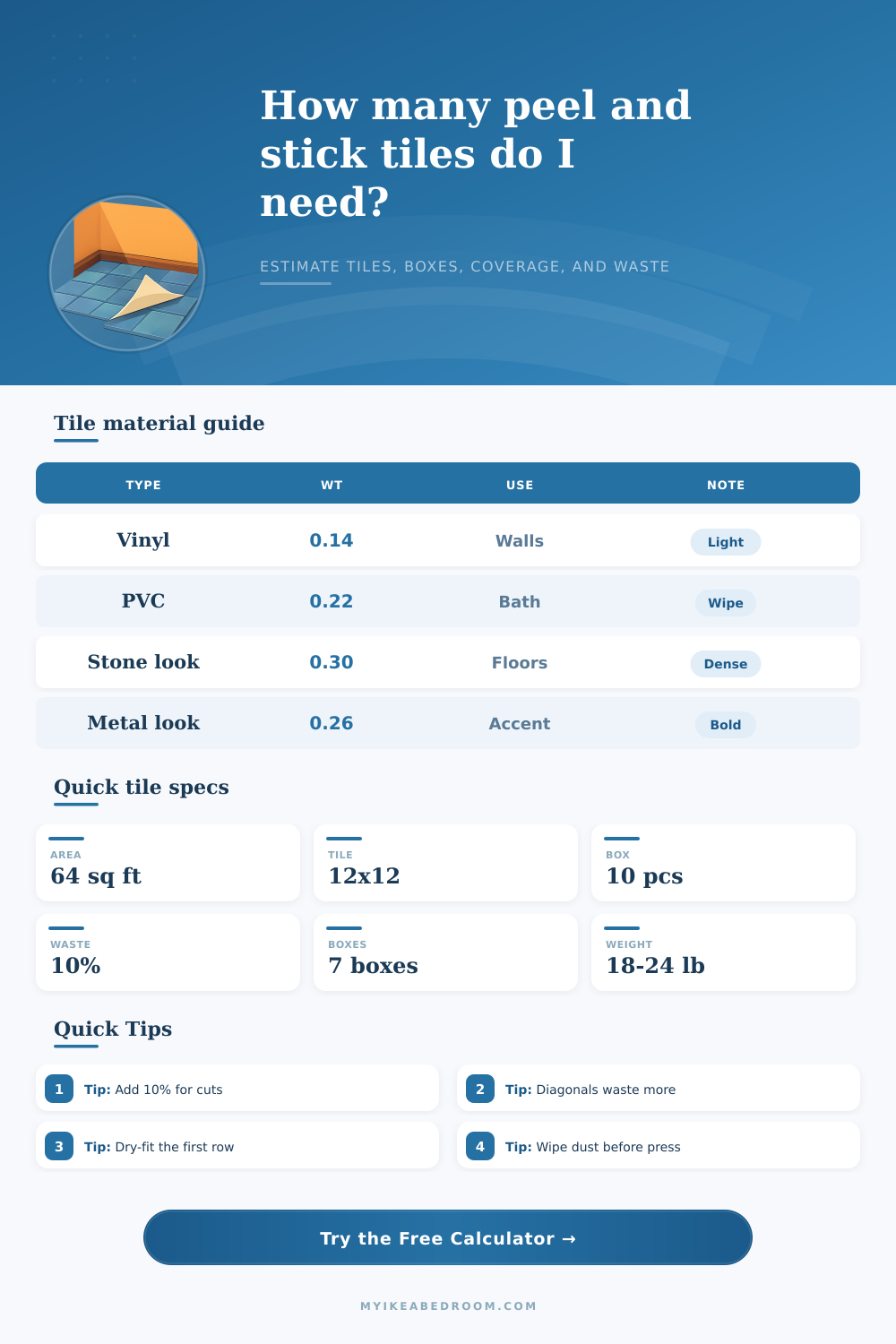
For areas that are to be laid out in a straight layout on smooth surfaces, many people add a ten percent waste buffer to account for the inevitable cutting of the peel and stick tile. For areas that are to be tiled in a complex pattern, many people will need to add a twenty percent waste buffer to account for the increased cutting of the peel and stick tile. For instance, areas that are to be tiled in a herringbone pattern will have to be cut more frequently than areas that is tiled in a simple straight pattern.
Thus, a herringbone pattern will require a larger waste buffer than a simple layout of the peel and stick tile. Additionally, those that wish to place the peel and stick tile on textured surfaces may require the purchase of additional peel and stick tile in order to account for the way in which the peel and stick tile may lie on textured surfaces. The type of peel and stick tile that you choose can impact the total cost and total weight of the peel and stick tile that will be used for your project.
For instance, vinyl peel and stick tile is a relatively lightweight peel and stick tile that can be used for areas like walls or for renters. Additionally, PVC peel and stick tile is waterproof and, therefore, can be used in areas like bathrooms. Lastly, stone look peel and stick tile is a heavier type of peel and stick tile that provides a denser feel to floors when walked upon.
Therefore, you will need to consider the weight of the boxes of peel and stick tile when choosing the type of peel and stick tile; stone look peel and stick tile will be heavier than vinyl peel and stick tile. Where you are to place the peel and stick tile will also impact your installation process. For instance, smooth drywall is the standard surface upon which peel and stick tile is applied.
However, if the walls that will be tiled with peel and stick tile contain any texture, you will have to press the peel and stick tile more firmly against the walls in order to ensure that the peel and stick tile bonds appropriately to the textured walls. Additionally, if the areas that will be covered by the peel and stick tile contain existing tile, then you will have to press the peel and stick tile against the area with a stronger adhesive; peel and stick tile will bond to non-porous surfaces. Finally, the floors must be flat; if the floors that will be tiled are not flat with the area to be tiled, the peel and stick tile will shift when walked upon.
Additionally, the areas to be tiled may contain cutouts for items like electrical outlets, vents, and pipes. Any cutouts will reduce the total square footage of the area to be tiled, but will also increase the amount of material waste created when cutting the peel and stick tile to fit into the cutouts. For instance, although a cutout for an electrical outlet may remove a small amount from the total square footage of the area to be tiled, the process of cutting the peel and stick tile around the electrical outlet will remove material that can be used for tiling.
Thus, even if the area to be tiled contains numerous cutouts, a waste buffer for the material should be accounted for when purchasing the peel and stick tile. Before the installation process begins, you must first clean the surface that will have the peel and stick tile applied. Any dust that is located upon the area to be tiled will prevent the peel and stick tile from bonding with the surface; the dust will cause the peel and stick tile to lift from the area to be tiled.
Therefore, you must wipe the area to remove all of the dust so that the adhesive portion of the peel and stick tile will bond with the area. Finally, prior to travel to the store where the peel and stick tile will be purchased, you should verify your measurements of the area to be tiled and the amount of material waste to ensure that you will purchase the correct number of box of peel and stick tile. If you purchase the correct number of boxes of peel and stick tile, you will have enough for your project, but you will also have some extra for potential future repairs.