Pedestal Plant Stand Size Calculator
Estimate the platform diameter, base spread, stand height balance, loaded weight rating, and stability margin for pedestal plant stands, tall plant tables, plinths, and raised indoor planters.
Load a real plant-and-pot scenario, then adjust the pot, stand, canopy, floor, and safety settings to match your room.
These cards compare the current plant and height against common stand shapes. Wider fills mean a better match for the calculated base spread.
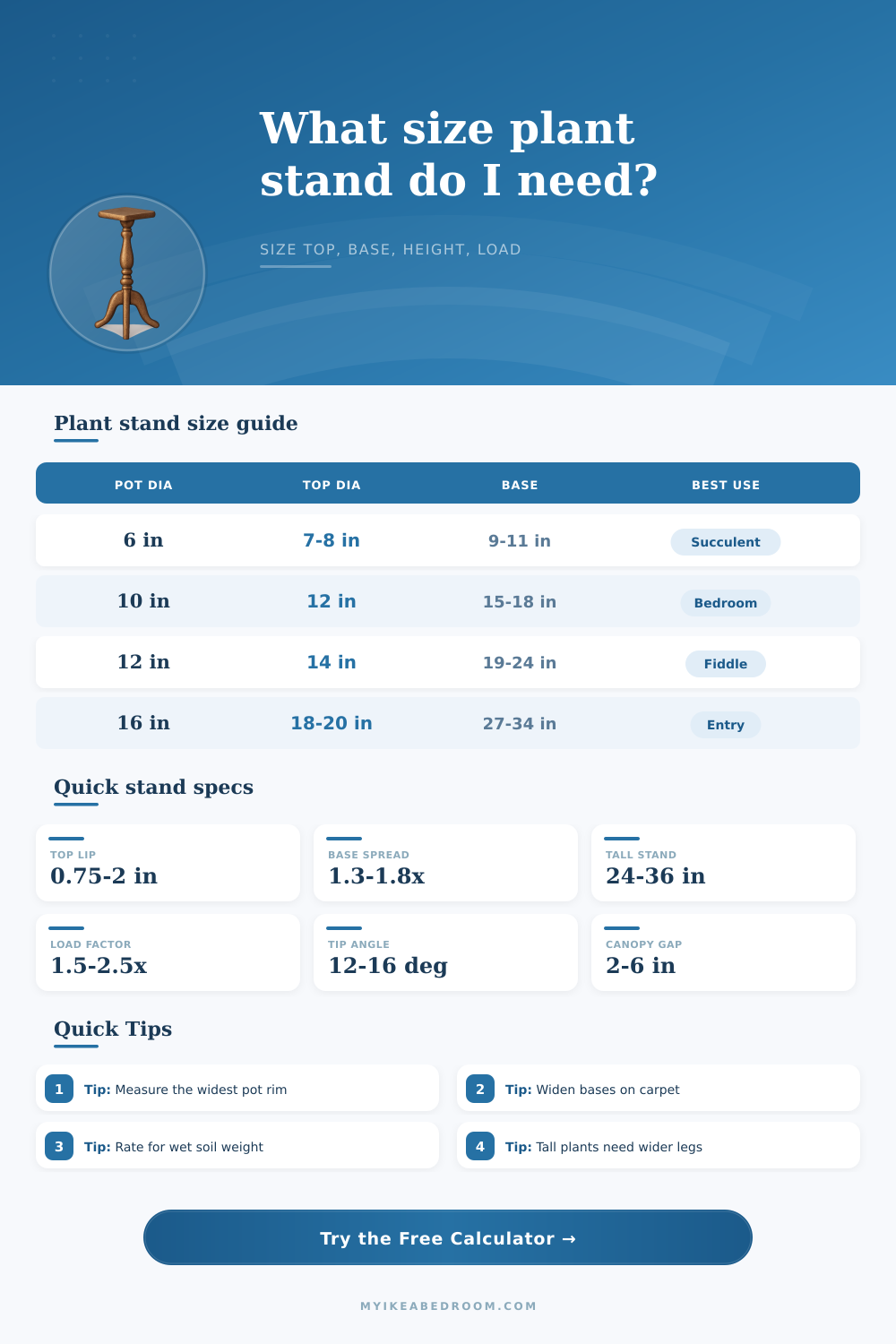
| Pot outside diameter | Minimum top platform | Minimum stable base | Best stand height range |
|---|---|---|---|
| 4-6 in small pot | 5.5-8 in | 8-12 in | 8-20 in |
| 7-8 in nursery pot | 9-10 in | 12-16 in | 12-28 in |
| 9-10 in ceramic pot | 11-12.5 in | 15-20 in | 16-30 in |
| 11-12 in floor plant | 13-14.5 in | 19-24 in | 10-28 in |
| 13-14 in large cachepot | 15-17 in | 22-30 in | 6-22 in |
| 15-16 in heavy planter | 17-20 in | 27-34 in | 4-16 in |
| Pot or saucer shape | Side allowance | Why it matters | Use with |
|---|---|---|---|
| Straight nursery pot | 0.5-1 in each side | Enough lip for a simple flat top | Light plastic pots |
| Tapered ceramic pot | 0.75-1.5 in each side | Allows the widest shoulder to sit fully | Bedroom and shelf displays |
| Pot with saucer | 1-2 in each side | Saucer is often wider than the pot rim | Watered indoor planters |
| Bulbous cachepot | 1.5-2.5 in each side | Curved sides need a larger visual platform | Statement plants |
| Grouped small pots | 2-4 in total spare width | Prevents edge crowding between pots | Herbs and propagation jars |
| Placement | Target tip angle | Base adjustment | Practical reading |
|---|---|---|---|
| Low traffic corner | 10 degrees | Standard base is usually fine | Good for small pots and low stands |
| Bedroom or living room | 12 degrees | Use a base wider than the pot | Best everyday default |
| Busy walkway | 14 degrees | Add 10-15 percent base spread | Better when people brush past |
| Pets, children, balcony | 16 degrees | Use wide legs, low height, or wall backing | Avoid narrow pedestal shapes |
| Pot size | Plastic pot range | Ceramic pot range | Stand rating to shop for |
|---|---|---|---|
| 6 in pot | 3-8 lb | 6-14 lb | 15-30 lb minimum |
| 8 in pot | 8-16 lb | 14-28 lb | 30-60 lb minimum |
| 10 in pot | 16-30 lb | 28-50 lb | 55-100 lb minimum |
| 12 in pot | 28-50 lb | 45-80 lb | 90-160 lb minimum |
| 14-16 in pot | 50-90 lb | 80-140 lb | 160-280 lb minimum |
Measure the real outside footprint. A saucer, flared ceramic shoulder, or drainage tray can be wider than the pot label, so size the top platform from the largest actual diameter.
Use wet weight for safety. Freshly watered soil is the load that matters. If the plant is tall, choose a wider base before choosing a taller pedestal.
Most folks purchase a plant stand because it looks good in their room and presume anything can go on it. Trouble arises when that assumption becomes a reality. A lightweight plastic nursery pot filled with soil are not the same as heavy ceramic pot of the same size full of damp soil. If you don’t account for this, your plant may topple over and mess up floor or simply make your display unstable.
There’s no secret equation to figuring out what’s strong enough, but most homeowners don’t consider the math because all they care about is making their rooms pretty. So what’s the problem? Leverage. And the tipping point is when the plant gets raised off ground. That all depends on balance between the size of the base compared to height of the stand. Yes, it sounds fancy, but try balancing a fiddle leaf fig atop a skinny, tall pedestal that has only one leg weighed down by all that wet soil in planter.
Why Plant Stands Tip Over
To help get your head around balance of visual appeal versus how stable it is, I made a calculator (above) that compares the recommended spread of the base based off the pot size. You can see how big those legs has to be to prevent tipping over, the safer the better!
The other input that people don’t expect is the wet weight. When soil is dry, it’s lightweight, but when it’s soaked, as it will be within moments after you water it in, its weight increase dramatically. A dense terracotta pot might weigh ten pounds empty, so add to that the twenty pounds of damp soil inside and suddenly it needs a different rating from a stand-load perspective. Most stands state a maximum capacity, and most customers fail to compare that with what they’re putting in. This one asks how much the loaded weight will be (including both the water you just added and whatever the plant itself weigh).
Material selection is equally important in that last equation. Heavier loads are better supported by steel or iron frames; they don’t bend easily when pressured. Lighter weight, more flexible materials like rattan or bamboo will give eventually, but that’s no reason to compromise style for substance; just acknowledge the physical limitations of softer materials. That said, a lovely wide-rimmed ceramic stand is great for supporting low-growing things, but risky with a tall, top-heavy plant whose center of gravity has been raised to high above the support surface.
Floor type plays a bigger role than many people think. While a stand might feel like it have rock solid feet on a tile or hardwood floor, that same stand may move just a hair on a thicker carpet, effectively shrinking its own footprint to create less space for support. Even a tiny amount of wiggle makes it much more likely to tip over, especially if kids or pets are playing nearby. You can avoid surprises by simply changing your minimums depending on what lies underneath those legs.
To give you some immediate benchmarks for various rooms, the calculator comes with handy reference tables so you’ll know at a glance how much caution you need to take with your selection. Finally, size matters, but mostly because you should of followed physics instead of fighting them. On one hand, you don’t want too big of a rim on the plant pot because then something might accidentally knock into it, causing it to topple over. But on the other hand, you don’t want it to be so tall and top heavy that it falls over because the base isn’t wide enough.
A little bit of thinking ahead can save lots of floor cleaning time later. If you have the proper balance between the planter’s height and width, your floors will stay clean and your plants will stand up straight.