Rounded aggregate planning
Pea Gravel Coverage Calculator
Work out net coverage area, placement depth, cubic yards, tonnage, and bag counts for rounded pea gravel in landscape beds, walking paths, splash zones, and narrow drainage runs.
Use the fill factor for curves, cutouts, or tree rings where the full rectangle is not completely covered with gravel.
These profile cards update with the current stone choice and your calculated loose spread depth.
Pea gravel are stones that are approximately the size of a pea. Pea gravel is often used in gardens for path, tree rings, and drainage areas due to the fact that pea gravel is smoothly and rounded. Because pea gravel is rounded and smooth, it dont lock together with itself like crushed stone will.
For these reasons, pea gravel will shift and migrate when individual walk on the pea gravel. The depth of the pea gravel should be carefully considered when installing gravel paths in a garden. If the depth of the pea gravel is too thin, the pea gravel may wash away into the soil.
How Deep Should Pea Gravel Be
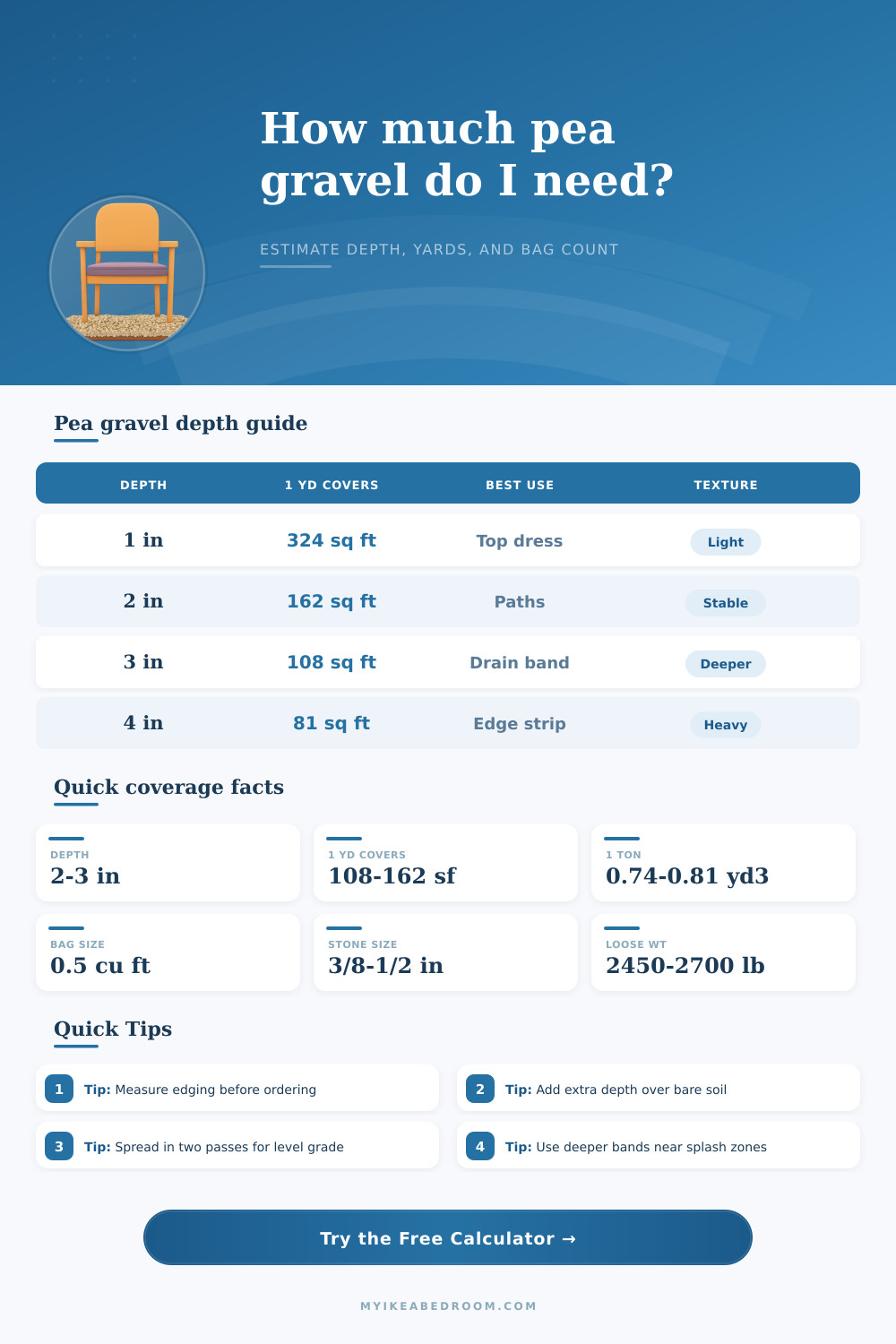
If the depth of the pea gravel are too deep, the cost of the pea gravel will be more higher, and the effort to move the gravel will be greater. Garden paths should be installed to a depth of two to three inches deep. Drainage areas should be installed to a depth of three to four inches deep to allow water to pass through the gravel.
When you place pea gravel on bare soil, the depth of the pea gravel will settle into the soil over time. Placing pea gravel on landscaping fabric will result in less settling of the gravel. Order pea gravel at approximately 10% more than the depth that you measure initially for your project.
This allow for settling of the pea gravel. Additionally, ordering extra pea gravel allows for any waste during placement of the pea gravel. You must use edging to contain the pea gravel.
Because pea gravel is rounded in its grain, the pea gravel will roll and move when the individuals steps upon the gravel area. If you do not use plastic or metal edging to contain the pea gravel, the pea gravel will roll away from the area where you intend for it to be and spread into other areas of the garden. Using edging will allow the pea gravel to remain within the boundary that you create so that the pea gravel remains looking tidy.
Before you can spread the pea gravel into your desired area, you should prepare the ground first. You should lay down landscaping fabric prior to the addition of the pea gravel because the landscaping fabric will prevent the pea gravel from sinking into the soil. If you do not use landscaping fabric, the pea gravel will sink into the soil and become difficult to view once its spread into the ground.
You should spread the pea gravel in two separate layer if the depth of the pea gravel is deeper than two inches. This way, you can rake the first layer of pea gravel flat and then add the second layer of pea gravel to avoid the formation of air pocket within the pea gravel layer. The size of the pea gravel will also play a role in the use of the pea gravel.
Three-eighths inch pea gravel rolls easy and is good for area that may become walked upon. Half-inch pea gravel is better for texture in areas of your yard where you do not want to create a bumpy surface. Additionally, pea gravel is heavy so it can be ordered by the cubic yard or by the bag.
If you need a large amount of pea gravel, purchase it in bulk. However, if you only need a small amount of pea gravel, purchase it in bag so that it will be easier for you to transport to your yard.