🏗 Paver Patio Calculator
Estimate patio area, paver count, base stone, bedding sand, and joint sand with real paver sizes, pattern waste, and edge lengths.
📋Descriptive patio presets
🔧Calculator inputs
📋Material and spec grid
📊Reference tables
💡Practical tips
📈Calculation results
To construct a paver patio, it is necessary to calculate the amount of materials that are required to construct the patio. The patio construction process require that the individual determine the shape of the patio, the material of the pavers, and any waste that may be caused in the construction process. If the individual dont plan for the waste that will be created during construction, it is possible that there will not be enough pavers to complete the project.
The shape that the patio will have will affect the amount of waste that is created during construction. Additionally, the shape will also impact the amount of edge restraint that is required for the patio. A patio that is in the shape of a rectangle will typically be easier to build compared to a patio of a circular shape.
How to Figure Out Materials Needed for a Paver Patio
Rectangular shapes have the advantage of having straight edges, which means that there will be less cutting of the pavers to fit the desired dimensions for the patio. Thus, there will be less waste of the pavers if they are to be build into a rectangular patio. In contrast, circular or curved patios will require more cutting of the pavers to allow them to fit into those curves in the patio design.
As such, you should purchase more pavers for a circular patio to provide for the waste that will be created during construction. The perimeter of the patio will also have an impact upon the amount of edge restraint that will be required to hold the pavers in place during construction. Larger perimeters will require more of this material than patios with smaller perimeters.
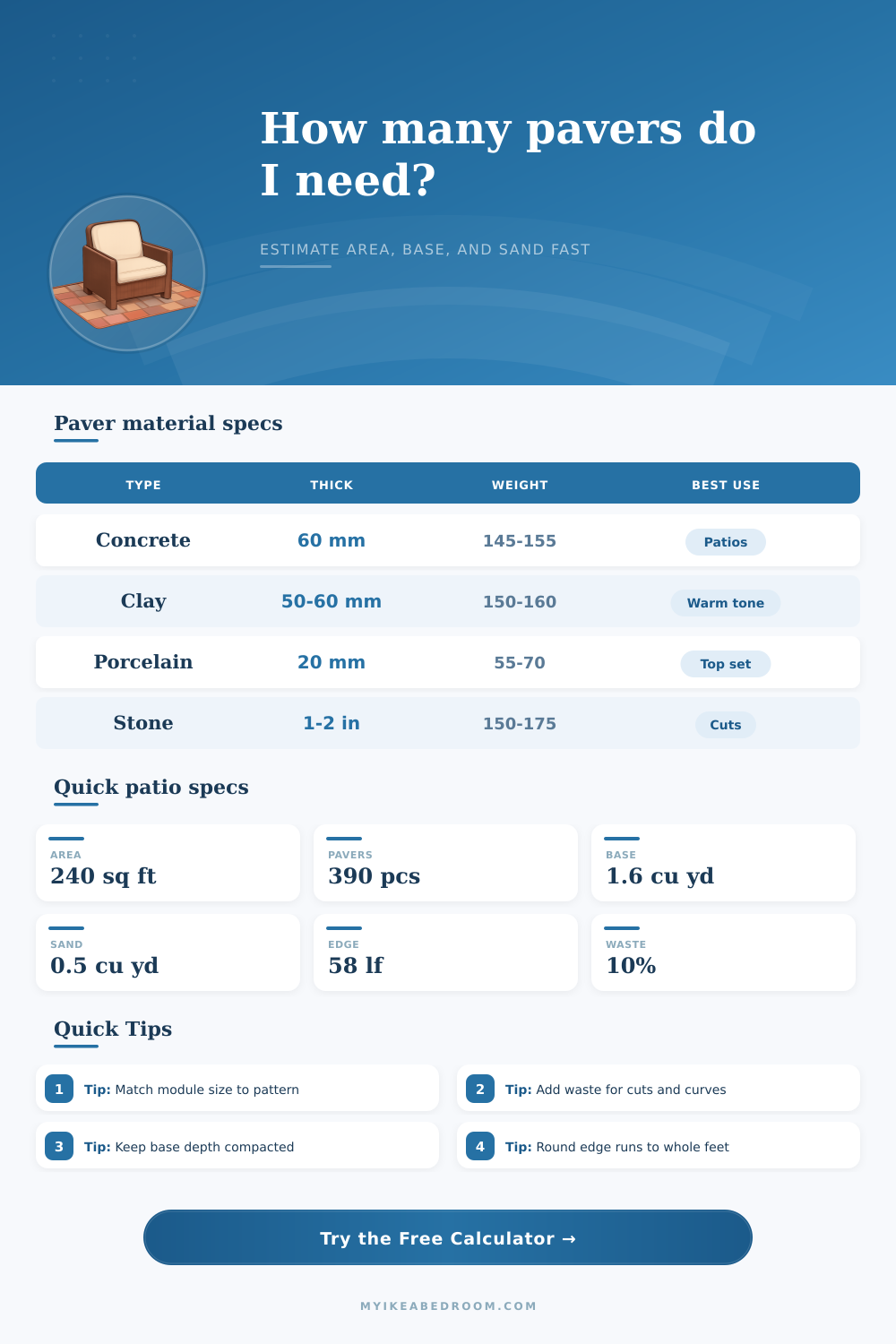
The material of the pavers will also need to be chosen prior to construction. For instance, pavers made of concrete are common, and are often 60 millimeters thick. Clay pavers is also an option, but more care must be take when bedding them in place so that they dont crack.
Porcelain pavers are thin, typically only 20 millimeters thick, but are also dense and can be installed directly over existing slabs. Natural stone pavers are another option for building patios, but they is heavy. Additionally, because of the weight of natural stone pavers, a thicker base is required beneath the patio.
The weight of each of these different types of pavers can have an impact upon the number of pavers that need to be transported to the building site. Another factor that will have an impact upon the patio construction process is the pattern of the pavers that are to be used. For instance, patterns like running bond require the pavers to be offset from one another in relation to the neighboring pavers.
Patterns like herringbone require the pavers to be interlocked at angles to one another, which creates more waste during the building process. The size of the pavers, or the module size of the pavers (such as 4-by-8 inch pavers or 12-by-24 inch pavers) will also impact the type of patio that is built, as the paver sizes must match the pattern that is to be created. Pavements have several layers to the paving process.
A base layer of crushed stone of a thickness of 6 inches is required. This crushed stone base is compacted to ensure that it reaches a high degree of density. A layer of bedding sand is added to the compacted base, typically of a depth of 1 inch.
This bedding sand will level the paving of the pavers. The joints between the pavers must be filled with polymeric sand to prevent the pavers from wobbling. In calculating the number of pavers that will be required, it is also necessary to include for waste.
A standard percentage for waste is 10 percent of the total number of pavers that are to be used for the patio. A percentage of 15 percent is better if complex paving patterns are to be used (like ashlar paving patterns), as well as for circular patios. If no allowance for waste is made in the calculation of the number of pavers that will be purchased, it is possible that there will not be enough pavers to complete the paving project.
The third consideration for paver construction is the actual conditions of the building site. The slope of the site should be construct to allow for a rate of 1/8 inch per foot. This will allow water to run away from the house and foundation.
In locations where the soil is clay-heavy, it is recommended to use a geotextile fabric placed beneath the base layer of stone. This will prevent the clay soil from mixing with the stone substrate. Finally, before permanently installing the pavers, they should be laid out in a dry fit.
This will allow the individual to view the layout of the patio prior to permanently installing the pavers.