🧱 Base planning for pavers
Paver Patio Base Calculator
Estimate excavation depth, compacted aggregate, loose base, bedding sand, drainage drop, geotextile coverage, and paver count before you start digging.
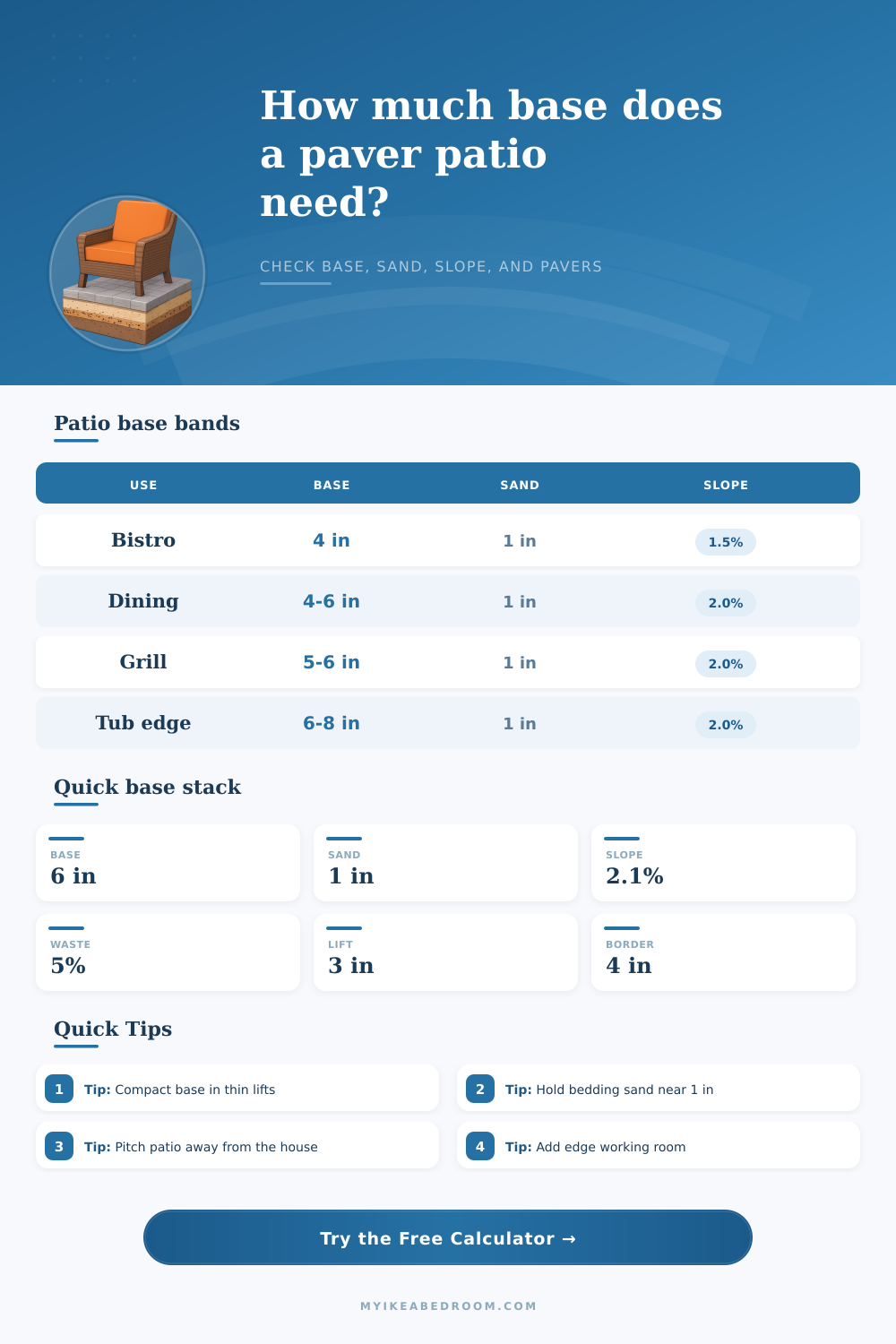
These planning tables help compare compacted base depth, drainage pitch, compaction allowance, and common paver module counts.
A paver patio consist of several layer of materials that have to be added to create a stable and level paver patio. The visible part of a paver patio is the topmost layer of pavers. However, the compacted gravel base that underlie the patio, the bedding sand that you add on top of the compacted gravel base, and the slope of the paver patio provide the stability and level of the entire patio.
If the gravel base isnt of sufficient thickness or is not compact properly, the paver patio may sink into the ground over time. Additionally, if you dont establish the slope of the patio correct, water will pool on the patio, which may lead to damage of the foundation of the house upon which the patio is construct. The first layer of a paver patio is the compacted gravel base.
How to Build a Stable Paver Patio
The gravel base will distribute the weight of the pavers throughout the patio. For small patio, four inches of compacted gravel may be all that is require. For larger patios, however, that may be required to support heavy table and chair, you should use five or six inches of compacted gravel.
The gravel base should be compacted in a series of thin layer of gravel, also referred to as “lifts.” Dumping all of the gravel into the designated location for the patio at once and compact all of the gravel at once will not result in a solid gravel base. Ordering additional gravel beyond what is required to create the gravel base will ensure that there is enough gravel to compact in these thin lift. The second layer of a paver patio is bedding sand.
You will layer the bedding sand upon the compacted gravel base. The bedding sand should be approximately one inch in thickness, and the sand should be level using a tool referred to as a “screed.” The bedding sand do not have to be used to level the patio; the gravel base will ensure that the patio is level. Rather, the bedding sand will provide a flat platform upon which the pavers will rest.
It is not necessary to add additional bedding sand to level the gravel base, as this may result in the patio becoming mushily. The third component of a paver patio that must be established prior to place the pavers onto the bedding sand is the slope of the patio. The slope will ensure that rainwater runs away from the foundation of the house.
The slope of the patio should be approximately two percent. Two percent mean that the patio will drop approximately a quarter-inch for every foot of length of the patio. If the slope is too shallow, water may collect in the pavers.
However, if the slope is too steep, it may become difficult for individual to walk on the patio. The slope must always slope away from the house; otherwise, water will seep into the basement of the house. The size of the pavers that are to be used for the patio and the depth of the gravel base for the patio must be calculated together to avoid error in construction.
Larger pavers will cover more of the area with fewer pavers than smaller pavers. However, the larger the pavers are, the more thickness that is required of the gravel base to prevent the pavers from sink into the gravel base. Additionally, you should add five to seven percent of the total number of pavers that are required for the patio to the total required for coverage of the area; some pavers will break during construction and some will have to be cut to fit onto the gravel base.
Finally, an “overdig” of the area should be established for the patio; this area will allow for the installation of the edge restraint for the pavers and to allow space to compact the gravel base along the border of the patio. When constructing a paver patio, there are additional factor to consider. For instance, if the soil in which the patio will be constructed is soft, it will be necessary to dig deeper into the ground to establish a stable foundation for the pavers.
Additionally, if the area in which the patio is to be constructed experience cold climate, it will be necessary to ensure that the gravel base is deep enough to prevent the ground from freezing and potentially move the pavers. Geotextile fabric may be used to prevent the soil from mixing with the gravel base. Finally, edge restraints may be used to prevent the pavers from spread apart over time.
By following these construction steps and ensuring that the gravel base is created correctly, the bedding sand is added correctly, and the slope of the patio is established appropriate, the paver patio will remain level and functional for a long period of time.