Outdoor dining shade planner
Patio Umbrella Size for Table Calculator
Estimate umbrella canopy diameter or width from table size, table shape, chair pullback, shade overhang, umbrella shape, pole offset, sun angle factor, and units.
| Table Setup | Table Size | Common Umbrella | Chair Pullback | Planning Note |
|---|---|---|---|---|
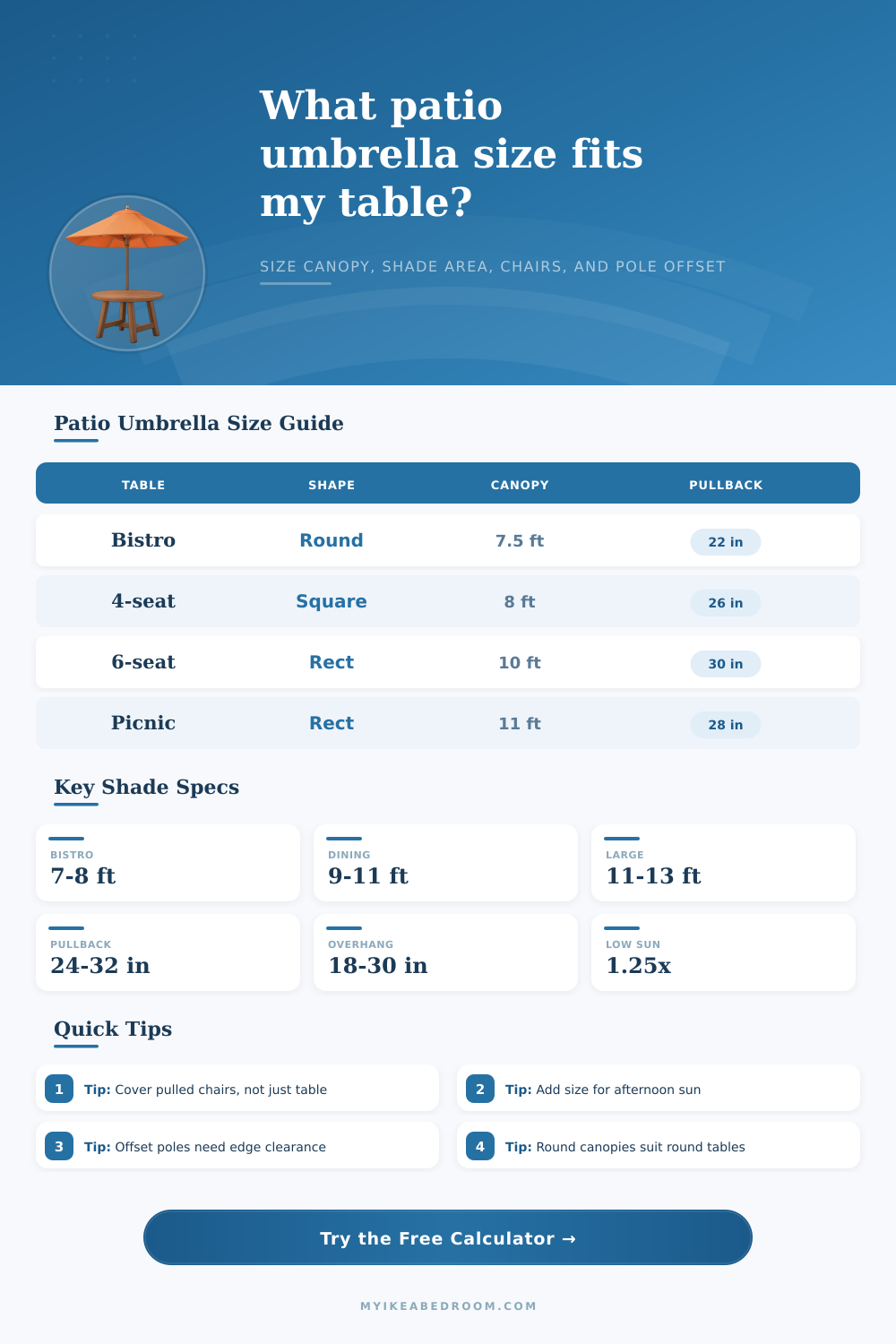
| Round bistro | 30-36 in diameter | 7-8 ft round | 20-24 in | Often works with a center pole and small base. |
| 4-seat square | 36-44 in square | 8-9 ft square or round | 24-28 in | Square canopies keep corner seats better covered. |
| 6-seat rectangular | 60-72 x 36-42 in | 9-11 ft or 8 x 10 ft | 28-32 in | Rectangular canopies shade the long side more evenly. |
| 8-seat dining | 84-96 x 40-44 in | 11-13 ft or 9 x 12 ft | 30-36 in | Check canopy height and base stability for large spans. |
| Formula Piece | Calculation | Why It Matters | Result Affected |
|---|---|---|---|
| Seated footprint | Table size + 2 x chair pullback | People move chairs beyond the tabletop. | Chair coverage |
| Shade target | Max(table + overhang, table + 0.7 x chair pull) | Balances tabletop shade with usable seating shade. | Canopy size |
| Sun adjustment | Shade target x sun angle factor | Low sun shortens effective shade below the canopy. | Recommended width |
| Pole offset | Canopy adds 2 x offset allowance | Side poles shift the useful shade center. | Fit score |
| Umbrella Shape | Best Table Shape | Area Formula | Strength | Watch |
|---|---|---|---|---|
| Round | Round, small square | Pi x radius squared | Simple centered shade | Less efficient for long tables |
| Square | Square, compact dining | Side x side | Good corner shade | Can feel oversized on narrow balconies |
| Rectangle | Rectangular, picnic | Length x width | Efficient long-side coverage | Orientation must match the table |
| Octagon | Round, oval | 0.92 x diameter squared | Soft look with more edge | Use diameter like round sizing |
| Pole Layout | Offset Input | Clearance Meaning | Typical Use | Calculator Response |
|---|---|---|---|---|
| Center pole through table | 0 in | Pole stays centered in table hole | Bistro and dining sets | No offset size penalty |
| Near-edge side pole | 24-48 in | Pole approaches the tabletop edge | Balcony or wall-side shade | Adds canopy width for shifted shade |
| Cantilever base | 48-84 in | Pole sits beyond the table edge | Larger patios and lounge zones | Checks edge clearance and chair zone |
| Low afternoon sun | Any offset | Shade lands away from canopy center | West-facing dining | Sun factor increases recommended size |
So here’s what happens: you purchase this umbrella and put it up at home, only to find that the table is in shade but your knees are baking. Chances are it wasn’t because of frame or fabric; it was simply bad math. And this is where most folks go wrong. They see the size of their table and that becomes deciding factor in which umbrella to buy.
Most people buys a seven-foot wide canopy for a thirty-six inch round table. But real problem isn’t protecting the table wood; the issue is that you has to protect yourself. When you pull out your chair, you don’t stop at the end of the table, you scoot way beyond it. If shade stops at end of table, then your legs are unprotected. By taking into account that pullback distance, the calculator does the geometry for you. You simply tell it how far back you want to push your chair, typically about twenty-four to thirty inches, and then it will calculate what size canopy it need to be. That one input alters everything because now it’s not about shading some surface area but rather just shading a human footprint.
How to Choose the Right Size Umbrella
Not only does the size of your table matter but so does its shape. If you have a round table then I think a round umbrella look great. The coverage is equal all around the table. But what about a long rectangular table? If you use a round umbrella, you will have to purchase an overly large canopy or leave empty space at the ends. This is why there are square and rectangle canopies. They matches the lines of the furnitures and give you enough coverage without wasting fabric in the air.
In real life, shade is a downward angle; it’s not vertical, which is how we imagine it. As the sun descends, its shadow will slide down the perimeter and shrink. If your lunchtime umbrella provides ten feet of shade, and you’re dining till dark (sevenish), you may have to upsize to an eleven- or even a dozen-footer. Devices that considers the sun’s angle work this way: They create a buffer zone. So when the sun shifts direction, no one pops out of the shade.
The other variable is the umbrella’s pole placement. For center-pole umbrellas, it’s easy math; the shade spread out evenly. Cantilever (offset) or pole umbrellas look cool and move center of gravity. Because of this offset, you will need a larger canopy to span distance. Forget about this offset, and half your party will be sitting in sun.
The size isn’t as much about material selection as you’d imagine, though it does impact comfort and durability. Olefin holds up well to moisture. Acrylic resists harsh UV rays for longer without fading. Polyester is lighter weight and cheaper, but it may need replacement after some time. Regardless, none of them alter the amount of square footage required.
Ultimately, it’s more about spatial planning than looks when it comes to getting the proper umbrella. Because you’re creating a micro-climate for your dinner guests. Stop thinking about table, and think about space that people actualy occupy while they sit down. It’ll become clear as day why you chose what you chose. No one has to stretch their arms way out across the table, and everyone eats their dinner in complete comfortablly.