Patio Paver Pattern Calculator
Inputs stay in their own row, and results stay in the row below for clean paver pattern takeoff.
Nine real layout and pattern starting points.
Shape, module size, joints, border style, and waste drive the pattern math.
Four pattern cards tied to the same patio dimensions.
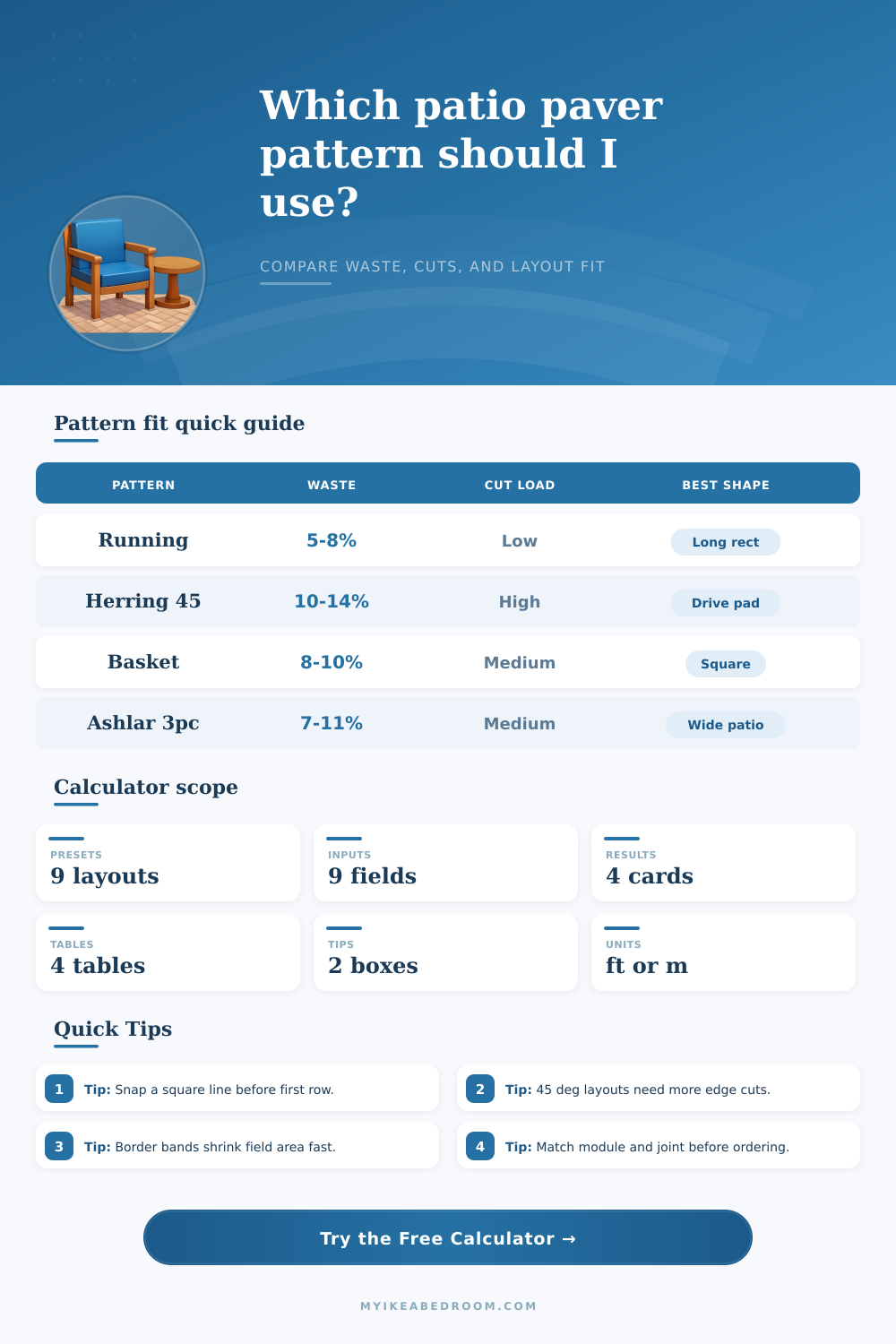
| Pattern | Waste | Cut load | Best use |
|---|---|---|---|
| Running bond | 5-8% | Low | Straight patios |
| 45 deg herringbone | 10-14% | High | Heavy traffic |
| Basket weave | 8-10% | Medium | Courtyards |
| Ashlar 3-piece | 7-11% | Medium | Large patios |
| Joint width | Coverage | Demand | Watch-out |
|---|---|---|---|
| 1/8 in | 85-100 sq ft | Low | Needs tight module control |
| 3/16 in | 65-80 sq ft | Medium | Check sweep depth |
| 1/4 in | 50-65 sq ft | Med-high | Increases bag count |
| 3/8 in | 35-50 sq ft | High | High sand demand |
| Paver module | Face area | Pieces/sq ft | Common use |
|---|---|---|---|
| 4 x 8 | 0.22 sq ft | 4.5 | Curves and borders |
| 6 x 9 | 0.38 sq ft | 2.7 | Balanced option |
| 6 x 12 | 0.50 sq ft | 2.0 | Linear layouts |
| 90 deg herringbone | 260-360 sq ft | Long rectangles split uses well | Hosting |
| Border style | Band impact | Why it matters | Target |
|---|---|---|---|
| No border | 0 | Maximum field area | Low cut jobs |
| Single sailor | 1 module width | Cleans perimeter cuts | General patios |
| Double sailor | 2 module widths | Raises border count quickly | Framed patios |
| Ashlar accent | Mixed widths | Extra sorting and cuts | Feature pads |
When you are planning your paver patio, you must decide on the pattern of the pavers. The pattern of the pavers will determine the number of pavers that you need for your patio and the amount of waste that you will create during the paver installation process. Paver patterns are essentialy the name for the various geometric arrangement of the pavers.
Each pattern creates a certain amount of stability within the paver patio and provides a differently aesthetic result for those who view the patio. If you choose a paving pattern that does not correspond to the dimensions of your patio, you will have to make numerous cut to your pavers, which will waste some of your paver material. There are several common paver patterns that can be used on patios.
Choosing the Right Paver Pattern for Your Patio
A running bond pattern shifts each row of pavers by half of a paver, which helps to distribute the joints between the pavers. A herringbone pattern places the pavers at angles, often 45 degree, which locks the pavers together and resists shifting of the pavers. A basket weave pattern includes short and long pavers placed together, which creates a rhythmic appearance for the patio.
Finally, an ashlar pattern use both small and large pavers that mimic the appearance of old stone walls. Each of these paver patterns requires a different amount of labor to install and wastes a different amount of paver material during installation. The dimensions of your patio are also important.
For instance, if you have a rectangular patio area, rectangular paving material will easily fit your patio. However, if you have a circular patio, circular paving material will be difficult to pave your patio with. Additionally, the width of the joints between the paving material also play an important role in the paving process.
If the joints are narrow, you will have to be precise with the paving of the pavers. However, narrow joints will use less joint sand during installation. Wider joints make for easier installation of the pavers, but will require more joint sand to fill those wider gaps.
Borders are often laid around the patio to frame the patio. Additionally, using borders will reduce the number of cuts that must be made to your pavers. One type of border is a sailor course, in which the paving material is laid end out of the patio.
Such a border can clean up the edges of the patio by one module width. However, if you opt for a double border, you will use more paving material to frame the patio, and the double border will increase the amount of waste that is created during installation. Additionally, different paving patterns create different amount of waste.
For instance, a patio paved with a 45-degree herringbone pattern will waste 10 to 14 percent of the pavers. In contrast, a patio paved with a running bond will waste only 5 to 8 percent of the paving material. Thus, 10 percent extra pavers should of been ordered to account for any breakage of the pavers.
Before purchasing paving material, you should test the paver pattern that will be used for your patio. You can calculate the number of paving material that will be needed for your patio of a specific shape. Additionally, the amount of joint sand that is required can also be calculated based on the width of the joints between paving materials.
For example, a patio paved with a herringbone pattern may require more labor than a patio paved with a stack bond pattern. However, the herringbone will provide better grip for the individuals who use the patio for foot traffic. Additionally, if the joints are to be increased in width, more bags of joint sand will be required for installation.
Thus, the amount of joint sand that is required for the patio can be calculated prior to installation. There are some mistakes that you should avoid when installing your patio. For instance, if the first row of paving material is not laid in alignment with the desired line for that row, the remainder of the paving material may create waves in the pavers.
To avoid this issue, place control lines into the patio prior to installation. Additionally, you should also decide upon borders before you start purchasing pavers. Borders will take up some of the area in the field where the paving material will be placed.
The size of the paving module should also be chosen prior to installation. For example, 4-by-8-foot paving modules are flexible in creating curves in pavers. In contrast, 6-by-12-foot paving modules are better for laying even paver materials in straight lines.
Beyond these factors, there are additional environmental factors that will play a role in your selection of paving patterns. For instance, if there are slopes in your yard, you may want to use paving patterns that resists shifting caused by those slopes. Additionally, if your yard is bordered by trees whose roots extend into the area of the patio, you may opt for paving patterns that resist shifting caused by those roots.
Thus, interlocking paving patterns, such as a 90-degree herringbone pattern are resistant to shifting caused by tree roots. In addition, if your patio will be shaded from the sun, you may want to use paving patterns that allow for water to reside between the paving materials so that moss does not grow in the joints. Finally, if the patio will be exposed to sunlight, light-colored paving materials may be desired.
In some cases, you may use the preset paving patterns that are available from paving material stores. For instance, a 10-by-12-foot patio paved with a running bond pattern and a single border of paving material will require fewer paving cuts. However, an 18-by-24-foot patio paved with a herringbone pattern will require more border paving material to frame the patio, and more paving material will be wasted during installation.
However, the interlocking herringbone pattern will last longer if the patio is to be used for gatherings with numerous individuals. Thus, you will need to purchase the paving materials of each desired size based on the size of the patio, the borders of the patio, and the type of paving patterns that you choose. Through careful planning of your patio paving materials, you will reduce the amount of paving material waste and the amount of time that you spend with a saw to cut paving materials to the desired sizes.