4 Size Patio Pattern Calculator
Build a four-size paver or outdoor tile takeoff from patio dimensions, modular piece ratios, joint width, border band, orientation, waste, and cut complexity.
Load a descriptive starting layout, then adjust every size, ratio, border, and allowance to match your slab, porcelain, stone, or concrete paver set.
| Pattern style | Typical ratio | Best fit | Planning note |
|---|---|---|---|
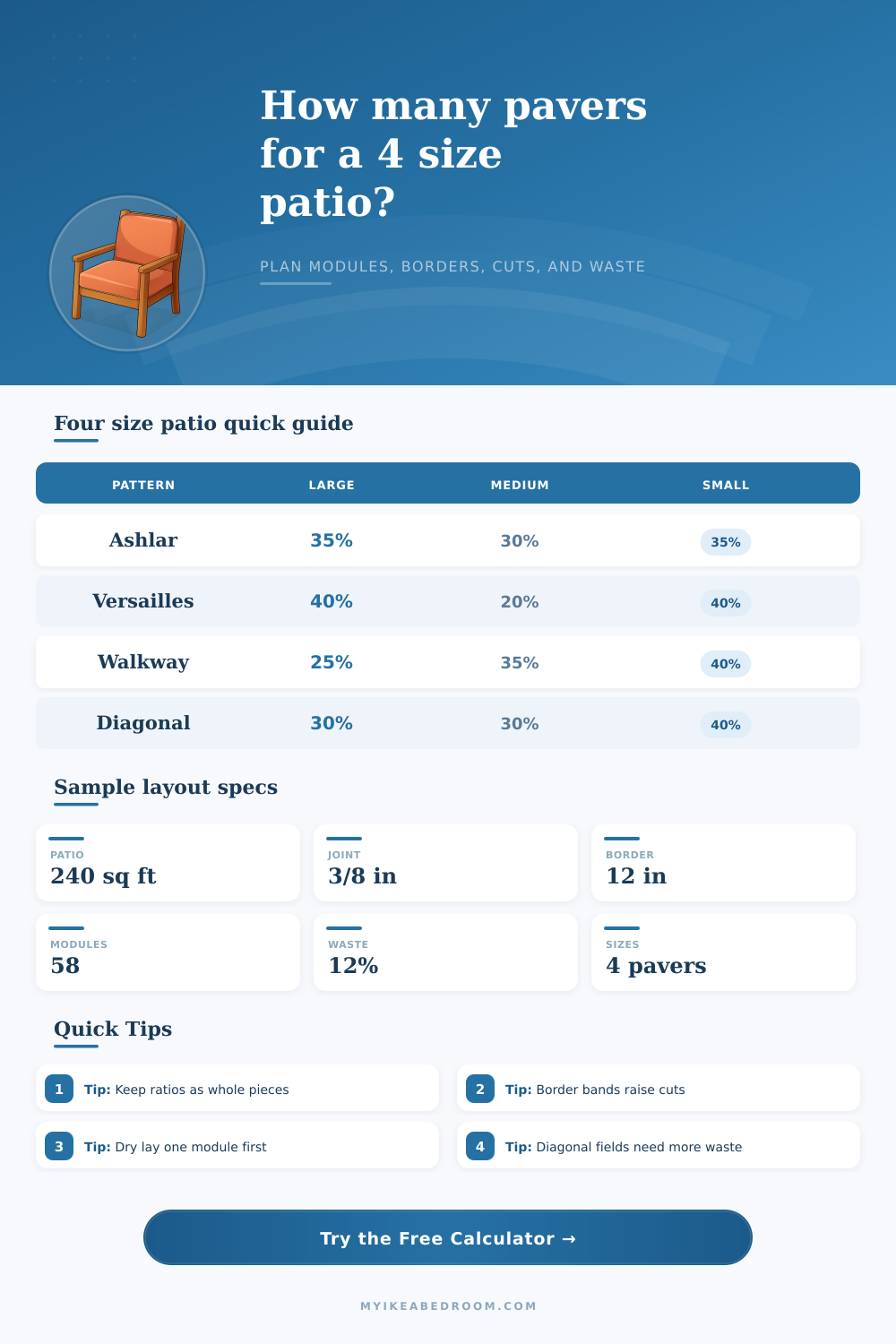
| Ashlar patio | 1 : 2 : 4 : 4 | Balanced patios and terraces | Strong repeat without a grid-heavy look |
| Versailles-style set | 2 : 1 : 2 : 4 | Natural stone modular packs | Large pieces dominate the visual rhythm |
| Random rectangle walk | 1 : 3 : 2 : 5 | Narrow routes and garden paths | More small pieces help stagger edges |
| Large terrace mix | 3 : 2 : 2 : 2 | Wide patios with fewer seams | Large slabs reduce joint density |
| Joint width | Works with | Pattern effect | Calculator impact |
|---|---|---|---|
| 1/8 in to 3/16 in | Rectified porcelain slabs | Crisp modern joints | Slightly smaller module footprint |
| 1/4 in to 3/8 in | Concrete pavers and gauged stone | Typical outdoor spacing | Moderate joint area in each repeat |
| 1/2 in to 3/4 in | Tumbled stone and rustic sets | Looser visual rhythm | Higher joint area, fewer paver faces |
| Over 3/4 in | Irregular slabs only | Very wide joint grid | Confirm the module by dry laying |
| Condition | Added cut load | Where it shows up | Use when |
|---|---|---|---|
| Simple rectangle | 1.5% | Outer edges only | No posts, curves, or diagonal field |
| Standard patio | 4% | Corners, steps, and door thresholds | Most patios with a normal border band |
| Complex perimeter | 7.5% | Posts, drains, curves, and jogs | Several interruptions in the layout |
| Intricate diagonal | 10% | Triangular edge cuts and extra sorting | Diagonal or high-variation modular work |
| Set name | Size A | Size B | Size C | Size D |
|---|---|---|---|---|
| Concrete ashlar | 24 x 24 in | 24 x 12 in | 12 x 12 in | 12 x 6 in |
| Porcelain terrace | 24 x 36 in | 24 x 24 in | 12 x 24 in | 12 x 12 in |
| Stone Versailles | 24 x 16 in | 16 x 16 in | 16 x 8 in | 8 x 8 in |
| Walkway rectangles | 18 x 12 in | 12 x 12 in | 12 x 6 in | 6 x 6 in |
When you is planning your paving project, you must decide how much different sizes of pavers you will buy. Many people attempts to purchase a equal amount of each size of paver, but this often results in having too many small pavers relative to the amount of large pavers that is needed. To avoid this problem, you should use a modular-ratio.
The modular ratio is the mathematical relationship between each size of paver that you will use as a pattern for your patio design. For instance, you can select a modular ratio of one large paver for every four small pavers. By using this same ratio throughout the patio, the pattern will be consistent, and the patio will not appear as if it are laid out in a grid.
Plan paver sizes and how many to order
The modular ratio that you use will change the appearances of the patio. For instance, an Ashlar pattern use a modular ratio that creates a balanced patio design that appear to be stable. A Versailles style pavement pattern include a high ratio of large pavers to small pavers, which creates a formal appearance for the pavement.
A random walkway pavement pattern uses a higher proportion of small pavers then large pavers in its modular ratio, which create a pavement design that is more casual in its appearance. Each of these different pavement designs use different proportions of large versus small pavers, which change the visual appearance of the pavement. In addition to the modular ratio, you must take into account the width of the joint between the pavers.
The width of these joints can add up to alot of space, especially on large patio. If you do not account for the joint width in your calculations for the number of pavers that you need to order, you will end up ordering too many pavers for the patio design. You must use a calculator that take into account the width of the joints between the paving stones.
By taking into account the width of the joints, you will save money on your paving project and you wont have to go back to the paving supply yard to purchase additional pavers. Pavers can also be laid in a border band around the area that is paved with the modular ratio. The border band contribute to the design of the patio by framing the paved area for the patio.
The border band, however, dont need to align with the modular paving pattern. Due to this difference in alignment between the modular pattern and the border band, you will need to cut pavers to fit between the border band and the paved field. The amount of pavers that are cut will depend upon the complexity of the border bands perimeter.
Perimeters with curves or pillars will require more cut pavers than perimeters with only rectangular shape. The complexity of cutting pavers can also impact the number of pavers that needs to be ordered. For instance, cutting paved pavers at a forty-five degree angle will increase the complexity of cutting those pavers.
Due to increasing the complexity of cutting the pavers, you will need to discard some pavers. To account for these pavers that will be cut but not used, you will need to order extra pavers for the paving project. Pavement calculators often allow for the addition of an extra percentage of paving stones to account for these cut pavers.
Before you order your paving stones, perform a dry lay of a single module of paving design. A dry lay is laying the paving stones on the ground without using sand or mortar to hold the paving stones together. Performing a dry lay allows you to see the paving pattern with the modular ratio.
By placing the paving stones on the ground, you can see if the ratio is correct and that there are not too much large paving stones in comparison to the other paving stones in the module. It is far easier to change the modular ratio in your paving calculator than to transport heavy pallets of paving stones to the location of the patio. Once you are satisfied with the dry lay of the paving stones, use the calculations to order the paving stones that is necessary to complete the paving project.