
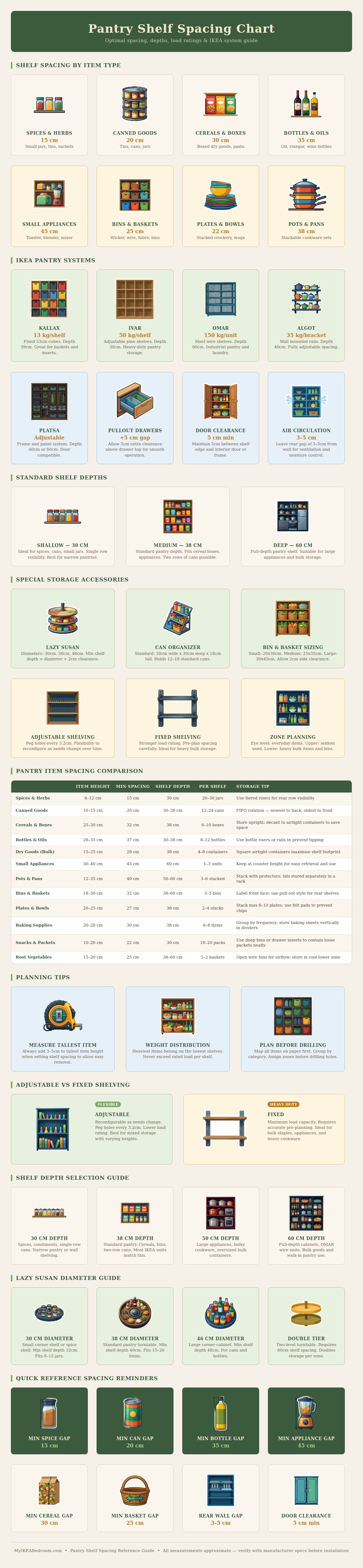
A pantry requires careful consideration of the organization of that pantry, as the organization of the pantry will affect how a person use the kitchen. For instance, if the shelves within the pantry are too close to each other, it will be difficult for the individual to reach the items that are stored in the back of the pantry; the height of those items is too close to the shelf above them. Additionally, if the shelves are too far apart from each other, the individual will lose some of the storage space within the pantry; the space between the shelves cannot be used to store other kitchen item.
Thus, an individual must consider these factors regarding the placement of the shelves within the pantry. One factor to consider is the measurement of the items that are within the pantry. For instance, an individual should measure the height of items like tall cereal boxes, the depth of items like deep stock pots, and the size of appliances that is within the pantry and that are used infrequently.
How to Organize Your Pantry Shelves
By measuring these items, the individual can determine how much extra space should be provided to allow for those items to be moved without contacting the shelf above the item. For instance, providing extra space will allow the individual to easily move the items within the pantry, and ensuring that there is extra space will prevent the items from continual knocking against the pantry shelves. The depth of the shelves is a second factor to consider.
One benefit of shelves that are of a shallow depth is that the individual can see all of the items within the pantry. For instance, shallow shelves are beneficial for storing spice or items that are contained within single rows of cans. Additionally, shallow shelves do not provide enough space for deep items.
Deeper shelves will allow for the storage of more items, but the items may become hidden from view on the back end of those deep shelves. Thus, if the person chooses deep shelves, bins may be required to provide visibility to the stored items. The depth of the shelves that they choose for the pantry will depend off the width of the pantry and which items are to be stored within it.
One of the factors to consider within the organization of the pantry is the weight of the items. Heavy items should be stored on the lower shelves within the pantry to prevent the shelves from sag under the weight of those items, as well as to allow the individual to easily move the items. Lighter items that are accessed more often can be stored on higher shelves within the pantry.
Additionally, there may be load rating for each shelf within a modular shelving system. However, not every centimeter of each shelf need to be filled with storage for items; this may cause weight distribution issue within the pantry. Additional accessories for the pantry include turntables and can dispenser.
The use of turntables allow for the storage of items within the corner of the pantry. However, the turntable requires additional clearance within that corner for the turntable to be able to rotate the items within it. Additionally, people use can dispensers within the medium depth of the pantry; can dispensers make it possible for the cans to be rotated without needing to reach behind the other items within the pantry.
The depth of the shelves within the pantry should be respected and not changed to accommodate these accessories for the shelves. An individual can choose between adjustable shelving and fixed shelving. Adjustable shelving allows the individual to change the layout of the pantry over time.
Fixed shelving is beneficial for the storage of heavy appliances within the pantry, but does not allow the individual to change the layout of the shelves. Many individual choose to incorporate both of these systems within their pantry. For instance, an individual may incorporate adjustable shelving into the middle shelves of the pantry, while the lower shelves is made of fixed shelving.
Air flow behind the shelves and the clearance of the pantry door are two additional factors that must be considered. For instance, an individual must leave a gap behind the shelves within the pantry; leaving a gap allows for the prevention of moisture buildup within the pantry. Additionally, the door to the pantry must have clearance to the front edge of the shelves; otherwise, the items within the pantry will not fit correctly.
These details ensure that the pantry will function as smooth as possible. Thus, an individual should create their pantry in a way that considers the items that they wish to store, and ensure that the pantry is organized in a way that allows for more maximum accessibility of the items and function as efficiently as possible.
