Paint Tint Calculator
Estimate how much tint concentrate to test and scale when moving a bedroom paint from one hex color toward another, with controls for base volume, tint strength, drops, opacity, sheen, test batch size, and adjustment step.
| Strength setting | Use when | Typical behavior | Calculator effect |
|---|---|---|---|
| 40% to 70% | Very strong universal colorant | Small changes show quickly | Reduces estimated ml |
| 80% to 110% | Normal tint concentrate | Good for bedroom wall colors | Baseline estimate |
| 120% to 150% | Weaker craft or sample tint | Needs more liquid to shift | Raises estimated ml |
| 160% to 180% | Low-load translucent tint | Better for gentle warming | Raises estimate sharply |
| Paint property | Lower setting | Higher setting | Mix note |
|---|---|---|---|
| Opacity factor | Transparent or thin paint | High-hide wall paint | Lower opacity needs more tint to show |
| Flat or matte | Absorbs light softly | Looks calmer when dry | Slightly lowers estimate |
| Satin | More reflected light | Color can read cleaner | Slightly raises estimate |
| Semi-gloss or gloss | Sharper highlights | Dark colors look deeper | Raises estimate and risk |
| Dropper rate | 1 ml | 0.25 ml step | Best use |
|---|---|---|---|
| 15 drops per ml | 15 drops | 4 drops | Thicker colorant |
| 20 drops per ml | 20 drops | 5 drops | Common lab dropper |
| 25 drops per ml | 25 drops | 6 drops | Thin liquid tint |
| 30 drops per ml | 30 drops | 8 drops | Very fine dispenser |
| Distance | Visual change | Suggested test size | Mix decision |
|---|---|---|---|
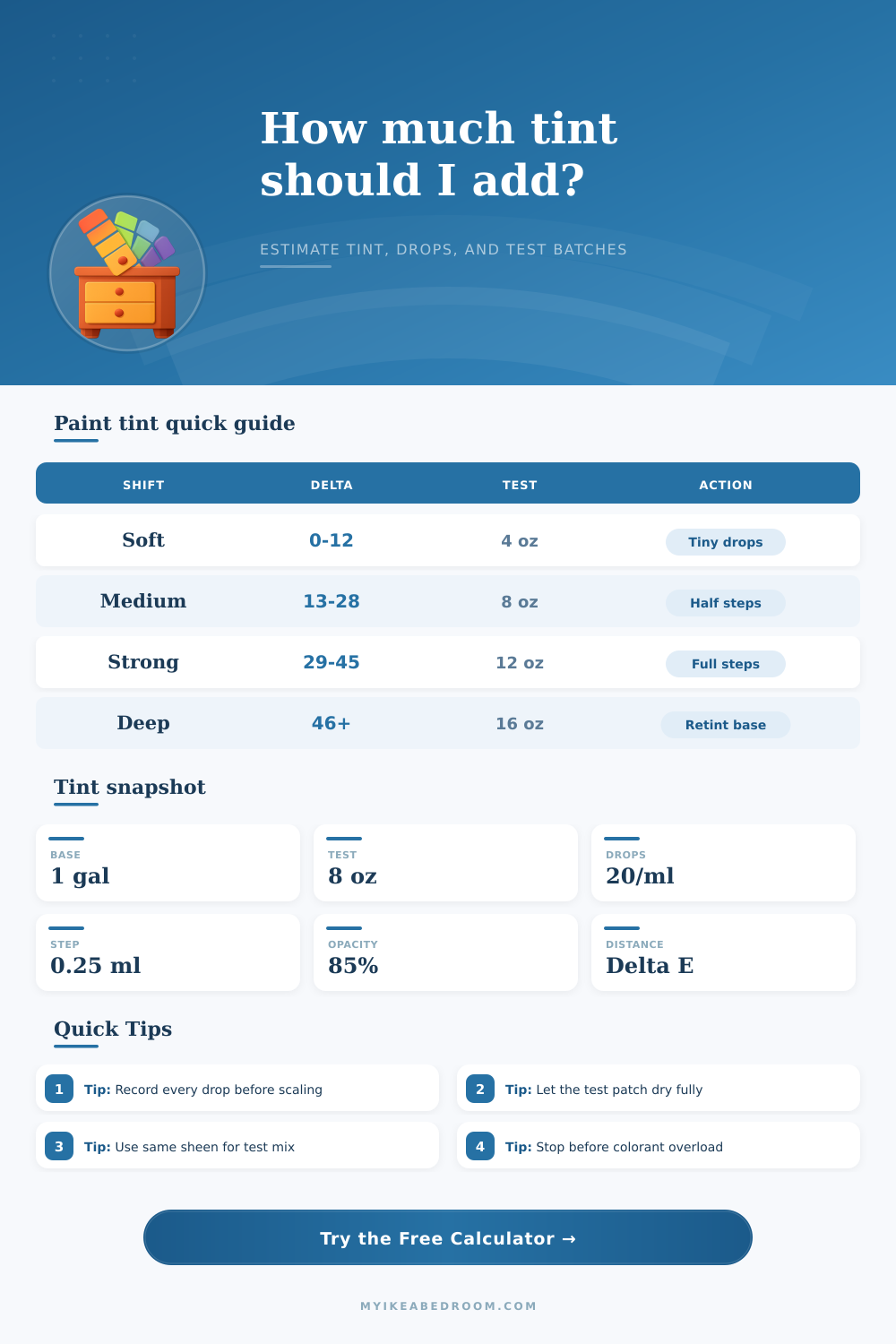
| 0 to 8 | Subtle warm or cool nudge | 2 to 4 oz | Use tiny adjustment steps |
| 9 to 22 | Noticeable bedroom tint shift | 4 to 8 oz | Scale after one dry patch |
| 23 to 42 | Strong accent color move | 8 to 12 oz | Use two staged test batches |
| 43 plus | Deep or chromatic change | 12 to 16 oz | Consider a different base |
When you attempt to change the color of paint, you must first understand that paint is a chemical suspension. The pigments that the paint contains determine the color of the paint. If the color of the paint that you have arent the color that you desire for your project, you may feel the need to add more pigment to the paint.
Adding more pigment to the paint, however, must be done careful; adding too much pigment to the paint can alter the chemical properties of the paint. Some pigments is more potent than others; a small amount of a highly potent pigment will change the color of the paint rapid, while you must add a larger amount of a less potent pigment to achieve the same change in the paints color. Professional grade universal colorants contain a high load of pigment relative to craft tints, which contain less pigment; the higher the pigment load within the paint, the more rapid the color of the paint will shift.
How to Change Paint Color Safely
To change the color of paint to an accurat desired color, it is first necessary for you to understand the distance between the color of the paint that you have to the color that you would like it to be. This distance between color is referred to as the “delta” of the paint; this value represent the extent of the change in the color of the paint that is necessary to achieve the desired color. Many believe the relationship between the amount of tint to be added to the paint and the change in the color of the paint is linear; however, this isnt always true of the two variables.
If the paint reaches a saturation point with the addition of pigment, adding more pigment than the paint can take will cause the paint to develop streak or to fail to dry proper. To avoid this potential problem, it is always best to create a test batch of the paint prior to adding the pigment to a full gallon of paint. Create a small sample of the paint in a cup to determine the color that it will take once dried, and apply it to a patch of the wall to visual inspect the color of the paint after it has dried.
It is important that you allow the paint to dry completely prior to visually inspecting it; wet paint will appear different than dry paint. The type of sheen that the paint has will also impact the way in which the color of the paint appear to the individuals that view the paint. Paint that has a flat or matte sheen will absorb the light that falls upon the paint, while paint that has a high gloss or semi-gloss sheen will reflect the light that falls upon the paint.
Due to the way that high gloss paint reflect light, you may have to add more tint to that paint than to a flat paint in order to achieve the same color depth from the flat paint. Additionally, the opacity of the paint will also impact the color of the paint. Paint that has a high opacity due to the amount of titanium white that the paint contains will resist the addition of the tint; you will have to add additional pigment to the paint to overcome the opacity of the paint’s base color.
Adding too much pigment, however, can create other problems with the paint. Paint that contains too much pigment may take longer to dry and may become tacky once dried. Additionally, the scrub resistance of the paint may be lost if too much pigment are added.
To determine the amount of paint tint that you should add to the paint in order to achieve the desired color, it is best to utilize a calculator. A calculator will allow you to avoid the guesswork of how much paint tint will be required to achieve the desired color when you scale that paint up to a gallon. To create the test batch of paint, it is first necessary to record the number of drops of paint tint that are added to the paint.
It is necessary to record the number of drops of paint tint to the project so that youll be able to repeat the paint mixing process for the gallon of paint. After the test batch determines the proper ratio of paint tint to paint, you can use that same ratio to mix the gallon of paint that will be used for your project. By treating the paint as a formula, you can be sure that the gallon of paint that is eventually applied to the project will contain the same color as that which you intended to create.