Paint Thinner Ratio Calculator
Measure thinner volume from paint volume and thinning percent, estimate final mixed volume, adjust for viscosity seconds, and convert the result across oz, ml, L, and gal.
🎨Coating and tool presets
⚙Ratio inputs
Your paint thinner ratio result
Calculation breakdown
📐Formula used
thinner volume = paint volume × thinner %
extra % = max(0, current sec - target sec) / 10 × adjustment rate
final volume = paint volume + thinner volume
🧮Quick ratio specs
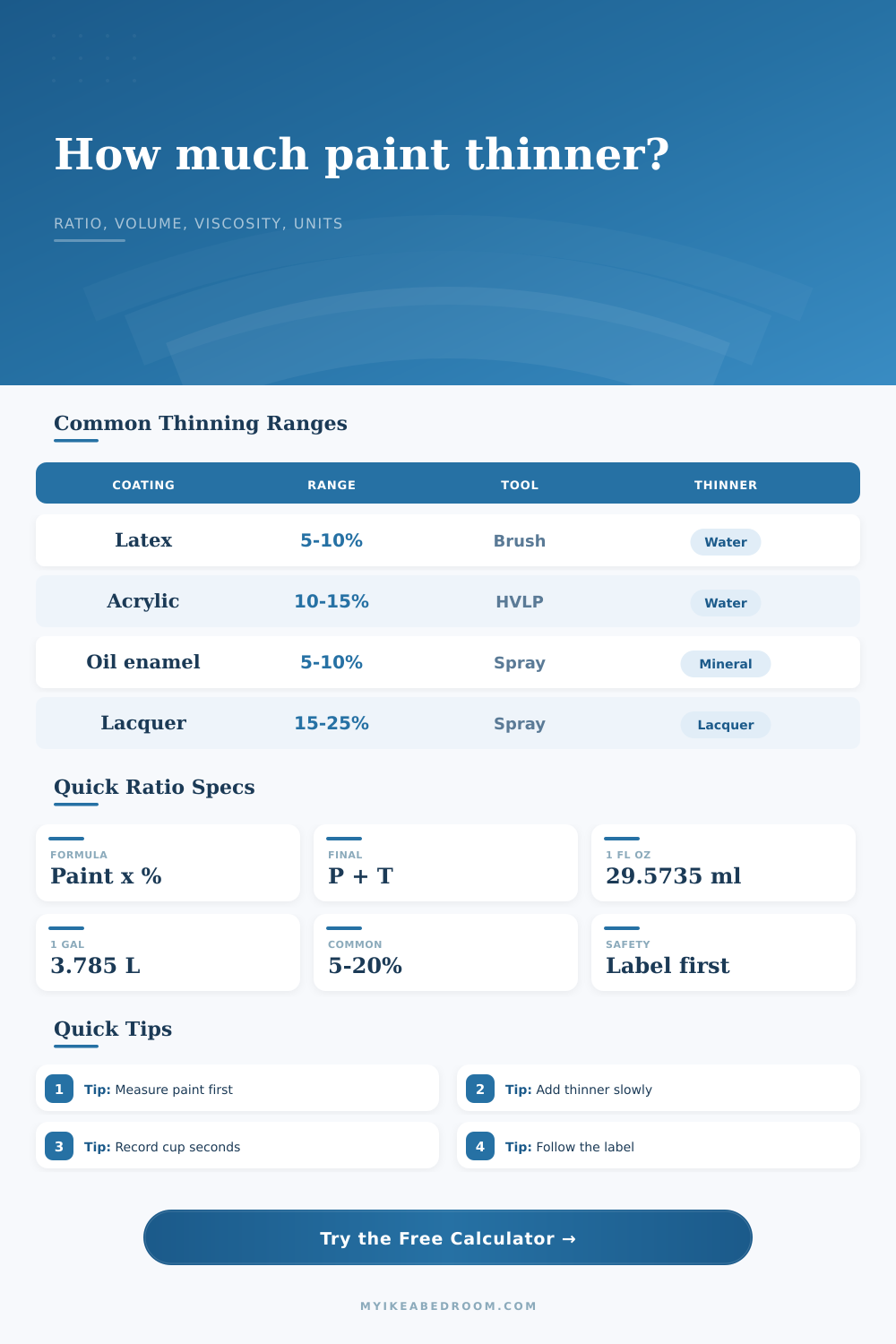
📊Common thinning ranges by coating and tool
| Coating and tool | Common planning range | Typical thinner family | Measurement note |
|---|---|---|---|
| Latex paint, brush | 0% to 5% | Water when label allows | Small addition, mainly for flow marks. |
| Latex paint, roller | 5% to 10% | Water when label allows | Measure tray batch before adding water. |
| Latex paint, airless spray | 5% to 10% | Water when label allows | Check sprayer manual and coating label. |
| Waterborne acrylic, HVLP | 10% to 15% | Water or label-specified reducer | Use viscosity cup seconds for fine adjustment. |
| Waterborne primer, brush | 0% to 8% | Water when label allows | Keep primer solids within label limits. |
| Waterborne primer, spray | 8% to 15% | Water or specified reducer | Filter after mixing if the label permits. |
| Oil enamel, brush | 0% to 5% | Mineral spirits or label thinner | Use a small test batch before the main volume. |
| Oil enamel, spray | 5% to 15% | Mineral spirits or specified reducer | Thin by measured ratio, then check flow. |
| Shellac primer, spray | 5% to 15% | Denatured alcohol when specified | Confirm alcohol type and maximum ratio on label. |
| Lacquer, spray | 15% to 25% | Lacquer thinner when specified | Small changes can move cup seconds quickly. |
📏Unit conversion reference
| Unit | Milliliters | US fluid ounces | Use in ratio math |
|---|---|---|---|
| 1 teaspoon | 4.9289 ml | 0.1667 fl oz | Very small test correction. |
| 1 tablespoon | 14.7868 ml | 0.5 fl oz | Small brush or cup adjustment. |
| 1 US fluid ounce | 29.5735 ml | 1 fl oz | Common measuring cup increment. |
| 1 US cup | 236.588 ml | 8 fl oz | Useful for quart-size batches. |
| 1 liter | 1000 ml | 33.814 fl oz | Metric paint and reducer batches. |
| 1 US gallon | 3785.41 ml | 128 fl oz | Full pail planning reference. |
🔢Thinner volume examples
| Paint volume | 5% thinner | 10% thinner | 15% thinner |
|---|---|---|---|
| 8 fl oz / 237 ml | 0.4 fl oz / 12 ml | 0.8 fl oz / 24 ml | 1.2 fl oz / 36 ml |
| 1 quart / 946 ml | 1.6 fl oz / 47 ml | 3.2 fl oz / 95 ml | 4.8 fl oz / 142 ml |
| 1 liter / 1000 ml | 50 ml / 1.7 fl oz | 100 ml / 3.4 fl oz | 150 ml / 5.1 fl oz |
| 1 gallon / 3.785 L | 6.4 fl oz / 189 ml | 12.8 fl oz / 379 ml | 19.2 fl oz / 568 ml |
| 2 gallons / 7.571 L | 12.8 fl oz / 379 ml | 25.6 fl oz / 757 ml | 38.4 fl oz / 1136 ml |
| 5 gallons / 18.927 L | 32 fl oz / 946 ml | 64 fl oz / 1.893 L | 96 fl oz / 2.839 L |
⏱Viscosity adjustment examples
| Current vs target | Adjustment rate | Extra thinner percent | What the calculator does |
|---|---|---|---|
| 32 sec current, 30 sec target | 2% per 10 sec | 0.4% | Adds 0.4% to the base percent. |
| 40 sec current, 30 sec target | 2% per 10 sec | 2.0% | Adds one full correction step. |
| 45 sec current, 25 sec target | 1.5% per 10 sec | 3.0% | Adds a larger slow-flow correction. |
| 28 sec current, 30 sec target | 2% per 10 sec | 0% | No extra thinner because current is not slow. |
| 0 sec current, 0 sec target | Any rate | 0% | Skips viscosity correction when not measured. |
💡Measurement tips
⚠Safety and label note
Take a quart of good quality enamel. Looks great in the can. Pour it into your sprayer cup. Immediately, you realize that it’s too thick. Instead of atomizing into a fine mist, the paint hang on like heavy globs.
This is where most painters freak out. They pull out their thinner, guess at what to use and go to town. A dash here, a splash there. Usually they end up with runny mess dripping down their trim. Or, they get a sagging thick coat that creates an orange peel texture.
How to Mix Paint Thinner Correctly
The ratio isn’t guesswork; it’s viscosity and volume. The paint thinner ratio calculator above run the numbers for you. It takes the anxiety out of getting it right and turns it into exact milliliter count. It’s basic math, but a bit backwards thinking.
When you need to thin something down ten percent, you know what you want to start with. Say you’re looking at a quart. To go from a quart to 90% of a quart, you simply add one-tenth of a quart. It is one tenth. Not add enough thinner to fill the cup. That’s where folks mess up. They look at an empty spot in the cup and figure they’re filling it up. No. You’re adding thinner to what’s already there. What you have to add is decided by how much is already in the cup.
The tool will take care of converting that for you. Your input is starting volume; its output is how much you’ll need to add.
Viscosity is both a science and an art. Paint labels provide ranges, however, none consider humidity or temperature. A paint that flow nicely on a warm day in the shop will be sluggish on a cool day in the garage. This is why the calculator has a field for viscosity adjustments. Use a standard flow cup and time in seconds how long it takes for the paint to drain out. If it’s slower then you want, the tool calculates the amount of additional thinner required to get it there. It doesn’t simply think of the thinner as a means to stretch the paint, but as a way to adjust its flow. You enter number of seconds and let the tool do the math.
The amount matters, but the type of thinner matter too. For lacquers: lacquer requires its own specific reducer. For acrylics and latex: water. For oil enamels: mineral spirits. If you use incorrect solvent, you can run into problems with drying too fast and even causing the paint to “curdle.” This is laid out by type of coating in the reference table on the page and shows typical ranges to plan for various techniques.
Spraying obviously needs lots; brushing usually doesn’t need any. Airless is in-between. The calculator offers a starting point, and you select the profile that corresponds to your tool. It’s a planning guide, not a substitute for reading the label first. There is often a maximum limit to how much you should of thin down. Check it. Then go mix.
There are also some of those other niggly unit conversions. You might have used ounces from your measuring cup, but paint is sold in gallons. Maybe the thinner was bottled up as metric? Attempting that in your head at a paint can with the lid off spells trouble; spillage! Behind the scenes the calculator converts all to milliliters and gives you the answer back in whatever units you like. And it’ll round to the next most sensible increment because nobody carries a pipette around for making up gallon mixtures. It stays useful for real world use in the workshop.
Stir well and add the thinner little by little. Test the flow. If it’s too thin, it can’t be fixed; if it’s a hair too thick, add some. The math calculator serve as a guide, but your eyes and the way the paint moves are the ultimate tests.
After awhile, once you get the hang of the ratio, there is no guessing. You will no longer stress out about whether you’ve thinned enough or not. Just concentrate on the finish instead of the dripping. Everything goes on evenly. Every coat covers the same. The job looks great.
Go back to basics. You apply a quality coat without the worry of “did I put in enough thinning?”.