Paint Pour Ratio Calculator
Estimate total pour volume from canvas area, coverage rate, paint-to-medium-to-water ratios, silicone drops, color splits, and ml or fluid ounce units.
▣Paint Pour Presets
Pick a starting point, then adjust the canvas, coverage, ratio, overage, color count, and split pattern.
⚙Pour Inputs
Imperial uses inches and fluid ounces. Metric uses centimeters for canvas dimensions, while calculations still show both ml and oz.
▦Mix Spec Cards
▤Paint Pour Ratio Table
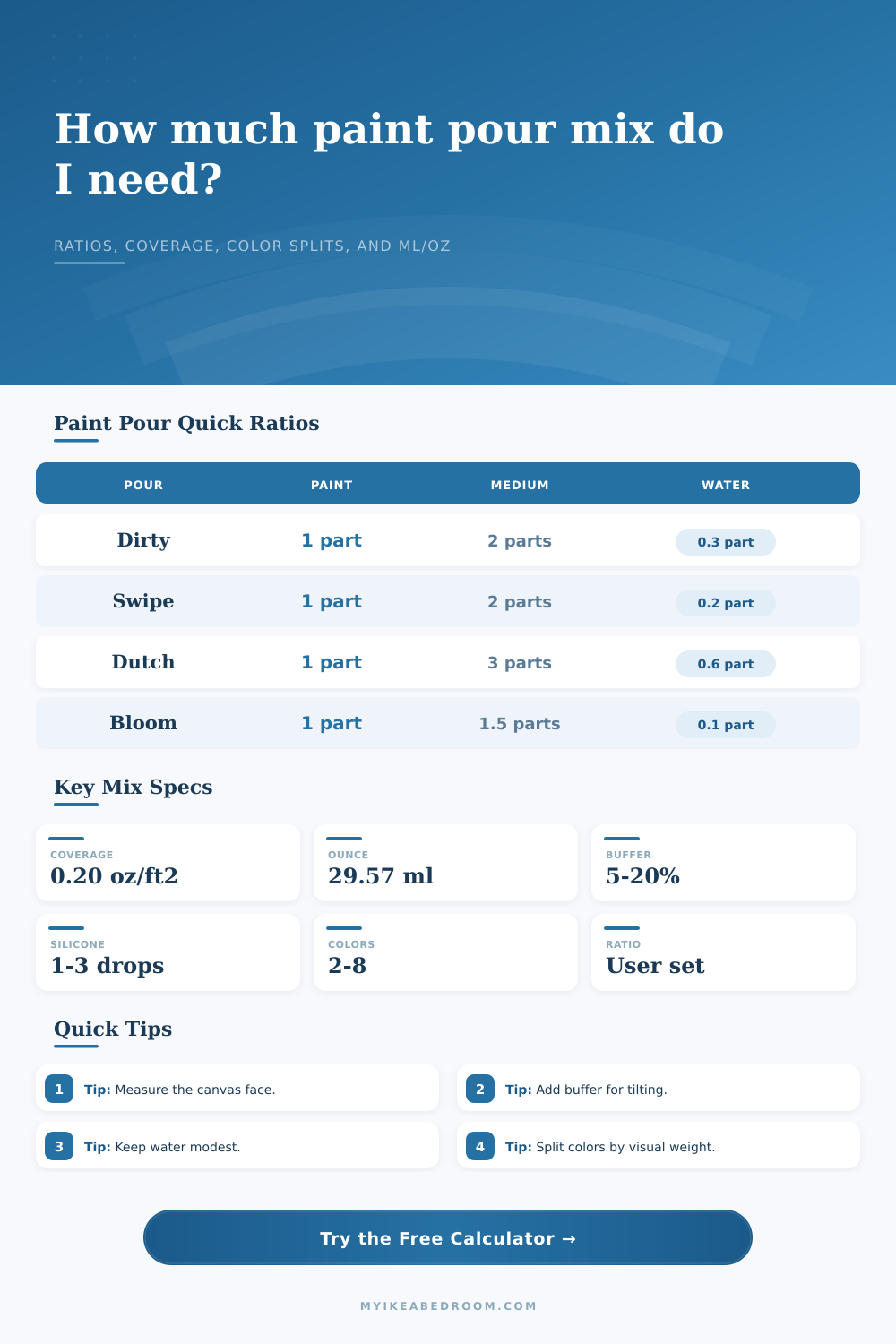
| Technique | Paint:Medium:Water | Coverage Start | Silicone Guide |
|---|---|---|---|
| Dirty pour | 1:2:0.3 | 2.5 oz/sq ft | 1 drop/oz |
| Swipe | 1:2:0.2 | 2.25 oz/sq ft | 0-1 drop/oz |
| Flip cup | 1:2.5:0.3 | 2.75 oz/sq ft | 1 drop/oz |
| Ring pour | 1:2:0.25 | 2.5 oz/sq ft | 0-0.5 drop/oz |
| Dutch pour | 1:3:0.6 | 3.0 oz/sq ft | 0 drops |
| Bloom base | 1:1.5:0.1 | 3.5 oz/sq ft | 1-2 drops/oz |
▥Canvas Area Coverage Table
| Canvas | Area | At 2.5 oz/sq ft | With 10% Buffer |
|---|---|---|---|
| 8 x 10 in | 0.56 sq ft | 1.4 oz / 41 ml | 1.5 oz / 46 ml |
| 12 x 12 in | 1.00 sq ft | 2.5 oz / 74 ml | 2.8 oz / 81 ml |
| 16 x 20 in | 2.22 sq ft | 5.6 oz / 164 ml | 6.1 oz / 181 ml |
| 18 x 24 in | 3.00 sq ft | 7.5 oz / 222 ml | 8.3 oz / 244 ml |
| 24 x 36 in | 6.00 sq ft | 15.0 oz / 444 ml | 16.5 oz / 488 ml |
▧Color Split Reference
| Split Pattern | Main Color | Middle Colors | Accent Colors |
|---|---|---|---|
| Even colors | Equal share | Equal share | Equal share |
| Base color 40% | 40% first color | Shared balance | Shared balance |
| Accent-heavy center | 25% first color | 55% shared | 20% shared |
| Negative space 50% | 50% first color | Shared 40% | Shared 10% |
▨Practical Mix Tips
Have you ever asked yourself if your amount of paint will be sufficient to cover that canvas? If so, then you’re not alone; this is one of the most frequently-asked questions among beginning pour painters. Use too little and you may find yourself with ugly dry spots. Use too much and you’ll be wasting precious pigment.
It all seems like an exercise in how liquids move, which sounds complicated. But when you break it down, it is very simple. When you understand how water mixes with medium and paint, you don’t have to guess anymore.
How to Mix Your Paint
Above is the calculator I used to determine how much I needed. Enter your canvas size and the method you will be using. Then it gives you an exact amount of what to mix up.
Knowing the number is one thing. But how do you know which numbers are correct? Why does it require that certain ratio? What purpose does the medium serve besides fill? Well, the medium holds the color and helps it move. Also, using the medium allows the pigment to flow without losing its color intensity. When mixed without medium, the paint will cure and dry hard, causing it to crack. Too much medium creates a muddy result where the color bleed into each other. Too little, not enough movement. So there’s a balance between pigment concentration and movement.
The mixture change with water. Water thins the paint, which help to pour it. But it also weakens the binding power of the acrylic. If you add too much water, then the paint doesn’t adhere to the canvas. Only a little bit of water is needed in most techniques. See the table below for how much is right for each style (e.g., swipes; dirty pours).
For Dutch pour, there’s more room. Here’s why: Air moves the paint around during this technique. So a thinner paint does just fine for this approach. Match your mix to how your method works.
The silicone color alters how the art finishes. Silicone will cause some lacing effects and create cells. Each brand of paint will have its own reaction to silicone. Some absorb it, some repel it. If you want clean, sharp lines, leave the silicone out entirely. Some pigments absorbs silicone and others repel it.
How much silicone do I add? Don’t worry about measuring drops of silicone. One drop per ounce of total volume is a good starting point. If you like large cells, add more; if you want sharper lines, omit silicone entirely. The tool calculates it for you. Your eye determines the outcome.
There’s an art and a science to color splitting. How much do I want? Well, maybe I’m going for a dozen ounces of this mixture. So then how do I divvy up the amount between my colors? Evenly is easy enough, but it is generally boring.
Heavy on the base side: Grounding tones prevail. One color might claim forty percent of the volume. The other pops off as accents. Imagine your color palette as a chord. It needs a root note to anchor it. Without a dominant color, the picture becomes scattered.
Add a cushion to your total volume. Spillage, plus coverage at the edges = 10-20% more. Paint loses volume as it spreads. A dry edge kills the effect. Better to buy too much than to little and end up short of border.
Know how big your canvas is and then choose your method. Let the tools do the math for you. Once you begin pouring, go with the flow, trust yourself. The math is the beginning. The rest is freedom.