Packing Paper Quantity Calculator
Estimate 24x36 inch packing paper sheets for box void fill, dishes, glasses, fragile decor, and a practical handling buffer.
Estimated packing paper quantity
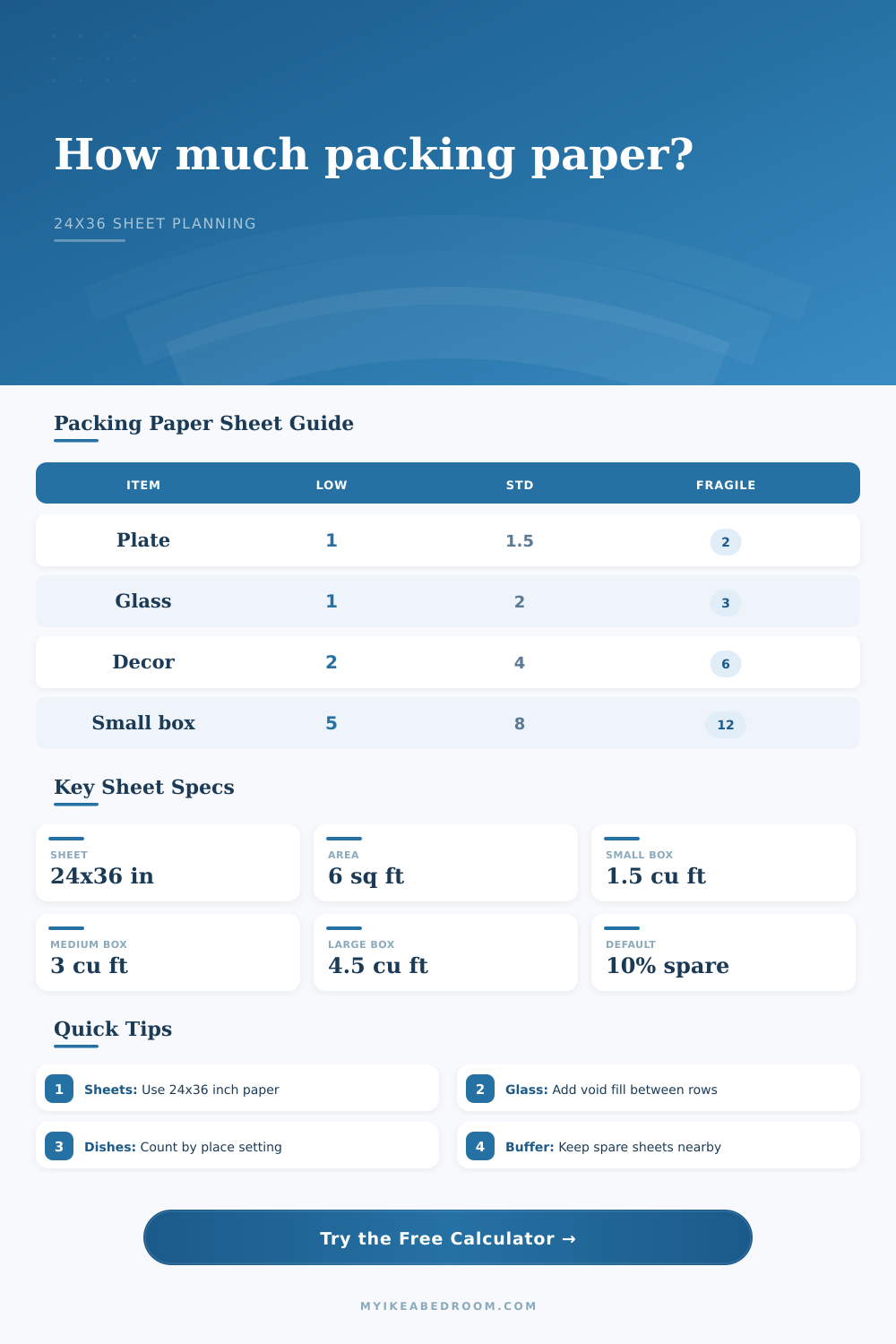
Calculations use common 24x36 inch packing paper sheets. One sheet is 864 square inches, 6 square feet, or about 0.557 square meters.
| Item type | Typical sheet count | Calculator base | How it is counted |
|---|---|---|---|
| Dinner plate | 1 to 2 sheets | Part of 7 sheets per place setting | Wrap plate face, fold over rim, stand plates vertically |
| Side plate or saucer | 1 sheet | Part of 7 sheets per place setting | Use one sheet between finished surfaces |
| Bowl or mug | 1 to 2 sheets | Part of 7 sheets per place setting | One sheet around the item plus a small inner tuck |
| Tumbler or jar | 1 to 2 sheets | 2 sheets per glassware piece | Roll diagonally, fold the ends, and add row fill |
| Stemware | 2 to 3 sheets | 2 sheets before style factor | Wrap stem first, then bowl, then add divider paper |
| Small decor piece | 3 to 4 sheets | 4 sheets per fragile piece | Wrap protruding corners and add outer padding |
| Lamp shade or frame | 4 to 6 sheets | 4 sheets before style factor | Use broad sheets to protect faces and corners |
| Box size | Typical volume | Balanced base sheets | Crumple fill guide |
|---|---|---|---|
| Small moving box | About 1.5 cu ft | 8 sheets | Bottom pad, top pad, and a few side gaps |
| Medium moving box | About 3.0 cu ft | 16 sheets | Bottom, top, row dividers, and corner voids |
| Large moving box | About 4.5 cu ft | 24 sheets | Large top voids and loose bulky item cushioning |
| Light fill factor | Tight pack | 0.65x base | Best when boxes are full and items are sturdy |
| Balanced fill factor | Normal pack | 1.00x base | Default for mixed household boxes |
| Fragile fill factor | Layered pack | 1.35x base | Use between rows of glass, dishes, and decor |
| Dense fill factor | Loose pack | 1.70x base | Use for odd shapes, top gaps, and soft crush zones |
| Sheet group | Flat paper area | Metric area | Planning use |
|---|---|---|---|
| 1 sheet | 6 sq ft | 0.557 sq m | One plate, one tumbler, or part of a pad |
| 25 sheets | 150 sq ft | 13.94 sq m | Small shelf of dishes or one fragile box layer |
| 100 sheets | 600 sq ft | 55.74 sq m | Common small bundle for one room or kitchen add-on |
| 250 sheets | 1,500 sq ft | 139.35 sq m | Multi-room packing with glassware and decor |
| 500 sheets | 3,000 sq ft | 278.71 sq m | Whole-home packing or repeated staging bins |
| Scenario | Boxes | Items counted | Likely paper range |
|---|---|---|---|
| Bedroom basics | 3 small, 4 medium, 1 large | Light decor and a few frames | 100 to 175 sheets |
| One-bedroom kitchen mix | 4 small, 6 medium, 2 large | 4 settings, 16 glasses, 8 fragile pieces | 225 to 325 sheets |
| Glassware-heavy bar cart | 2 small, 4 medium, 1 large | 36 glasses and stemware pieces | 175 to 275 sheets |
| Family kitchen pack | 6 small, 10 medium, 3 large | 8 settings, 32 glasses, 14 fragile pieces | 475 to 675 sheets |
| Whole-home staging bins | 8 small, 12 medium, 6 large | Mixed decor, lamps, frames, and tableware | 650 to 900 sheets |
An open cardboard box is like panic. It’s empty, but it stands as a sign of your anxiety. Of course you need something to fill the void. Of course you don’t want to get dishes broken!
But then again, how much paper should you purchase? Chances are most will gets it wrong. They either purchase too much paper for their tiny apartment or too little so that they have to brave bad weather once more. There must be a middle ground. Don’t buy too much because you don’t want extra waste. But don’t buy too little either, since the vase need protection.
How to Use the Packing Paper Calculator
I mean how does it work? Well the calculator above does the math. You don’t have to guess because you enter your item list or box count. Then the tool splits up the job into two bucket. First is the item bucket, which includes wrapping individual items such as plates. And then there’s the void fill bucket (for each box).
This require two different approaches. One approach is creating a protective layer (as with a plate being wrapped). Another approach is creating a shock absorber (as with void filling a box). The tool figures out both amounts. Plus it builds in a buffer for human error (when you’re tired, mistakes will be made).
Think about kitchen geometry: There’s plenty of exposed surface on one place setting. The calculator estimate seven sheets required for every standard setting. That includes the mug, bowl, side plate and dinner plate. That sounds like a lot by gift-wrapping standards. But a place setting isn’t a gift; it’s a descent down a ramp.
To prevent broken dishes, you need layers. You can customize layer count with wrap style. For heavy, stable stoneware, a snug fit may do the job. For delicate antiques, go double-wrap. Or even a fragile. Safety and cost is at stake here. Every additional sheet add money; every lost sheet subtracts protection.
Most of us gets it wrong here. We think we can stuff a big box. Sure it’s full, but what about those gaps? And then there’s that pesky air. Moving boxes with air is a problem. As your truck brakes, things move within the box. And when things move, they bang into other things.
This crumple fill factor is built in the calculator. It knows if I have a little box, it won’t need as many sheets as a big box. But the difference between these two grow very quickly. Yes, a big box has more volume. But it also has more empty space. There’s a lot of surface area. The calculator accounts for your packing style here. How tightly did you pack them? Did you leave some air between stuff? Then the sheet number go up.
Paper isn’t just a wrapper (it’s a structural element too). As mentioned above, there’s a table on the page that shows what to expect in terms of number of sheets depending off its fragility. It should be taken as an illustrative guide rather than a hard-and-fast rule. In the end, it comes down to your own patience. Folding paper over and over again can get repetitive. You might find yourself getting irritated. You might start to get cramps in your hand.
Here’s where the buffer can assist. The buffer essentially gives you about ten percent extra. This accounts for mistakes, tears, and missing sheets. It’s an insurance policy against the realities of packing.
And don’t be cheap with the little boxes. Because even though they look harmless, the boxes will carry heavy stuff like books which form sharp corners. And unless they’re padded, your other stuff will get sliced by those corners. Each box size gets a minimum number of sheets assigned to it by the tool. If you know that you’re packing lightly, you can adjust the fill level to whatever you want. Otherwise go with fragile setting or the balanced one just in case. Better to have too many sheets than to discover cracks on a teacup.
It is logistics disguised as chaos. Paper performs the physical labor. It protects the objects. Count correctly. Secure tightly. Pad the spaces. Seal the box. The space is occupied. The panic has passed. Move on to Box #2.