Patio furniture and rug fit planner
Outdoor Rug Size for Patio Calculator
Size an outdoor rug around patio dimensions, furniture group footprint, dining chair pullback, border clearance, table size, seating count, and door swing zones.
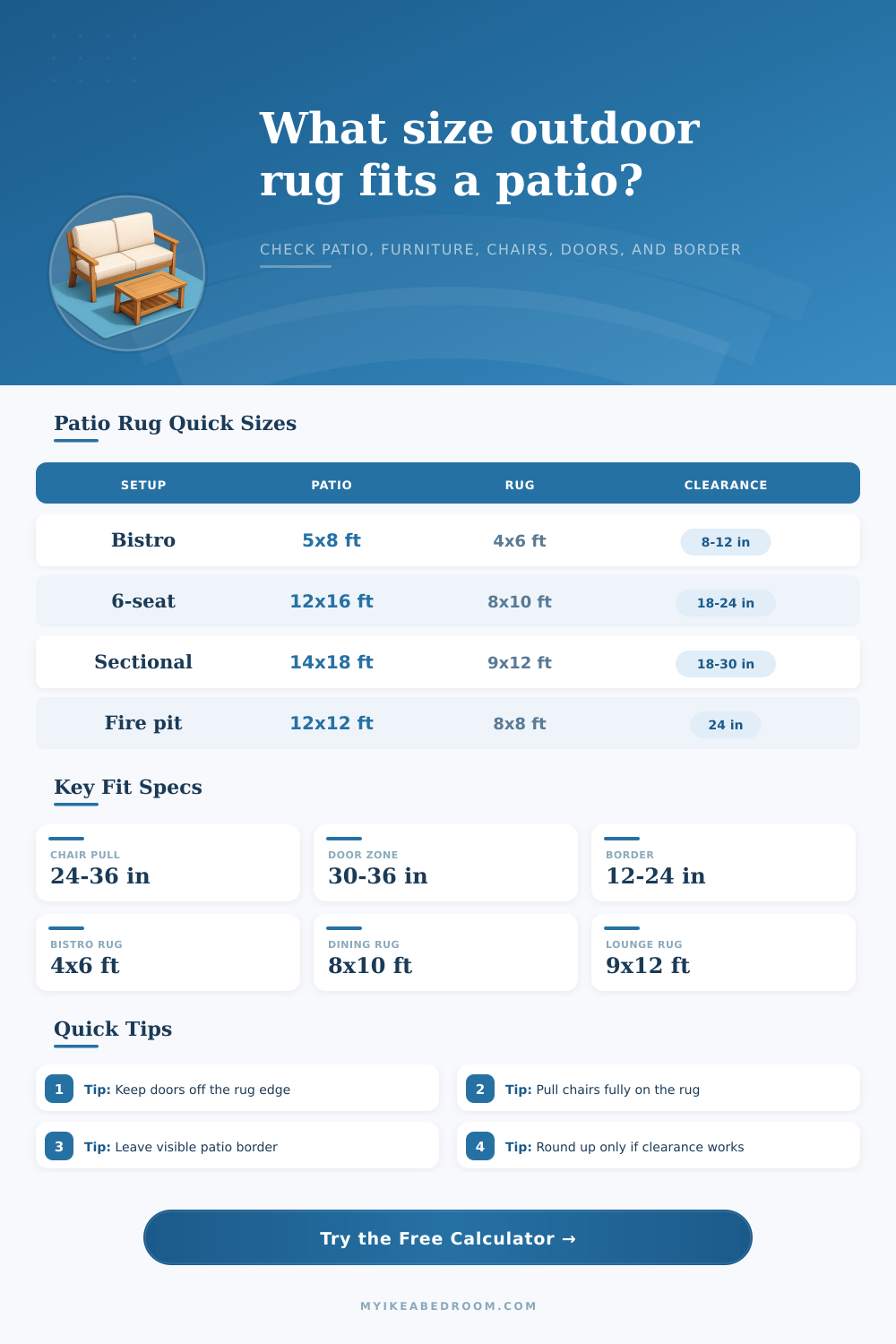
| Patio setup | Typical furniture group | Starting rug size | What to verify |
|---|---|---|---|
| Balcony bistro | 30 to 36 in table with two chairs | 4 x 6 ft or 5 x 7 ft | Door swing and railing border before rounding up. |
| Four-seat dining | 48 to 60 in table plus chair pull | 6 x 9 ft or 8 x 10 ft | Chairs should remain on rug when pulled out. |
| Six-seat dining | 72 in table with chairs on long sides and ends | 8 x 10 ft or 9 x 12 ft | Allow 30 in pullback behind each chair side. |
| Sectional lounge | L-shaped sofa and coffee table | 8 x 10 ft or 9 x 12 ft | Front legs should overlap at least 12 to 18 in. |
| Fire pit chairs | Four to six chairs around center | Round 8 ft or square 8 x 8 ft | Keep fire pit edge and chair movement centered. |
| Formula item | Calculator formula | Why it matters | Common target |
|---|---|---|---|
| Recommended length | max(group length + overlap, table length + pullback) | Captures both lounge anchoring and dining chair motion. | Round up to nearest standard size. |
| Recommended width | max(group width + overlap, table width + pullback) | Prevents chairs from dropping off side rug edges. | Full table plus chairs on rug. |
| Border clearance | (patio dimension - rug dimension - door zone) / 2 | Checks the visible patio edge and door swing route. | 12 to 24 in exposed edge. |
| Area coverage | rug area / patio area | Shows whether the rug overwhelms the patio surface. | About 25% to 55% for many patios. |
| Fit score | chair score + border score + door score + area score | Turns several clearance checks into one planning signal. | 80 plus is strong. |
| Chair pullback | Use case | Rug effect | Planning note |
|---|---|---|---|
| 18 to 24 in | Bistro or compact balcony | Smaller rug, tighter chair movement | Works best for light chairs and short meals. |
| 24 to 30 in | Everyday four-seat dining | Balanced size for most patio tables | Good default when space is limited. |
| 30 to 36 in | Six-seat dining and armchairs | Larger rug keeps chair legs on the weave | Use for guests pushing chairs fully back. |
| 36 in plus | Deep lounge chairs or benches | May require a custom or oversized rug | Check door clearance before choosing larger. |
| Material type | Chair movement | Best patio role | Clearance note |
|---|---|---|---|
| Polypropylene flatweave | Smooth | Dining, balcony, uncovered patios | Can use slightly tighter chair pullback. |
| Recycled PET weave | Moderate | Dining and lounge areas | Use normal 24 to 36 in pullback. |
| Synthetic jute texture | More drag | Covered lounge patios | Add a few inches for chair legs. |
| Cushioned outdoor pile | Highest drag | Sofas, sectionals, barefoot seating | Better for lounge than dining chairs. |
| Rubber-backed patio mat | Stable | Porch and entry-adjacent zones | Check door sweep and edge thickness. |
Most people make one mistake with their patios: they use a rug that makes space feel unstable and small. A perfect looking piece of furnitures may have been chosen, but if the rug is too small, the area feels cramped. But this isn’t a matter of taste. It’s a matter of geometry and human movement in the space.
There has to be room for chairs to be pulled out for dinner or pushed back when having a conversation. To do that, all you need to do is input your patio’s size and footprint of each piece of furniture in the calculator above. That’s because most people estimate based solely on the table dimensions, but rarely take into account the space required by a dining chair when it’s pulled out full length from the table edge.
How to Pick the Right Size for Your Patio Rug
When you’re at dinner with friends and chairs has their feet dangling over the end of carpet, you feel as if something isn’t quite right. You want to be anchored on the rug even with your chair pushed all the way back. Typically, it’s about two to three feet (twenty-four to thirty-six inches) between the table edge and where the chair sit. That’s called the pullback. The calculator takes that into account.
You might think “Hey, it’s just a rug… how different could it be?” The answer: it matters, because the material make a difference. On a plush pile or a cushy synthetic jute rug, your chair legs create friction as they moves across the surface. You’ll require more room to navigate. On a super-slippery, thin polypropylene flatweave, you can gets away with a little closer contact and the chair will glide along. The math takes all of that into account. If you choose a material with a higher pile, it will nudge the recommended area up accordingly. It’s not much, just enough to ensure you’re not pulling heavy wicker chairs through a bunch of rough fibers each time somebody needs to sit down.
Sliders and doors add limitations. An outdoor rug might look like right size for your furniture, but it is not a good fit if it covers a sliding glass door opening or creates a trip hazard at the threshold. You will need to enter information about any door swing zones in the tool. This leaves enough room on one side of your patio for people to walk naturaly without stepping on edge of the rug. It also avoids potential trip hazards at high-traffic areas of entry and keeps the rug lying flat. Additionally, this leaves a visible band of stone or pavers surrounding the rug to frame furniture layout as opposed to allowing it to run off into the edges of the space.
And what about that coverage percentage? It makes a bigger difference then you think. Typically, the rug should cover between one-quarter and half of patio space. Less than that, and the furniture will feel isolated on concrete; too much, and it will make the outside room feel confined and disconnected from the yard or garden beyond.
That’s why the tool offers a fit score, a combination of these factors that can be used as an indicator for determining if your selected size seems comfortabley or cramped. It is not so much about making everything fit. It also shows how empty space around it will affect the final feeling of comfort. Ultimately, the size of an outdoor rug depends as much on creating a space where people want to hang out as it does on how much ground it covers. By laying down that visual framework, you’re pulling together different elements of furnitures into one seating area. If chairs sits on top of the weave, doors open freely and edges look intentional, then it’s working. The room begins to feel like a room without any walls, rather than just a bunch of stuff.