Outdoor Lighting Layout Calculator
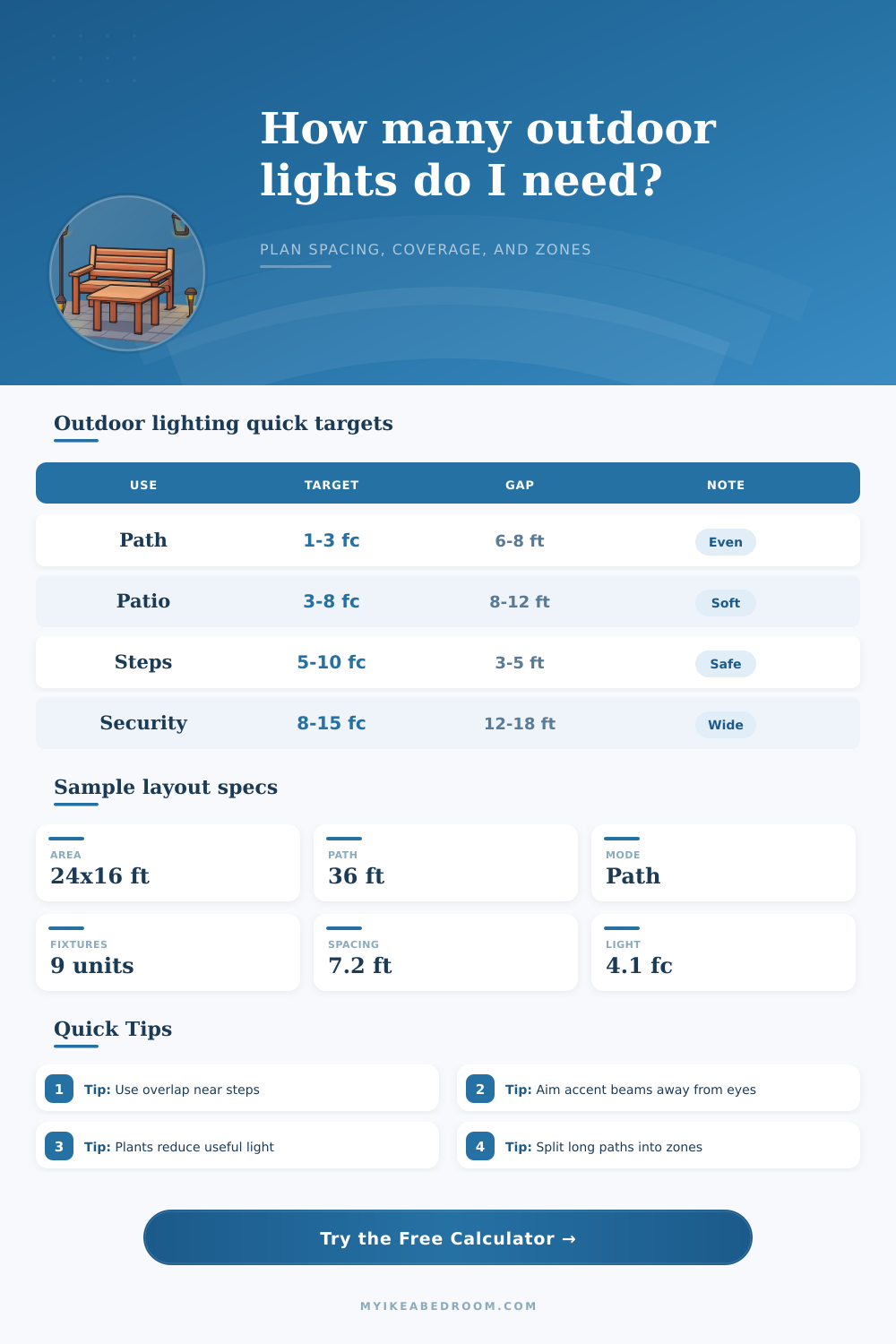
Plan path, patio, deck, driveway, landscape, and security lighting from area size, path length, fixture lumens, beam spread, mounting height, spacing factor, overlap, obstructions, and zones.
Load a starting outdoor scene, then adjust beam spread, mounting height, overlap, landscape obstruction, and zone count for your actual layout.
Path rhythm: Long straight paths usually feel calmer when fixtures are staggered across the walkway instead of mirrored directly opposite each other at every point.
Landscape loss: Shrubs, railings, planters, furniture, and dark mulch absorb useful light. Lower the obstruction factor when plants sit between the fixture and walking surface.
When planning outdoor lighting, there are many different variable to consider. Many people will purchase outdoor lighting fixture based on a feeling. However, a feeling isnt the best way to install outdoor lighting.
If a person dont make a plan to install the outdoor lighting fixtures, they may end up with bright spots in some area and dark spots in other areas. Outdoor lighting is a physical resource, and as the light travel away from the source, it loses it’s strength. The strength of the light bulb in the outdoor fixtures need to be balanced with the distance that the light will have to travel to the ground.
How to Plan Your Outdoor Lights
The mounting height for outdoor fixtures is a variable that must be consider. For instance, if the outdoor light fixtures is mounted at two feet off the ground, the fixtures will create a small amount of light. However, if the outdoor light fixtures are mounted at six feet off the ground, the light will spread over a more larger area, but the strength of the light will be lessened because it is more spread out.
The purpose of an outdoor area will also play a role in the amount of light that is required for that specific area. For instance, walkways will require a low amount of light so that individuals do not trip on the walkway. Patios may require more light to allow individuals to read menus or pour drink.
Foot-candles is used to measure the amount of light that lands on a specific square foot of the area that is to be lighted. The beam spread of the outdoor light fixtures will determine the spread of the light. Outdoor light fixtures with a narrow beam spread will shine a spotlight on a specific area.
However, narrow beam are not the best choice for outdoor path lighting because there will be bright spots and dark spots under the path with narrow beams. The outdoor light fixtures should have an overlap in the lights that they emit. Another factor to consider when installing outdoor lighting is the landscape.
For instance, area with dark mulch will absorb the light and appear darker than areas with lighter mulch. Similarly, areas with pale concrete will reflect the light and appear brighter than areas with darker surface for the outdoor landscape. If an area has many plant that will block the light from the outdoor light fixtures, the light fixtures will need to be place closer together.
Grouping the outdoor light fixtures into zones will allow for the outdoor lighting to be controlled. For instance, groupings will allow individuals to control security light and decorative lights on separate switches. This will allow individuals to turn off the security lights when they are not needed and save money on electricity bill.
Another factor to consider when installing outdoor lighting is glare. Glare occur when the light fixture is aimed into the eyes of an individual who is viewing the fixture. You can avoid glare by using shielded fixture.
Shielded fixtures will direct the light downward towards the ground. Using shielded fixtures eliminates the chance of the light going into the air with an open lens fixture. Using a calculator will help an individual determine the exact number of outdoor light fixtures that they will need to purchase for there property.
A light fixture calculator will remove the guesswork involved in purchasing outdoor lights. Outdoor light fixture calculators can help an individual decide how close or how far apart the outdoor fixtures will be spaced. Finally, another factor to consider when installing outdoor lights is their physical placement.
For instance, it is common for individuals to place light fixtures on the opposite side of an outdoor path to mimic how humans naturaly see light; it is more natural for the lights to be on the opposite sides of the path than it is for the lights to be evenly spaced in a straight line. By following a plan that takes time to calculate and plan for each outdoor lighting installation, an individual can have a lighting design that is both functional and safe for the area that is to be lighted. They should of thought about the lights spacing more carefully.
The light fixtures is important to place based off the path. It would of been better to use a moddern calculator.