Outdoor cushion foam planner
Outdoor Cushion Foam Calculator
Estimate foam volume, sheet count, foam weight, cushion compression, drainage score, wrap build-up, seam allowance, and cover cut dimensions for patio chairs, benches, chaises, sectionals, ottomans, and balcony seating.
Compression uses a 180 lb seated design load per cushion and a practical ILD proxy for each foam type. Adjust the target to compare soft, balanced, and firm outdoor seating.
| Foam type | Typical density | Drainage behavior | Compression feel |
|---|---|---|---|
| Dry-fast outdoor foam | 1.6 to 2.0 lb/ft3 | Very open; drains through quickly | Medium support for exposed cushions |
| Reticulated open-cell foam | 1.4 to 1.8 lb/ft3 | Highest airflow and fastest drying | Softer lounge feel unless thickened |
| Marine drainage foam | 1.8 to 2.2 lb/ft3 | Open structure with firmer support | Balanced for boats and patios |
| Firm upholstery foam | 2.4 to 2.8 lb/ft3 | Slower drying unless protected | Firm, durable, covered seating |
| Closed-cell foam | 1.8 to 2.2 lb/ft3 | Repels water but traps surface moisture | Very firm, limited cushion give |
| Common cushion | Finished foam size | Suggested foam | Typical wrap |
|---|---|---|---|
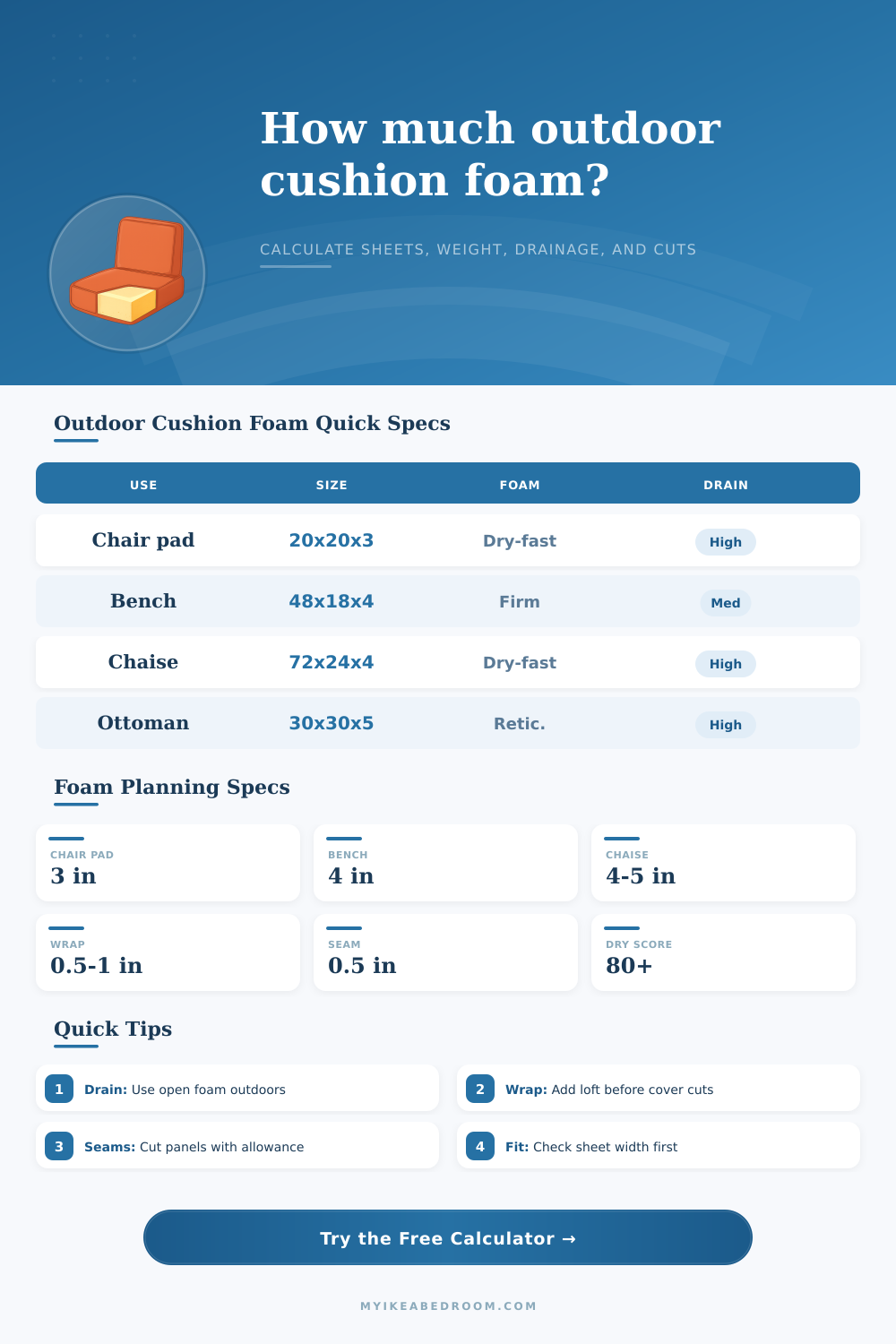
| Patio chair pad | 18 to 22 in square x 2 to 3 in | Dry-fast or marine foam | 0.25 to 0.5 in |
| Outdoor bench | 42 to 60 in wide x 3 to 4 in | Firm or marine foam | 0.5 in |
| Chaise lounge | 70 to 76 in long x 4 to 5 in | Dry-fast or reticulated foam | 0.5 to 1 in |
| Sectional seat | 24 to 30 in deep x 4 to 6 in | Marine or medium HR foam | 0.5 to 1 in |
| Outdoor ottoman | 24 to 36 in square x 4 to 6 in | Firm or medium HR foam | 0.5 in |
| Sheet size | Sheet area | Good fit example | Layout note |
|---|---|---|---|
| 24 x 72 in | 12.0 ft2 | One chaise strip or three small pads | Check cushion width before ordering |
| 30 x 72 in | 15.0 ft2 | Deep chair cushions and narrow bench pads | Useful for 24 to 28 in deep seats |
| 36 x 72 in | 18.0 ft2 | Bench cushions and ottoman blocks | Often easier for square layouts |
| 48 x 72 in | 24.0 ft2 | Sectional seats, chaise pads, large benches | Most flexible common upholstery sheet |
| 60 x 80 in | 33.3 ft2 | Multiple lounge cushions from one sheet | Best when several pieces share thickness |
| Cover cut part | Calculator formula | What it includes | Use in sewing plan |
|---|---|---|---|
| Top panel | Width + 2 wrap + 2 seam | Foam face, loft, seam allowance | Cut two if cover has separate top and bottom |
| Bottom panel | Depth + 2 wrap + 2 seam | Same allowances as top panel | Match to top unless adding zipper flap |
| Boxing width | Thickness + 2 wrap + 2 seam | Cushion side height and seams | Use for side strip height |
| Boxing length | 2 x width + 2 x depth + overlap | Perimeter plus closing allowance | Piece strips if fabric width is short |
| Total cover area | Panel area + boxing area | One cushion multiplied by count | Use as a cut-area estimate, not a yardage layout |
If you measure your chair frame with a tape measure, order a block of foam to fit it, and sew the cover to that same size, you might expect it to simply slip right on. However, the fabric will bind at the corners and seams will strain from the tension. Why? The vast majority of us are forgetting that we aren’t making a cushion out of foam alone. There’s always a layer of fiber wrap or batting surrounding core to give body and softness to the edges. Plus, there has to be seam allowance for actual sewing! These hidden inches can realy add up.
Remember, you have to cut the cover to match finished assembly, not just the raw dimensions of foam. After plugging in what frame size you’re using and how much loft you desire, the calculator does the rest of math for you. It figures out the volume required; do you only need one standard sheet? Or is this something you’ll be ordering more of? This is important because foam is bulky and a huge waste to toss! It’s also not cheap.
Why Measuring Foam Alone Is Not Enough
The other cool thing it does is translate your comfort preference into physical terms. What do you mean when you say “I want my chair to be comfortable?” Well, do you want something supportive? If you do, then you want a certain compression target and a higher density foam. You have the ability to change that variable around (how firm you want the item to be) on the fly so you get an idea how denser foam affects overall feel and weight of product before purchasing anything.
If you’re making a choice outside, consider how your foam will react when wet. In general, indoor upholstery absorbs water and holds it against fabric. Moisture gets trapped inside the foam core where mold or mildew can grow. Outdoor specific foams has an open cell structure that allows water to pass through rapidly different than absorbing into foam. On the page, there’s a comparison chart showing drainage rates between materials.
For seats on your patio that get left in elements, use dry fast foam which combines good support with quick drying time. If time is critical (i.e., around a pool), go for a net-like option which will allow air flow for the quickest possible drying time. If your furnitures isn’t going to be exposed to weather, firm upholstery foam may suit your needs. However, this foam will dry slowly if it are left out in elements.
But that weight also makes you think about practical use. Yes, heavy chaise cushion will be comfy when sitting there, but hard to grab out and wash the cover several times a year. If you plan to remove cushions often, keeping the density fairly medium realy makes a big difference day to day. The calculator gives you an idea of what the whole thing weigh (in terms of mass) from its size and density, so you have a good feel for how much lifting will be required.
If the density isn’t too low, you can still get away with lighter overall weight while sacrificing a bit of durability, as long as the drainage is high enough to avoid rotting. Many projects go south at the point of sewing the cover together, as their pattern fails to consider how thick the build-up will be inside the wrap. Half an inch extra on each side doesn’t sound like much, but that’s two whole inches added onto the depth and width you need to cut out for the fabric.
To avoid getting a too-tight-around-the-zipper cover, or worse, having to re-cut it all to fit what’s actualy going in there, I’ve included a dedicated field in the calculator just for wrap thickness. This way, you can make sure you’re cutting out enough fabric to cover the thing you want to put it on. I’ve also accounted for seam allowances so you don’t have to tweak anything at the last second. Planning out those measurements beforehand saves you from any hair-tearing frustration later.
So what makes good outdoor cushions? The answer lies in thinking about the entire system, including the foam block, as opposed to just that part. Outdoor cushions are really a three part assembly: the core support, the softening layer and the protective shell. The proportions matter. If you get it wrong then the furnitures will feel uncomfortable to sit on, won’t look inviting, and might fall apart in the next summer storm.
When you’re standing in the store aisle staring at the foam it’s easy to only think about how thick it should of be. Save yourself some headaches down the road by remembering the additional inches needed for seaming and wrapping. Your frame size comes from your tape measure. Your finished product comes from doing the math.