Ottoman Size for Sectional Calculator
Balance footprint, height, and walkway clearance for a sectional ottoman that feels intentional in the room and still leaves enough space to move.
📋 Real-World Presets
Pick a room style to load a practical sectional and ottoman setup. Each preset uses a different use case, shape, and space allowance so the calculator stays specific instead of generic.
Recommended ottoman size
Run the calculator to see the ideal footprint, height, and fit verdict for your sectional layout.
📊 Reference Tables
| Use case | Length ratio | Width ratio | Best height |
|---|---|---|---|
| Footrest | 0.56 x span | 0.84 x depth | Match seat |
| Coffee table | 0.64 x span | 0.92 x depth | 1 below |
| Extra seating | 0.72 x span | 1.00 x depth | Match seat |
| Storage top | 0.60 x span | 1.06 x depth | 1 above |
| Sectional type | Footprint style | Clearance note | Best fit |
|---|---|---|---|
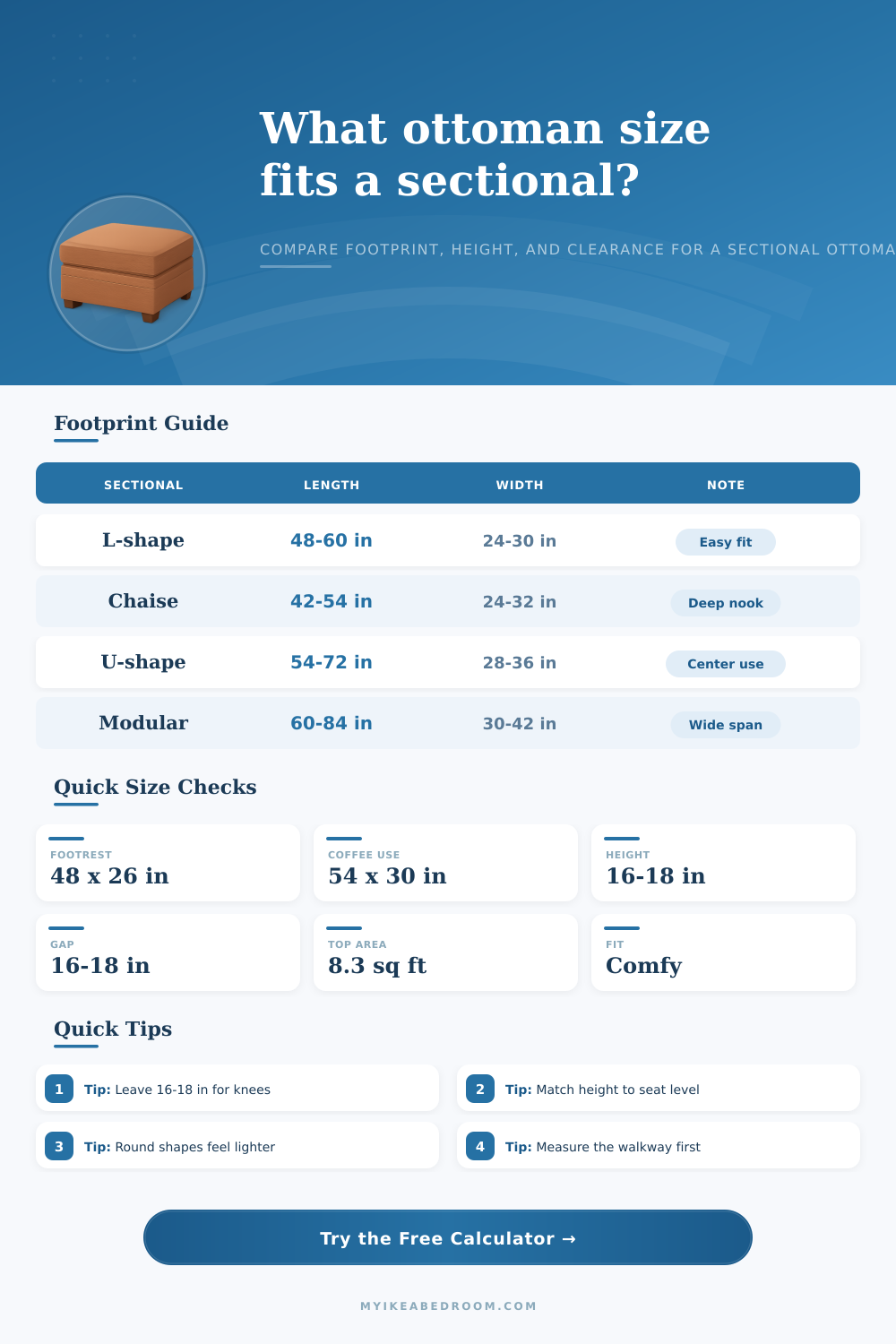
| L-shape | Rectangle | 16-18 in gap | Open front |
| Chaise | Round or square | Keep knees free | Deep lounge |
| U-shape | Oversquare | Center spacing | Shared use |
| Modular | Rectangle | Room to move | Big spans |
| Front gap | What it feels like | Best use | Fit note |
|---|---|---|---|
| 12-14 in | Tight | Small rooms | Only narrow shapes |
| 15-18 in | Comfortable | Daily lounging | Most homes |
| 19-22 in | Open | Tray use | Easy traffic flow |
| 23+ in | Very open | Large rooms | Big ottomans fit |
| Sectional span | Ottoman length | Ottoman width | Example feel |
|---|---|---|---|
| 72-84 in | 32-44 in | 20-26 in | Reading nook |
| 85-100 in | 40-52 in | 24-30 in | Compact room |
| 101-120 in | 48-60 in | 28-34 in | Family room |
| 121-150 in | 56-72 in | 30-42 in | Large lounge |
🧰 Furniture and Material Comparison
Upholstered fabric
Looks cozy and lands well in footrest setups. Add a little more width if the sectional is deep.
Best for relaxed lounging, layered textiles, and family-friendly living rooms.
Leather or faux leather
Reads visually lighter, so it can work a bit larger without feeling heavy in front of the sofa.
Best for cleaner lines, easier wipe-downs, and smaller-looking footprints.
Storage ottoman
Usually needs a wider top and a stronger clearance buffer because the sides are straighter.
Best when the ottoman must work as a hidden bin and a footrest at the same time.
Tray-top ottoman
Ideal when you want coffee-table function. The calculator usually favors a flatter, wider footprint.
Best for drinks, books, and balanced surfaces beside a sectional.
💡 Practical Tips
Measure the path from sofa edge to obstacle, not just the ottoman space.
Match ottoman height to seat height unless the ottoman is a tray surface.
An ottoman size for sectional calculator helps balance span, clearance, and seat height. Use it to compare footprints, match the sofa, and keep the room comfortable.
There is no standard size for ottomans They come in many shapes and sizes, which can make finding the right one for a space tricky. You choose ottoman size based on the available space and the furniture already in the room.
Ottomans range in height from 13 to 20 inches. Standard size ottomans measure between 26 and 40 inches, acting as good seating for one person or practical footrests. A typical model is around 40 inches wide and 26 inches deep, which makes it perfect to serve as a coffee table or extra soft seat.
How to Choose the Right Ottoman Size
Square ottomans are availabel in sizes like 20×20, 24×24, 28×28, 24×36 and 28×36 inches too.
Choosing the right ottoman size goes beyond the look. It is about use and balance. The ideal ottoman does several things, from adding seating to acting as a coffee table or simply giving a place for feet up.
A sturdy piece even works as a comfortable footstool. For use as a coffee table, a bigger model better holds drinks and snacks. A top tray helps with that.
Ideally the ottoman matches height with the sofa or is a bit lower for best comfort. A sofa with 21-inch seat height will match with a 16-inch ottoman. Even a very low sofa at 14.5 inches works with a 16-inch model.
Some small ottomans are only one foot tall, much lower then adult seating at 30 to 35 inches. That size meets the need for a small footrest with a bit of storage.
For modular corner sofas, a square footstool in 30×30 inches or even 36×36 inches works best, depending on the seating of the sofa. Smaller pieces start to look lost. Putting two square ottomans together adds even more flexibility.
The ottoman size relative to the sofa is measured like for a coffee table. A round ottoman sits 12 to 18 inches from the sofa for a good look.
If ottomans are big, one between two chairs is enough. A big model is good and can comfortably seat two people. Some have removable and machine washable covers, which is handy.
Fabric quality helps the piece, and some brands offer single and double sizes. A big round ottoman well breaks the monotony in a room with leather sofas.