🏕 Octagon Roof Framing Calculator
Hip rafters, common rafters & geometry for gazebos and pavilions
Quick Presets
Octagon Dimensions
Common Roof Pitch Angles
Octagon Geometry Quick-Reference
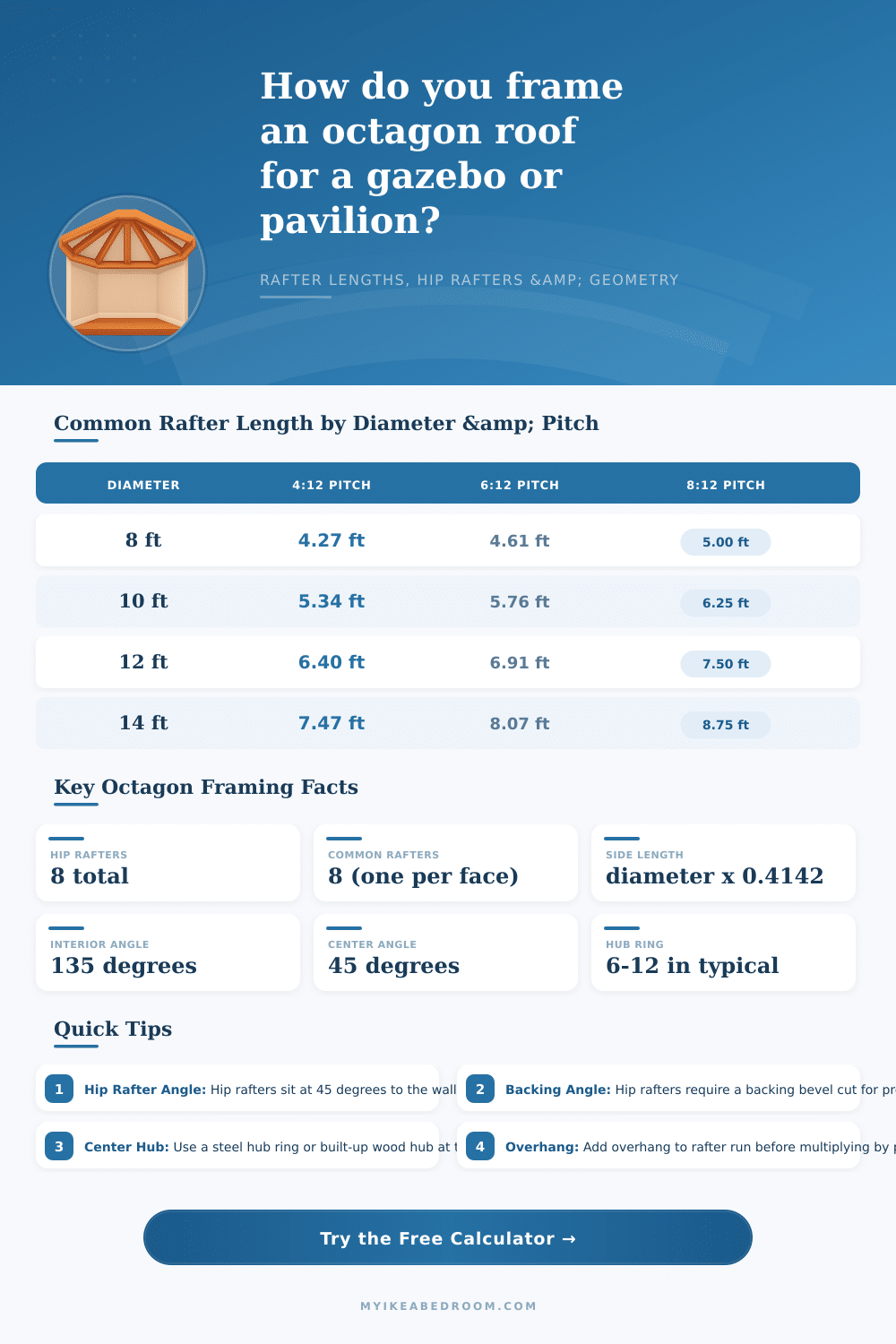
Common Rafter Length by Octagon Diameter & Pitch
All values in feet. Includes 12 in overhang. Common rafter run = diameter / 2 + 1 ft.
| Diameter (ft) | Side Length (ft) | 4:12 Rafter | 6:12 Rafter | 8:12 Rafter | 12:12 Rafter |
|---|---|---|---|---|---|
| 6 | 2.49 | 3.61 | 3.91 | 4.27 | 4.95 |
| 8 | 3.31 | 4.27 | 4.61 | 5.00 | 5.66 |
| 10 | 4.14 | 5.34 | 5.76 | 6.25 | 7.07 |
| 12 | 4.97 | 6.40 | 6.91 | 7.50 | 8.49 |
| 14 | 5.80 | 7.47 | 8.07 | 8.75 | 9.90 |
| 16 | 6.63 | 8.54 | 9.22 | 10.00 | 11.31 |
| 18 | 7.46 | 9.61 | 10.37 | 11.25 | 12.73 |
| 20 | 8.28 | 10.67 | 11.52 | 12.50 | 14.14 |
Roof Pitch Guide for Octagon Structures
| Pitch | Angle | Pitch Factor | Rise / ft Run | Best Use |
|---|---|---|---|---|
| 4:12 | 18.4° | 1.054 | 4 in | Low-profile shade structures |
| 5:12 | 22.6° | 1.083 | 5 in | Gentle backyard gazebos |
| 6:12 | 26.6° | 1.118 | 6 in | Standard gazebo & pavilion |
| 7:12 | 30.3° | 1.158 | 7 in | Good weather shedding |
| 8:12 | 33.7° | 1.202 | 8 in | Moderate slope, visual height |
| 9:12 | 36.9° | 1.250 | 9 in | Steep, dramatic profile |
| 10:12 | 39.8° | 1.302 | 10 in | High-style pavilion |
| 12:12 | 45.0° | 1.414 | 12 in | Steep cottage or bell curve |
Octagon Framing Geometry Reference
| Measurement | Formula | Example (10 ft) | Notes |
|---|---|---|---|
| Side Length | diameter × 0.4142 | 4.14 ft | Each of the 8 equal sides |
| Common Rafter Run | diameter / 2 + overhang | 6.0 ft (12 in OH) | From wall face to center hub |
| Hip Rafter Run (plan) | √(run² + (side/2)²) | 6.14 ft | Diagonal plan distance to hub |
| Common Rafter Length | run × pitch factor | 6.71 ft @ 6:12 | Actual board length |
| Hip Rafter Length | hip run × hip pitch factor | 6.91 ft @ 6:12 | Longer than common |
| Hip Pitch Factor | √(1 + (rise/(hip run × 12/run))²) | 1.126 @ 6:12 | Adjusted for diagonal run |
| Total Hip Rafters | 8 (fixed) | 8 | One per corner |
| Total Common Rafters | 8 (fixed) | 8 | One per face center |
Octagon roof framing is one of those satisfying builds… It looks incredible after it’s finished, but building it? Here is where the real challenge starts.
The whole structure with eight sides must work in perfect harmony to set the corners strongly and here comes the biggest sweating for the builders. A solid base is made up of an octagonal ridge block or a king post with eight sides, that goes down to the floor or sits on a high beam of ceiling.
How to Build an Octagon Roof Frame
Here’s a concrete example: if the octagon segments are each 4 feet, they stack up to reach a base width of almost 9 feet and 8 inches. The roof itself has eight common rafters with eight hip rafters, all pitched at 20-in-12. Here is where it gets precise, because that turret sits here, only half of the rafters extend to tails forming the soffit.
That well shows, how far everything must be done, down to fractions of an inch.
Rafters must have one end locked firmly to the posts and the other end tied to the king post. The alignment is entirely critical, because otherwise the whole roof ends up lopsided and uneevn. Many use 6×6 lumber for the king post, which gives solid support.
For the framing square, I found that 6.159 on the tongue and 10 on the body works well for laying out plumb and level cuts on octagon hip rafters. Tools like the Chappell Master Framing Square remove a lot of the guesswork. With line 2 under 8:12, multiply 2.902 by 56 inches, which gives around 162.5 inches.
On line 3 under 8:12, multiply 3.069 by 56 inches, and you get close to 172 inches.
At the octagonal area, bisecting those angles at the single top plates really smooths out the framing process. Then double top plates lap over the singles with miters cut to match the building angle. I commonly sea builders lay 2×12 rafters even when it seems excessive, but that extra depth really pays off; it opens up space to tuck the bottom of the fascia against the ridge vent.
Dropping 2×6 tails is another popular method. Slightly raising the octagon walls upward can also help, when the spacing gets too tight.
Large diameter octagons bring a new level of trouble. A diameter of 24 to 30 feet without a specified pitch is a serious clear span, and many designs specifically need to avoid planting a center post right in the middle. A SketchUp model is invaluable for testing how the complex measurements and angles fit into the framing members and connect together.
There are also plan view drawings from above, with the roof elevation drawn right above it. References like Roof Cutter Secrets offer solid methods for tackling such roofs anddeserve a spot on your shelf.