Nursery Glider Footprint Calculator
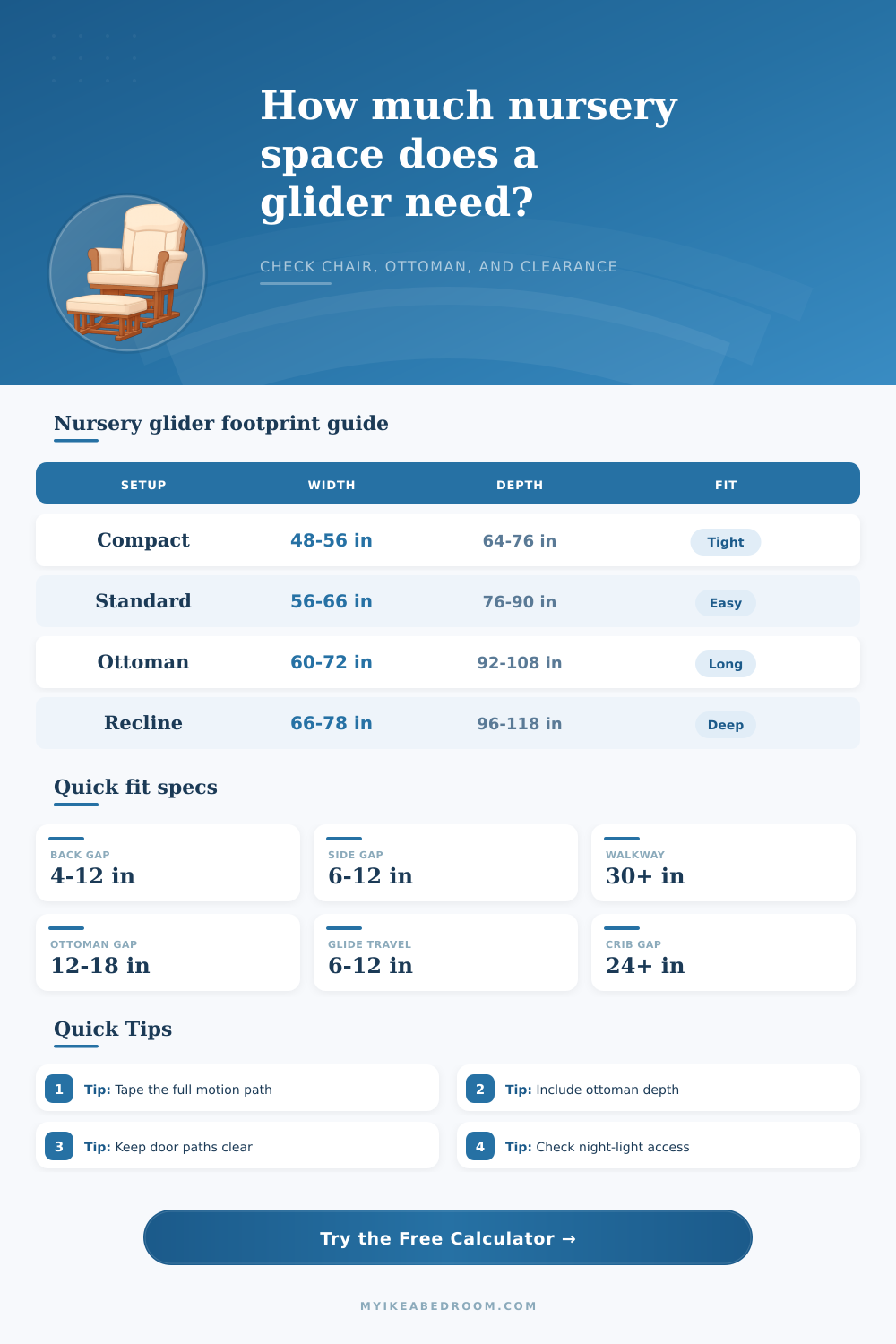
Estimate the working footprint for a nursery glider, rocker, swivel glider, recliner, ottoman, side table, wall gaps, crib clearance, and the walkway needed for late-night feeding paths.
Choose a realistic nursery setup, then adjust chair size, motion travel, ottoman depth, wall gaps, and room space to match your actual layout.
How the footprint is built
Width includes chair width, both side clearances, swivel width when needed, and the side table or basket zone.
Depth includes back wall clearance, chair depth, glide travel, recline extension or ottoman depth, the ottoman gap, and the front walking aisle.
Fit compares the calculated working zone with your available nursery width and depth. A glider can physically fit but still feel awkward if the front walkway, crib gap, or side reach is squeezed.
Use the preview as a taping guide: mark the body of the chair first, then tape the full motion and walking path before moving furniture.
| Glider setup | Typical chair body | Motion or footrest | Recommended working footprint | Best room condition |
|---|---|---|---|---|
| Compact fixed nursery chair | 28-31 in wide, 30-34 in deep | 0-4 in body movement | 44-54 in wide by 62-74 in deep | Apartment nursery, corner near closet, no ottoman |
| Standard glider | 30-34 in wide, 34-38 in deep | 6-10 in glide travel | 54-66 in wide by 76-92 in deep | Most single-crib nursery layouts |
| Swivel glider | 31-36 in wide, 35-40 in deep | Rotation needs wider side space | 62-76 in wide by 80-96 in deep | Open wall with side table set back |
| Glider with ottoman | 30-35 in wide, 34-39 in deep | 20-28 in ottoman plus 12-18 in gap | 58-72 in wide by 96-116 in deep | Long wall or open corner away from crib |
| Reclining glider | 32-38 in wide, 36-42 in deep | 18-30 in footrest extension | 64-80 in wide by 98-124 in deep | Larger nursery with clear front aisle |
| Clearance task | Tight minimum | Comfortable target | Why it matters | Calculator input |
|---|---|---|---|---|
| Back wall gap | 3-4 in | 6-12 in | Protects wall, curtains, baseboards, and glider rails | Back wall clearance |
| Side reach beside arms | 4-6 in | 8-12 in | Lets you reach books, bottles, blankets, and burp cloths | Side clearance each side |
| Front nursery walkway | 24 in | 30-36 in | Gives a steady path while holding a baby at night | Front walkway after chair |
| Crib or dresser separation | 18 in | 24-30 in | Reduces crowding around drawers, crib rails, and bedding | Crib, dresser, or bed safety gap |
| Ottoman leg space | 10-12 in | 14-18 in | Prevents knees and shins from feeling pinned | Gap between glider and ottoman |
| Nursery scenario | Available glider zone | Suggested setup | Watch item | Fit expectation |
|---|---|---|---|---|
| Small 8 by 10 ft room | 60 by 84 in | Compact glider, no ottoman, narrow table | Door swing and crib aisle | Often workable but tight |
| Standard 10 by 11 ft nursery | 72 by 108 in | Standard glider with small table | Keep front walkway open | Usually comfortable |
| Window nook | 66 by 90 in | Glider with extra back gap | Curtains, cords, and sill depth | Comfortable if table is slim |
| Shared twin nursery | 70 by 96 in | Swivel or standard glider, no ottoman | Crib aisle and drawer access | Needs careful taping |
| Large room with lounge corner | 84 by 126 in | Recliner or glider plus ottoman | Full footrest extension | Comfortable with open front path |
Tape the moving envelope, not just the chair body. The real footprint includes glide travel, recline extension, ottoman depth, and the front aisle where you stand up while holding a baby.
Check nursery access points while seated. Side tables, baskets, night lights, monitor cords, and books should be reachable without blocking the chair motion or the crib path.
A glider is comfortabley. It’s cute. You buy it. Then you put it in the nursery. Once you are seated, you discover your feet rest against wall. The ottoman prevents walking to the crib. And the side table? That’s sooo far away if we need a burp rag.
It’s not a furnitures fault here. It’s math. Most people don’t take measurements of how the chair will move. A glider move forward and back. It might rock from side to side. It also often offers an extended footrest. Before laying out your room, use calculator on this page to figure out what happens when they move.
How to Plan Space for Your Glider
It translates all that movement into real life square footage. However, the input does parallel what happens in real life. You can measure how wide a chair is by measuring from arm to arm. People tend to err on glide travel. Most regular gliders will require six to ten inches of clearance so the mechanism function correctly.
If you are getting a recliner then double that number with an additional eighteen to thirty inches for the foot rest. Half of that can be space consumed. Then there’s the ottoman which also adds depth but should also have a gap between it and the chair. The ideal gap is twelve to eighteen inches. Anything less will feel cramped, anything more and you’ll have trouble standing up.
Clearance around the sides of the chair is important too. Allow enough space for your arms, basket of diapers, nursing pillow, plus a lamp. Leave at least six to ten inches on each side and clear away any clutter so it is not an obstacle course.
Front clearance is non-negotiable: You’re going to be waking up at 3 AM with an infant in one arm; thirty inches or more ensures that you have a secure path. Less space different than that, and you’re doing this in slo-mo. How does a small fixed chair fit compared to a swivel glider? Check out the reference table.
Check out the reference table. Don’t pick up a thing without taping down your floors first. Mark the outline of the chair body with painter’s tape. Add extra length for the glide travel and walking area. Also, add more space for wall clearance. If you intend on using a side table, include its zone, too.
A literal mockup will show you problems a mental picture cannot: The glider prevents opening the closet door; it requires you to walk around the dresser (and tip-toe, no less). Moving furniture after you’ve already unpacked boxes? It is much more harder than moving some tape.
Think about your function in the room. If there are two cribs, like a shared nursery, you’ll need more aisle space to avoid traffic jams when it’s time for middle of the night checks. If it’s a window nook, allow for more back gap clearance so curtains don’t block gliding mechanism. For large rooms, you could of gotten away with a full recliner and ottoman set up. For tight apartments, you may have to remove some of the extra features to maintain an open path.
You want a place that makes rocking and feeding comfortable without sacrificing your space. Think of it as somewhere you can move the other pieces and still be able to rock your baby. Consider access points as well. You’ll want to reach outlet cords, monitors and night lights. And if the footprint of the chair block all available outlets nearby, you’ll find yourself with an extension cord stretched out on the floor.
This is dangerous in a nursery. Keep your utilities out of the taped off area. It sounds small until you’re standing in the dark plugging something in while trying not to wake the baby. All told, then, a nursery glider is a piece of furniture you invest in peace of mind. And to make it work, you must plan for more than just mass; you have to plan for motion.
Measure twice, tape once, leave room to breathe. When you finally get your baby in your arms and sink back into that chair, you want to be supported by the space around you. That thoughtful consideration to footprint transforms a basic seat into a sanctuary.