Nightstand Spacing From Bed Calculator
Plan the exact bedside width for mattress size, nightstand width, reach gap, wall clearance, drawer swing, and outlet access.
Tight reach setup
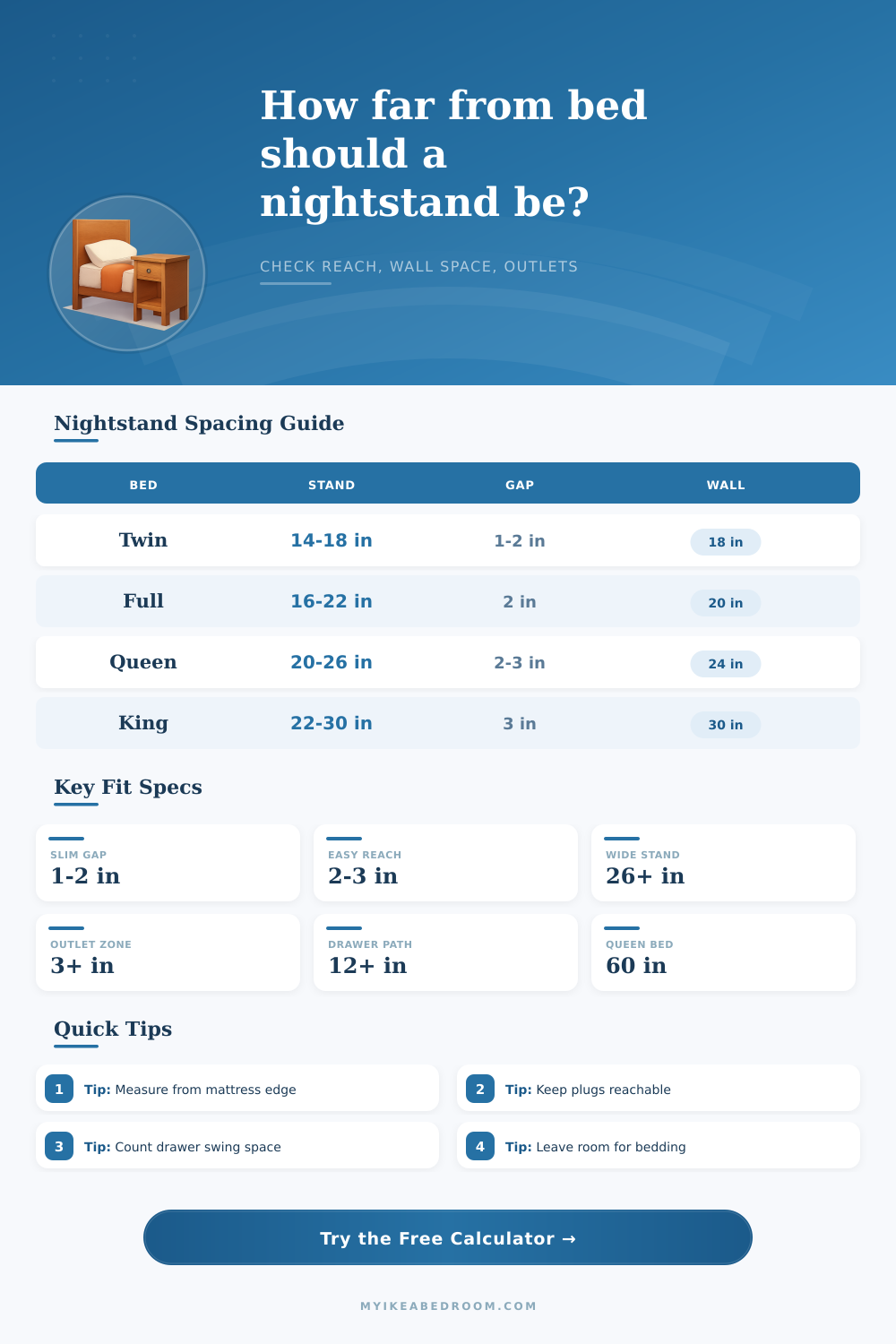
A 1 to 2 inch gap keeps the top close to the mattress. It works best with slim stands, shallow drawers, and outlets above the stand.
Balanced bedside setup
A 2 to 3 inch gap leaves bedding space while keeping lamps, phones, and water within easy reach from the pillow edge.
Outlet-first setup
A wider gap or extra outer clearance helps when the outlet lands behind the stand and the plug needs finger room.
| Mattress size | Mattress width | Common stand width | Two-stand span with 2 in gaps |
|---|---|---|---|
| Twin | 38 in | 14 to 18 in | 70 to 78 in |
| Twin XL | 38 in | 14 to 18 in | 70 to 78 in |
| Full | 54 in | 16 to 22 in | 90 to 102 in |
| Queen | 60 in | 20 to 26 in | 104 to 116 in |
| King | 76 in | 22 to 30 in | 124 to 140 in |
| California king | 72 in | 22 to 30 in | 120 to 136 in |
| Bed to stand gap | Reach quality | Best use | Watch point |
|---|---|---|---|
| Under 1 in | Too close | Very thin bedding | Blankets may bind |
| 1 to 2 in | Close reach | Small rooms | Check drawer pulls |
| 2 to 3 in | Balanced reach | Daily bedrooms | Leave plug room |
| 3 to 5 in | Flexible reach | Thick bedding | Phone may feel far |
| Over 5 in | Long reach | Outlet access | Lamp may sit too far |
| Outlet lands | Access result | Spacing response | Clearance check |
|---|---|---|---|
| Inside reach gap | Open access | Keep 2 to 3 in gap | Protect cable bend |
| Behind stand | Partly blocked | Add side or rear gap | Needs 3 in access |
| At outer edge | Reachable | Center stand carefully | Check plug width |
| Beyond stand | Open wall access | Use normal reach gap | Avoid cord stretch |
| Outside clearance | Wall feel | Drawer depth supported | Typical use |
|---|---|---|---|
| Under 8 in | Blocked edge | None | Wall-side only |
| 8 to 15 in | Very tight | Shallow tray | Occasional access |
| 16 to 23 in | Compact | Small drawer | Guest rooms |
| 24 to 29 in | Comfortable | Most drawers | Daily bedrooms |
| 30 in or more | Generous | Wide drawer | Shared bedrooms |
Determining the distance between the bed and an nightstand is another essential feature when planning out the bedroom correctly. By determining the distance between the bed and the nightstand, you ensure that the bedroom furniture will functions correctly. If the distance between the bed and the nightstand is too small, the blankets may get caught on the nightstand drawer.
If the distance is too large, it may be difficult for the sleeping person to reach the items on the nightstand. Several factors will determine the distance between the bed and the nightstand, including the width of the mattress, the width of the nightstand, the reach gap, and the placement of electrical outlet. Using a calculator will allow you to determine these measurements correctly and avoid making mistake when moving the furnitures into the bedroom.
How Much Space Should Be Between the Bed and Nightstand
The calculator requires a few specific measurement from the bedroom. You need to know the width of the mattress, the width of the nightstand, the reach gap, and the placement of the electrical outlets. The calculator software will use the mattress and the nightstand widths to calculate the possible reach gap.
Additionally, the reach gap considers the space required for the bed frame side and the nightstand drawer depth. By considering the distance from the mattress to the outlet, the reach gap calculator will provide you with the most accurately calculation. This calculator will let you test out different types of bedroom furniture and see how they will fit in the bedroom without having to move any of the furniture.
The reach gap between the bed and the nightstand should be between one and three inches. A reach gap between these dimension will provide enough space for your bedspread while giving up the ability to reach the items on the nightstand if the gap is too wide. If the reach gap is less than one inch, the bedding may get pinched between the bed and the nightstand.
If the gap is too wide, at over three inches, the person may have difficulty reaching the items on the nightstand. The reach gap calculator will alert the person if the chosen reach gap is outside the recommended range. The calculator will also show the buffered outer clearance to the user as this will provide space for vacuuming the bed area or for placing storage bins on the bed.
The placement of the electrical outlets in the room is one of the most critical factor to consider when placing the nightstand in the bedroom. People often forget this when placing furniture in the bedroom. If the electrical outlet is behind the nightstand, there will have to be a larger reach gap to accommodate the item that will be plugged into the outlet.
The reach gap calculator will compare the distance between the outlet and the nightstand with the reach gap and the width of the nightstand. Based off these measurements, the reach gap calculator will let you know if the outlet is visible in the bedroom or if it is behind the nightstand. Another important factor in determining the reach gap between the bed and the nightstand is the depth of the drawers on the nightstand.
The depth of the nightstand drawers determine the space that the person will have to accommodate the nightstand. If the drawers are deep, there will have to be more space between the bed and the nightstand so that the nightstand drawers will not get in the way of the bed. The reach gap calculator will subtract the depth of the nightstand drawers from the available space.
The reach gap calculator will warn the individual if the depth of the nightstand drawers is too deep for the space available for the bed and nightstand. The calculator can also be used to determine whether or not a large nightstand will work in the bedroom. The total width of the bedroom will determine whether the bed and nightstands will fit in the bedroom.
The total width of the bedroom is the last measurement to consider when determining the reach gap between the bed and the nightstand. The reach gap calculator will add the width of the mattress, the width of the two nightstands, the reach gap between the bed and the nightstands, and the distance from the nightstand to the bedroom wall. If the total calculated width is larger than the total width of the bedroom, the bed and nightstands will not fit in the bedroom.
If the total width that is calculated is less than the total width of the bedroom, there is extra space in the bedroom that can be used for other furniture. Using the reach gap calculator allows the individual to choose a percentage to buffer the bedroom with extra space for future change to the bedroom furniture. The context of the bedroom may change the reach gap between the bed and the nightstand, even with the same mattress size.
A queen mattress in a small guest bedroom will require a different reach gap than a queen mattress in the primary bedroom. A twin bed in a dorm room will take up less space than a king bed in a large bedroom. The reach gap calculator allows the individual to test these scenarios in the software without having to draw out a floor plan every time.
The calculator will save the user from having to redraw the bedroom floor plan every time the individual changes the scenario. The bed frame will add to the width of the bed. When measuring the bed, the width of the mattress may not be the same as the width of the bed frame.
The bed frame may have box springs or side rails that take up part of the total width. This width must be accounted for when measuring the reach gap between the bed and the nightstand. The reach gap between the bed and the nightstand may be measured from the outer edge of the bed frame in case the bed frame adds to the distance between the bed and the nightstand.
Another factor that may be important to consider is the height of the electrical outlet and the thickness of the plug for the item that will be placed on the nightstand. For example, if there is a three-inch reach gap between the bed and the nightstand, the person may be able to reach the electrical outlet. However, if the item that is plugged into the outlet has a thick power brick, it may take up the entire reach gap between the bed and the nightstand.
Although the reach gap calculator will not determine the thickness of the power plug for the item, the alert about the reach gap to the outlet may alert the user about the thickness of the power plug. In this case, the person may have to use a power strip on the nightstand. The thickness of the bedding may play a role in the reach gap between the bed and the nightstand.
For example, if the individual uses heavy blankets on the bed, the extra space will take up some of the reach gap between the bed and the nightstand. Furthermore, if the space between the bed and the nightstand is too small, the blanket may rub against the side of the nightstand. The reach gap calculator will have a buffer setting for the person to set the thickness of the bedding on the bed.
Using a higher percentage for the bedding buffer will ensure that there is enough space between the bed and the nightstand for the persons heavy blankets. When deciding on the placement of the nightstand between the bed and the nightstand, you must prioritize what is most important to you. For some individuals, having the phone alarm within reach is most important.
For others, having the lamp or books on the nightstand is more important. Other people may need space for the drawers on the nightstand so that their medication or glasses will have enough space to swing open the drawers. The reach gap calculator will show you the importance of each of these features.
Furthermore, it will help the user to decide which is the most important need in the bedroom. The goal is for all of these features to be important and to function correct in the bedroom.