🌿 Mulch Depth Calculator
Estimate the fresh spread depth you need now, the settled depth you will keep later, and the mulch volume, bag counts, and weight needed for beds, rings, borders, and custom landscape shapes.
📋Depth presets
🔧Depth planning inputs
📋Depth comparison grid
📊Reference tables
💡Practical tips
📈Calculation results
Mulch settling describe the loss of volume that mulch experience after it has been spread. Since mulch can settle and compact over time, you must account for mulch settling. Otherwise, the mulch will be more thinner than you would like it to be after watering or after days of settling due to its own weight.
Thinner mulch layers will allow more weed to grow in the garden beds and it will dry out more quick. Due to the different type of mulch, mulch can settle at different rates. For instance, shredded hardwood mulch can compact quickly due to the weight of the mulch and the amount of moisture in the mulch.
How to Plan for Mulch Settling
Shredded hardwood mulch can lose 18% of its volume due to settling. Pine bark mulch will hold its volume for longer periods of times because the mulch is chunkier in structure. Rubber mulch will barely move once you place it in the ground.
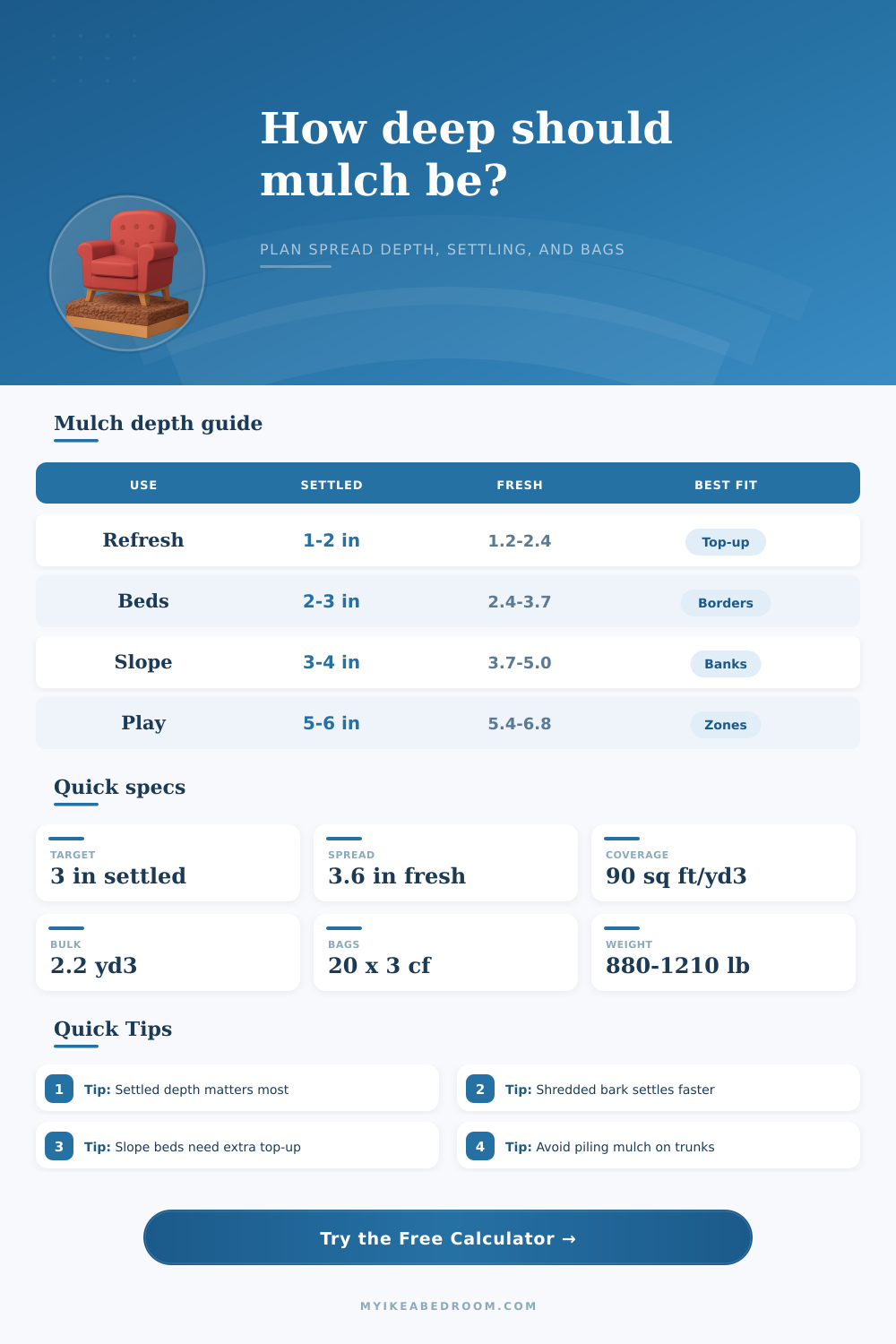
Therefore, you must account for these difference in settling rates when you select the amount of mulch that you would like to use in your garden. The depth of the mulch will depend upon the area that you use for your mulch. For narrow foundation strips, you should use one to two inches of mulch so that you can prevent weeds without bury the drip lines of the trees.
For broad island beds, two to three inches of mulch will help to insulate the plant roots during winter months. On slopes, three to four inches of mulch will help to prevent erosion. For play zones, five to six inches of rubber mulch will create a cushion for the children when they fall.
To calculate the amount of mulch that is needed for your project, determine the square footage of the area that you would like to cover. For rectangular area, simply multiply the length of the area by the width of the area. For circular areas, square the diameter of the area and divide that number by pi.
For triangular areas, simply multiply the base of the triangle by the height of the triangle and divide that value by two. Once you have the square footage of the area, multiply that value by the depth that you want the mulch layer to reach to find the number of cubic foot of mulch that you will need for the job. Change to cubic yards if ordering the mulch.
Allow for some extra mulch to account for waste and mulch that will wash along the edges of the beds. Allow 10% extra to account for spills and edges. Allow for extra mulch if you plan on using slopes for drainage.
For example, if you would like three inches of mulch in your garden beds after settling, but mulch settles 18% when placed in the ground, you will need to spread mulch at a depth of approximately 3.7 inches. If you would like to account for mulch that washes thin along the edges of the beds (which can happen in slopes), add 6% mulch to account for this. Therefore, you will spread mulch at a rate of approximately four inches.
Avoid placing mulch against the roots of trees, as this can cause the trees to develop mulch burn or mulch rot. Three inches of space should remain clear around the stems of trees. The type of mulch that you use can also matter for your garden beds.
For instance, arborist chips will settle alot but will grip the slopes well. Compost mulch will help to build the soil but will settle quick, so it may need to be topped yearly. Cedar mulch repels some insects but is light in weight.
The time of year that you apply mulch can change the behavior of the mulch. For instance, mulch applied in the spring will be dry so it will fluff and settle less quickly. Mulch added in the fall may be pre-wetted from the mulch piles at the mulch suppliers so it will settle upon application to the ground.
You can perform a test to determine how quick the mulch will settle. For instance, spread mulch in a one-foot square area and water the mulch. You can measure the depth of the mulch the following morning to determine how quick the mulch settles.
Proper mulch depth will provide a number of benefits for the garden. For instance, proper mulch depth will smother the weeds so that they cannot grow. Proper mulch depth will help to cool the plant roots in the hot months and retain the moisture in the soil during dry weeks.
Finally, proper mulch depth will prevent washouts of mulch along the bank of the ground after storms. By planning for mulch settling, you can ensure that your mulch depth will be correct and your gardens will feature healthy plant.