Moving Box Quantity Calculator
Estimate the number of small, medium, large, extra-large, dish, and wardrobe boxes for a home move using box volume, room size, contents mix, hanging clothing, and a packing buffer.
Estimated Moving Box Plan
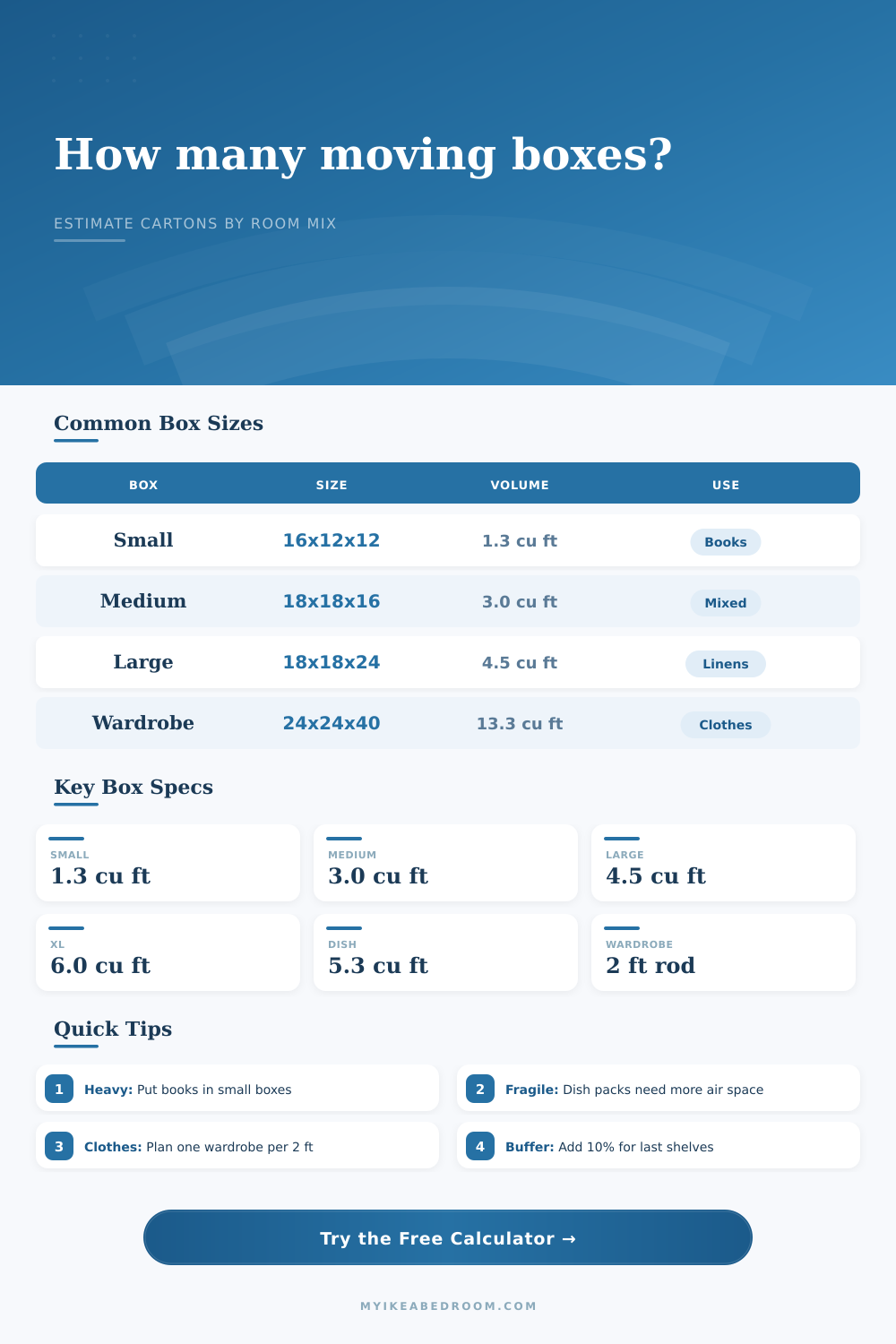
| Box type | Common dimensions | Calculated volume | Best packed contents |
|---|---|---|---|
| Small book box | 16 in × 12 in × 12 in | 1.33 cu ft / 0.038 m³ | Books, files, tools, pantry cans, records |
| Medium moving carton | 18 in × 18 in × 16 in | 3.00 cu ft / 0.085 m³ | Mixed bedroom, bathroom, toys, small kitchen items |
| Large moving carton | 18 in × 18 in × 24 in | 4.50 cu ft / 0.127 m³ | Linens, pillows, light lampshades, folded clothes |
| Extra-large carton | 24 in × 18 in × 24 in | 6.00 cu ft / 0.170 m³ | Comforters, bulky soft goods, seasonal textiles |
| Dish pack carton | 18 in × 18 in × 28 in | 5.25 cu ft / 0.149 m³ | Dishes, glassware, vases, fragile decor with padding |
| Wardrobe box | 24 in × 24 in × 40 in | 13.33 cu ft / 0.378 m³ | About 2 linear feet of hanging clothing |
| Move size | Typical area | Common box range | Volume cue |
|---|---|---|---|
| Dorm or single room | 120 to 250 sq ft | 8 to 18 boxes | Mostly small and medium cartons |
| Studio apartment | 350 to 600 sq ft | 15 to 30 boxes | Few closets, limited kitchen volume |
| One-bedroom home | 600 to 900 sq ft | 25 to 45 boxes | Kitchen, linens, closet, and decor mix |
| Two-bedroom home | 900 to 1,300 sq ft | 40 to 65 boxes | More bedroom and storage overlap |
| Three-bedroom home | 1,300 to 1,900 sq ft | 60 to 90 boxes | Family closets and mixed storage areas |
| Four-bedroom home | 1,900 to 2,600 sq ft | 85 to 130 boxes | Dense shelves, linens, decor, and seasonal goods |
| Contents mix | Small box share | Medium box share | Large and XL share |
|---|---|---|---|
| Balanced home goods | 18% of loose carton volume | 45% of loose carton volume | 37% for soft and bulky items |
| Books, files, and dense items | 34% of loose carton volume | 42% of loose carton volume | 24% to keep heavy boxes manageable |
| Kitchenware and fragile shelves | 22% of loose carton volume | 38% of loose carton volume | 28% after dish-pack allocation |
| Linens, bedding, and soft goods | 10% of loose carton volume | 34% of loose carton volume | 56% for larger cartons |
| Minimal edited storage | 12% of loose carton volume | 50% of loose carton volume | 38% for light bulky contents |
| Family bedrooms and closets | 20% of loose carton volume | 40% of loose carton volume | 40% for toys, linens, and soft storage |
| Specialty input | Planning formula | Capacity basis | Calculator use |
|---|---|---|---|
| Dish packs | Home carton volume × fragile percentage | 5.25 cu ft per dish carton | Rounded up separately before core boxes |
| Wardrobe boxes | Hanging rod length ÷ 2 linear ft | About 24 in of hanging space | Rounded up, then included in total boxes |
| Occupant adjustment | 3% per person beyond first occupant | Personal items, toiletries, clothing | Multiplies the area-based carton volume |
| Packing buffer | Calculated boxes × buffer percentage | 0% to 20% selectable | Applied before final rounding by box type |
The Truck Rental. It’s rarely the first symptom of moving stress.
The Box Run is. Ah, the first symptom of moving stress. The Box Run.
How to Choose the Right Boxes
And there you are, standing in middle of the aisle, looking at all those piles of cardboard, trying to figure out which are Large enough for your linens and which Small will hold your books. Too many, and you’re paying for excess storage space. Not enough, and you’ll be making a mad dash for supplies. Usually it boils down to one thing: Volume does NOT equal Weight, which determine what size box you CAN carry around.
Everyone begins with the same question: How big is my room? It’s understandable. But it’s also wrong. You could have an empty, cavernous mansion, or you could live in a small apartment that has floor-to-ceiling bookcases. And latter will take many, many more boxes.
You can enter your square footage into the calculator above, and it’ll do the math. But then it does more than just divide your space by the box capacity. It factors in packing density. Density refers to how many actual things you possess, divided by each square foot of living space. If your home is sparsely furnished (think clean lines), you’ll generate perhaps eight percent of a cubic foot of boxes per square foot of living space. Your place might be stuffed full of junk, like overflowing drawers and crowded closets. You may be up to eighteen percent or even higher. Your overall number change by dozens of boxes when you choose the appropriate density option. It makes you see what’s really on those shelves, as opposed to guessing based off floor plan drawings.
The strategy works by setting the content mix. Because of the laws of physics, there’s no way to pack books into a big box. Those things are too darned heavy to carry easily and they’re going to rip through the seams anyway. When you choose a heavy mix, the tool gives that volume to small boxes instead. That keeps weight manageable in the smaller cartons.
On the other hand, if you’ve got a lot of comforters and linens, the system moves more of that volume to large and extra-large boxes. Those bulky items has lots of volume but little weight. It wastes tape to put pillows in small boxes, and then it’s a headache when you stack them on top of each other. This is the kind of tradeoff the calculator figures out for you automatically. All you have to do is tell it what’s realy inside your home.
That brings us to another wrinkle: Fragile stuff is tricky. Because there’s padding in the box, it has more volume than a regular box. You’re moving plates but also air. That’s why there’s a fragile setting on the intensity slider. It accounts for that wasted space. If you have a lot of glassware or collectibles, you’ll want to use those special dish packs. Nothing goes next to anything, which means no breakages. The tool carves out that volume from the rest of the pile, otherwise you might understate how much you need to protect.
Except this: Wardrobe boxes aren’t like anything else. A wardrobe box is a clothing storage container sized by how many feet of hanging rod it holds. Standard wardrobe boxes will fit roughly two feet of hanging clothes. Longer items such as dresses and long coats may require deeper boxes, but fewer boxes overall.
This is why the calculator has a separate request for length of what you want to hang; otherwise, we’d all fall into the trap of folding up our clothes to save box space. But you can’t fold up your clothes because it ruins them. You want to keep those things hanging. You want to keep those things hanging. And planning for that ahead of time is something most people should of forget to do until they’re at the last minute.
There is nothing pessimistic about adding a buffer. Adding a buffer is realistic. There are always those last-minute thing that need to be added, whether it is the toothbrush left in the bathroom or discovering you didn’t pack that one tool. Or you find a little space on a shelf just moments before the truck pulls up. The extra 10-15% covers those holes without bloating your order. It’s the difference between being stuck and being prepared.
There’s even a table on the page that lays it all out by standard dimension. But the trick is in the ratio. It needs to be a mix. One size won’t cut it. Houses aren’t all the same.
Use small boxes for books. Use large ones for clothes. Use padded ones for dishes. How do you know what to get? This way you have the split from the calculator and now you can confidently order. Instead of guessing, you go into the store with a list. It is the difference between chaos and a simple logistics problem. And there are answers to logistic questions. You just need the correct data to answer those questions.
Enter your square footage. Adjust based on how packed your shelves actualy are. Let the tool do its thing. Then shop for boxes.