Mosaic joint fill planning
Mosaic Tile Grout Calculator
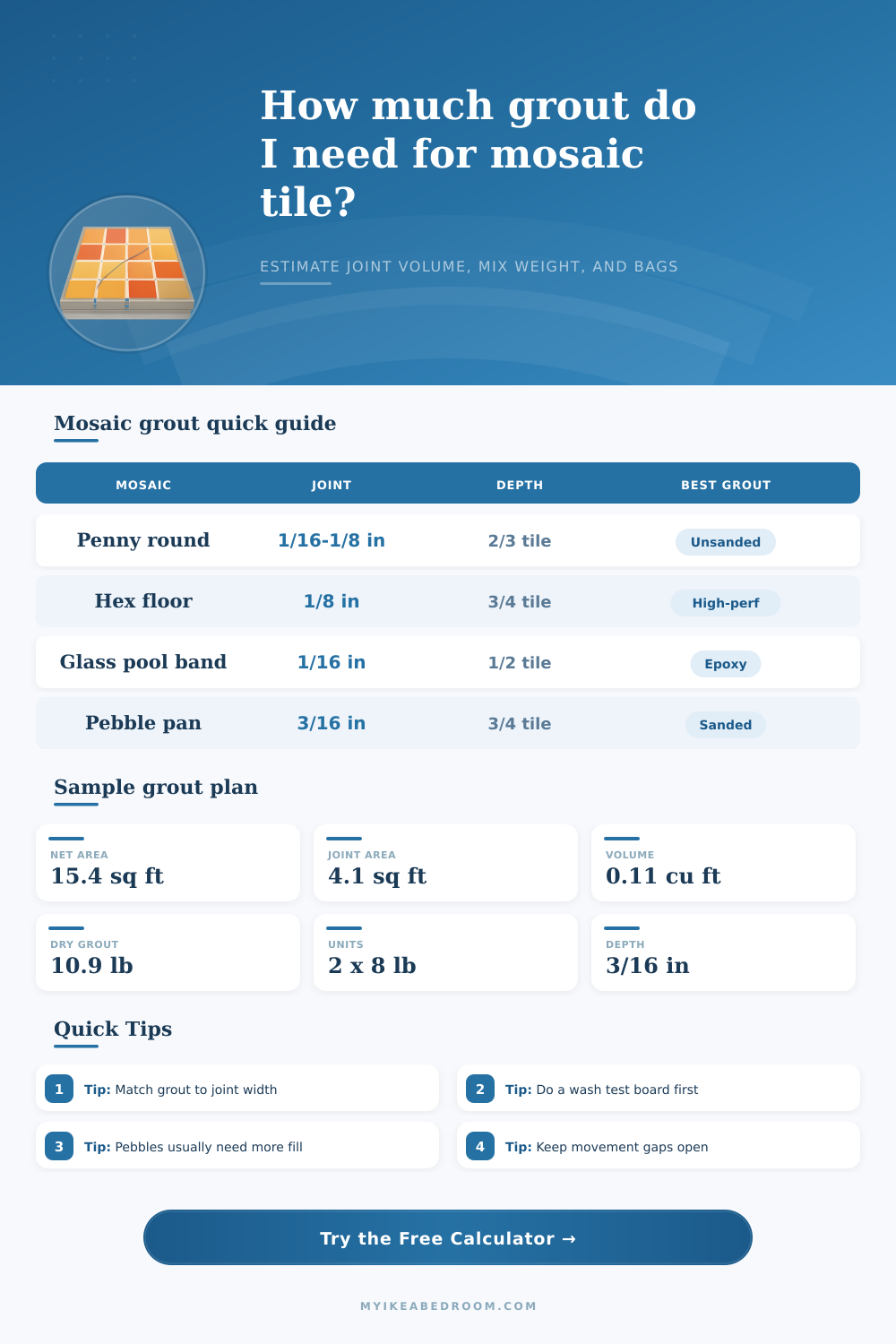
Estimate grout coverage for penny rounds, hex sheets, kit-kat bars, pebbles, glass pool bands, basketweave, and other mosaic layouts using sheet size, chip size, joint width, depth, and grout family.
Each preset loads a real-world mosaic condition with a matching grout family, joint width, and depth target so you can compare backsplash, shower, floor, niche, and pool scenarios fast.
Detailed grout breakdown
Joint width, tile edge softness, stain risk, and cleanup speed all change which grout family feels easiest to install on a mesh-mounted mosaic.
When tiling with mosaic tiles, calculating how much grout is needed for the project are essential. When calculating how much grout is needed for an tiling project, there are a few different reasons to perform this calculation. First, because grout batches can come in different colors, running out of grout during a project is not ideally.
Second, many people will worry about buying to much grout for a project. Mosaic tiles require a different calculation for how much grout is needed compared to the calculation for large format tiles. This is due to the fact that mosaic tiles has many more joints.
How to Calculate Grout Needed for Mosaic Tiles
For tiles that are smaller in size, the perimeter of the individual tiles is going to be larger in comparison with the surface area of the tiles. Perimeter is the measurement of the length of each joint between mosaic tiles, so having more perimeter mean that there are more joints that require grout to fill the gap between each mosaic tile. The layout of the mosaic tiles will play a role in the amount of grout needed for the project.
For instance, if the mosaic tiles are laid out in a square grid fashion, then the amount of grout needed will be different than if the mosaic tiles are laid out in a pebble fashion. The reason for the difference is due to the fact that pebble tiles are going to have more grout swallow within the joint gaps between the tiles because the pebbles are not all manufactured with flat surfaces; rather, they have deep valleys along their perimeter. For this same reason, if you use the same amount of grout within a mosaic tiling project as is used with flat tiles, the grout will likely run out before the project is complete.
In order to account for this, each project require that you calculate the fill factor for the tiles being used; the fill factor will determine the amount of grout that will be needed within the project. Another important calculation to make is the choice of the correct family of grout for the project. For example, if the project is using tight joints with polished stone tiles, then you should use unsanded grout.
This type of grout is fine in texture and will not scratch the decorative surface of the tiles. If the joints between the tiles will be relatively wide, such as if you use mosaic pebble tiles, then you should use sanded grout in the project. Sanded grout is ideal for projects with wide joints because the sand within the joints will help the tiles not crack or shrink over time.
An alternative to both sanded and unsanded cement is high-performance cement. This type of cement is useful for a variety of projects because it has a wide working range. Another alternative to cement is epoxy grout.
This type of cement is often used in areas that will become wet after the project is completed, like showermen. Epoxy cement is waterproof and will resist stain from the water in these wet areas. However, epoxy cement is difficult to use because it has a short working window for the cement to cure.
If you do not wash away epoxy cement after a certain period of time, it will leave a permanent haze on the tiles. In addition to the type of cement that will be used within the project, the amount of grout that is needed to fill the gaps between the mosaic tiles also must account for the amount of grout that the seams and the perimeter of the tiling project will consume. Any number of mosaic sheets will have seams where they join to form a complete tiling project.
All of the seams along a large wall of mosaic tiles will require a significant amount of grout. The gaps around plumbing fixtures and niches for soap will require a portion of the cement to fill the gaps between the tiles. If you do not account for these gaps when purchasing the grout for the project, then there may not be enough cement to complete the project.
Waste of the grout during the project is another factor in the calculation. Some of the grout will become mixed with the mosaic tiles, some will remain within the mixing bucket, and some will get wiped away during the cleaning of the tiles after the project is complete. It is common to lose ten percent of the cement during the tiling project.
An additional ten percent of the cement will be purchased as an allowance in case some of the grout gets wasted during the project. For projects that use irregular tiles, such as mosaic pebbles, it is likely that more than ten percent of the grout will be wasted. It is better to purchase too much grout then too little to ensure that there is enough to complete the project.
Finally, when purchasing the cement for mosaic tile projects, there is a specific mix plan that must be followed. The amount of water that is mixed with the cement must be the amount that the manufacturer of the cement recommends. If there is too much water in the cement, the cement will crack.
If there is too little water in the cement, the cement will be difficult to spread even between the mosaic tiles. Following this mix plan will ensure that the grout is even and that the color of the cement is the same throughout the project.