Mosaic sheet planning
Mosaic Tile Calculator
Plan sheet coverage, loose chips, outlet cutouts, and movement gaps for backsplashes, shower walls, mosaic floors, niches, and pool bands.
Chip shape, translucency, and edge softness all affect sheet seams, cut speed, and the joint width that looks balanced.
When planning a project that uses mosaic tiles, calculating an amount of mosaic tiles that will be needed for the project is necessary. If you dont buy enough mosaic tiles for the project, you will find yourself without enough mosaic tiles to complete the project. However, if you buy too many mosaic tiles, you will have leftover mosaic tiles once the project is complete.
Mosaic tiles is generally sold in sheets that are mounted on a mesh backing to allow the mosaic tiles to adhere to the project area. In calculating the number of mosaic tile sheets that are necessary for a project, there are many different factors that must be accounted for. Mosaic tiles sheets are not solid tiles; rather, they are comprised of many individual tiles that mesh holds together.
How to Measure and Buy Mosaic Tiles
Each sheet is sold as a certain size, and each sheet covers a certain area. However, the area that the mosaic sheet covers is not the area of the entire sheet; the area that is covered is based off the width of the grout lines that separate the individual tiles. If the grout lines are wide, for instance, the sheets will cover less of the project area then if the grout lines are narrow.
Additionally, the size of the mosaic sheets may vary for different projects; some sheets is designed for use on walls, and others are designed for projects that are to be placed on floors. In order to determine how many mosaic sheets will be required for a project, you must measure the area that is to be tiled. For instance, if the tiles are to be applied to a backsplash on a kitchen countertop, the depth and the height of the backsplash must be measured.
Any areas within that measurement that are to be left without tiles must be subtracted from the total measurement of the area; such areas may include countertops, sink openings, and electrical outlets. Additionally, gaps along the edges of the area that will be tiled must be accounted for; gaps are required to allow for any movement of the countertop. The type of mosaic tiles that are to be used in the project can also impact the amount of mosaic tiles that are required to be purchased.
Some types of mosaic tiles has different requirements for waste allowances than other types. For instance, if the project utilizes a tiled pattern that is comprised of squares, only 10% of mosaic tiles may need to be purchased in advance of the project to account for any tiles that may be cut during installation. In contrast, patterns like herringbone require 15% or 18% waste allowances.
Similarly, if pebble mosaic tiles are to be used, an 18% waste allowance must be made for the tiles due to the irregular shapes of the tiles. Prior to installing mosaic tiles sheets onto the area that will be tiled, you should “dry-fit” the sheets to that area. Dry-fitting involves placing the mosaic tiles onto the area without using thin-set to adhere to the area.
By dry-fitting the tiles, it is possible to ensure that the tiles will fit well around the electrical outlets, corners, and other obstacles. Additionally, dry-fitting allows for the mosaic sheets of different batches to be blended together prior to installation. Blending the sheets ensures that any color variations between batches will create an even installation of the tiles.
In addition to any measurements of the area that will be tiled, an allowance for waste should be made in the purchase of the mosaic tiles. Waste is created when cutting the mosaic sheets to the size of the areas to be tiled. Because of this, an allowance for waste is always made when purchasing mosaic tiles.
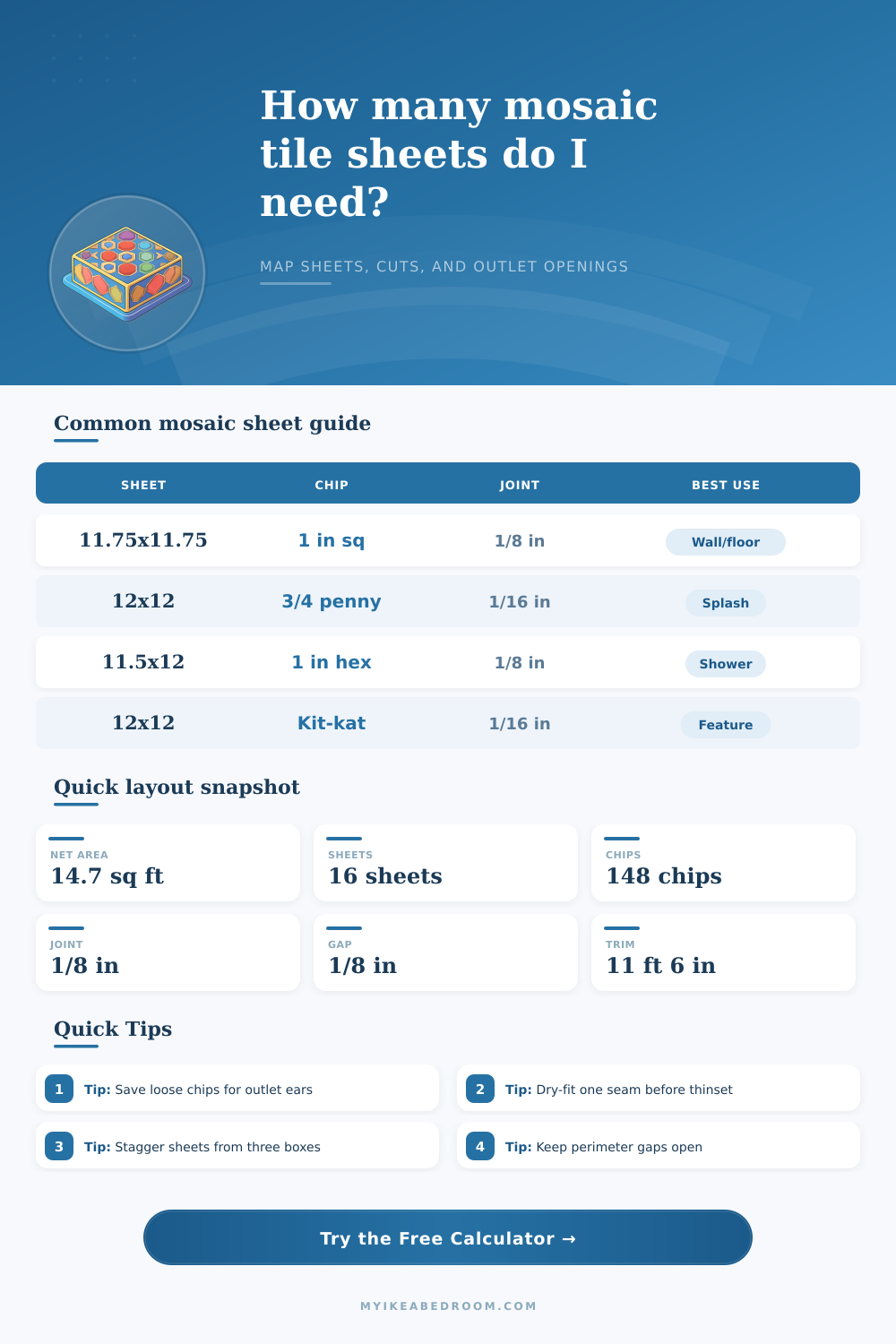
An 10% waste allowance indicates that 10% more mosaic tiles will be purchased than the total area that will be tiled. If using a type of mosaic tile like pebble mosaic tiles, however, an 18% waste allowance should be made for the same reasons that an 18% allowance is made for cutting those tiles. In addition, any small pieces of mosaic tiles that are cut during the dry-fitting process should be saved; these pieces can be used to fill small gaps between the mosaic sheets during installation.
The properties of the mosaic tiles also impact the installation process for those tiles. For instance, glass mosaic tiles will require thin grout lines between the individual mosaic tiles, allowing light to pass through those gaps. Stone and marble mosaic tiles may require wider grout lines between the individual mosaic tiles due to the natural variations in the shape of those tiles.
Additionally, porcelain mosaic tiles are generally easier to cut than either glass or marble mosaic tiles. Regardless of the type of mosaic tiles that will be used, specific tools may be required for cutting those tiles; glass mosaic tiles, for instance, may require a specific blade for the saw to prevent chipping of the tiles, and marble mosaic tiles may require the use of a wet saw to ensure that the cutting process does not damage the tile. Finally, individuals can use reference tables to ensure that the calculations regarding the amount of mosaic tiles and the amount of grout that will be required for a project are correct.
These tables generally list the dimensions of mosaic sheets, the dimensions of grout lines, and the number of tiles that are included in each sheet. These tables can help to verify the measurements that have been taken of the area that will be tiled, as well as the calculations for the amount of mosaic tiles that will be required for that project. By using the information described in these reference tables, individuals can ensure that they purchase the correct amount of mosaic tiles, the correct amount of grout, and that they purchase the correct tools for that project.
Youll find that using these moddern methods helps to avoid mistakes. It is better to have alot of tiles then to not have enough for the rooms size. Making sure you have the right tools is actually very importent for a sucessfull job.