Mirror Weight Calculator
Estimate mirror glass weight, framed total weight, hanger load per point, and handling category from dimensions, shape, glass thickness, backing, frame, bevel, film, and hardware allowance.
Load a common mirror size, then adjust the thickness, frame, backing, hardware, hanger points, or unit system to match the piece in front of you.
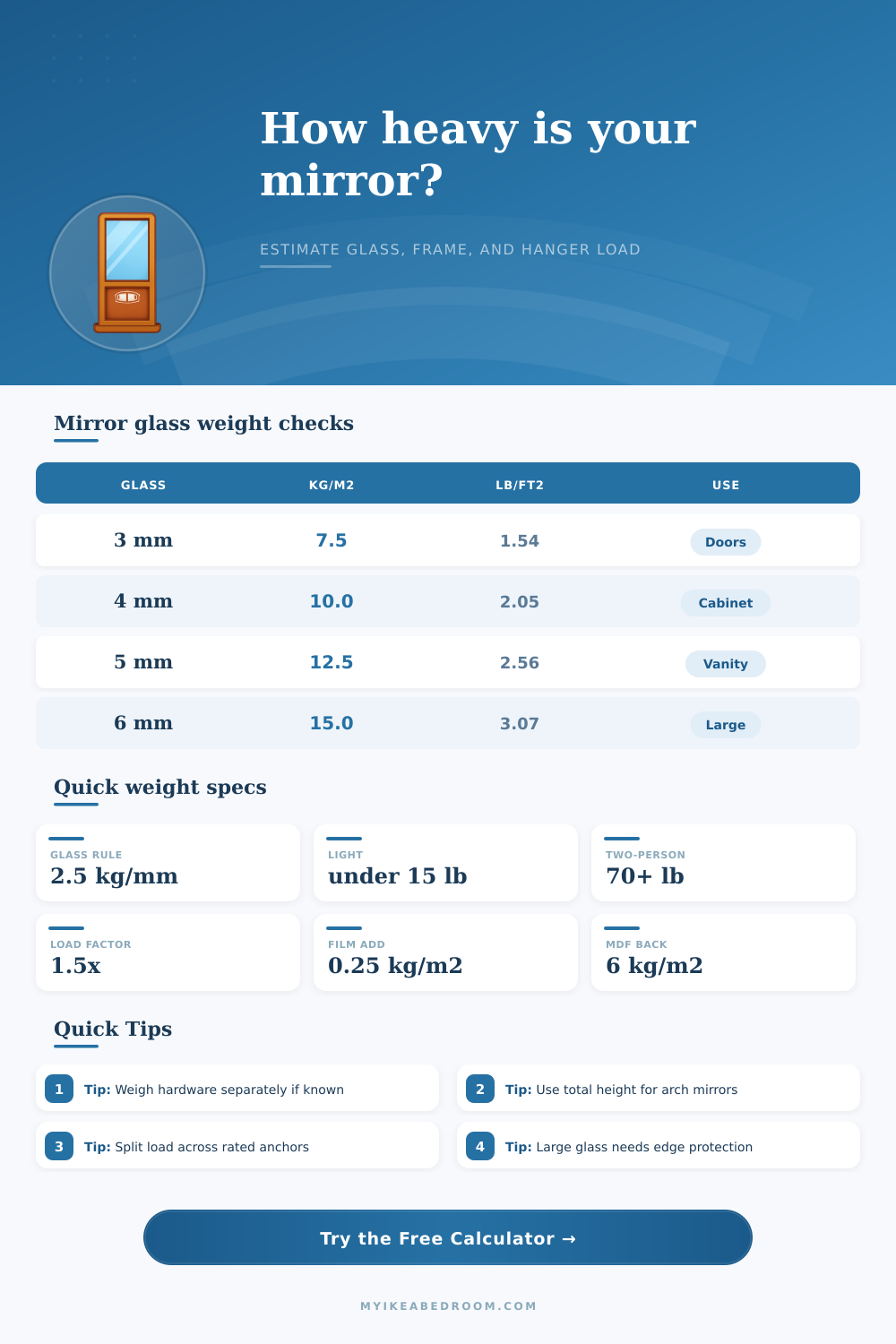
| Thickness | Weight per sq ft | Weight per sq m | Typical mirror use |
|---|---|---|---|
| 3 mm | 1.54 lb/ft² | 7.5 kg/m² | Light closet doors, small inserts, cabinet faces |
| 4 mm | 2.05 lb/ft² | 10.0 kg/m² | Medicine cabinets, framed dresser mirrors, lighter wall mirrors |
| 5 mm | 2.56 lb/ft² | 12.5 kg/m² | Common vanity mirrors and medium framed mirrors |
| 6 mm | 3.07 lb/ft² | 15.0 kg/m² | Large wall mirrors, leaning mirrors, wide bathroom panels |
| 8 mm | 4.10 lb/ft² | 20.0 kg/m² | Heavy feature mirrors and specialty glass |
| 10 mm | 5.12 lb/ft² | 25.0 kg/m² | Very heavy custom glass; confirm support design |
| Layer | Calculator allowance | Where it appears | Weight effect |
|---|---|---|---|
| Paper or foil cover | 0.15 kg/m² | Light framed mirrors | Very small, mainly dust protection |
| Thin board or foam pad | 1.2 kg/m² | Protective rear pads and safety boards | Modest area weight |
| Hardboard panel | 3.5 kg/m² | Framed dresser and hallway mirrors | Noticeable on large pieces |
| MDF back panel | 6.0 kg/m² | Wide decorative frames and door panels | Can rival thin glass weight |
| Safety film | 0.25 to 0.65 kg/m² | Closet doors, bathrooms, family spaces | Small weight add, useful containment |
| Frame material | Weight per ft | Weight per m | Typical use |
|---|---|---|---|
| Slim aluminum | 0.25 lb/ft | 0.37 kg/m | Bathroom, vanity, medicine cabinet, modern slim frames |
| Plastic composite | 0.18 lb/ft | 0.27 kg/m | Light closet or dorm mirrors |
| Light wood | 0.45 lb/ft | 0.67 kg/m | Dresser and hallway frames |
| MDF or laminate | 0.75 lb/ft | 1.12 kg/m | Wide decorative framed mirrors |
| Heavy solid wood | 1.15 lb/ft | 1.71 kg/m | Large leaning mirrors and thick profiles |
| Steel or iron | 1.35 lb/ft | 2.01 kg/m | Industrial or heavy round statement mirrors |
| Mirror type | Typical glass | Approx total | Handling note |
|---|---|---|---|
| 24 in round vanity mirror | 5 mm round glass | 10 to 16 lb | One person can usually position it; use two hands at the edge. |
| 18 x 68 in closet door mirror | 3 mm rectangle glass | 16 to 25 lb | Long and flexible; support the full height while moving. |
| 36 x 30 in dresser mirror | 5 mm with wood frame | 28 to 42 lb | Two people make alignment and fastening much easier. |
| 28 x 42 in arch hallway mirror | 6 mm arch glass | 35 to 55 lb | Protect the arch shoulder and keep frame loads even. |
| 36 x 72 in leaning mirror | 6 mm framed glass | 90 to 125 lb | Plan a two-person lift and anti-tip restraint. |
Full area
Formula: width × height.
Best for wardrobe, dresser, door, cabinet, and leaning mirrors.
Reduced area
Formula: ellipse area from width and height.
Round mirrors are often lighter than a same-size square frame.
Mixed shape
Formula: rectangle plus half circle.
Use total height, not the straight-side height alone.
Rated load
Formula: total weight × 1.5 divided by points.
Check every anchor, rail, clip, and wall connection.
Mounting tip: Compare the calculator's per-point hanger load with the lowest-rated part in the chain: wall anchor, screw, rail, hook, bracket, and frame attachment.
Handling tip: Large mirrors can be awkward before they are truly heavy. Treat long, thin, beveled, or frameless glass as a higher handling category when planning the lift.
When considering the purchase of a new mirror for your home or commerical space, there are many different aspect of the mirror that you should consider before making your final decision. Beyond the style of the mirror that you would like to purchase, one of the most critical aspect of mirrors is the weight of that mirror. If you dont know the weight of the mirror that you are considering, you will not be able to make certain that you purchase the correct anchoring hardware for your drywall.
A calculator can help to determine the weight of a mirror by considering each of the component of the mirror. You can determine the weight of the mirror by considering the thickness of the mirror’s glass. The thicker the mirror, the more weight the mirror will possess.
How to Find Mirror Weight and Pick the Right Anchors
In addition to the thickness of the mirror’s glass, the weight of the mirror also includes the weight of the mirror’s backing. Additionally, you should also account for the weight of the frame of the mirror in the calculation of the total weight of the mirror. If the mirror include a paper cover, the weight of that paper should be accounted for in the calculation.
Additionally, if the mirror includes an MDF panel, you should also account for the weight of that panel. Finally, the weight of the safety film that is applied to the mirror and the hardware that is attached to the mirror can also be accounted for in the calculation of the weight of the mirror. Beyond determining the weight of the mirror, it is also important to consider how the shape of the mirror may impact the total weight of the mirror.
For instance, round mirrors will typically have less weight than square mirror of the same diameter. Additionally, arched mirrors has a different shape than rectangular mirrors, but the calculator accounts for the shape of the arched mirror to ensure that the total weight of the mirror is not undercounted. Finally, mirrors that have irregular shapes have a custom area that can be accounted for in the calculation of the total weight of the mirror.
Once you know the total weight of the mirror that you are considering, you need to calculate how the weight will be distributed across the mounting points of the mirror. In order to ensure the safety of the mirror, a safety factor will be applied to the total weight of the mirror. The total weight will be divided by the number of anchor points that you plan to use for the mirror.
This will tell you the weight that each anchor point will have to support. By determining the weight that each anchor point will have to support, you can determine whether you will need a single anchor or whether you will need a cleat and multiple stud. Determining this information is important, as mirrors that have too much weight per anchor point may sag onto the drywall.
Based off the total weight of the mirror, a handling category can be determined. Categories include light, medium, heavy, and extremely heavy mirror. For instance, one person will typically be able to move mirrors in the light category, while those in the heavy category will require two people to move the mirror.
Additionally, the handling category also accounts for the area of the mirror. For instance, a large mirror may be difficult to move by one person, even if the mirror is not particularly heavy. Thus, the handling category will allow you to determine if you will need to find an extra person to assist in moving the mirror.
In order to understand what the mirror will weigh, each of the inputs of the calculator should account for the specifics of the mirror. For instance, if the mirror will be mounted on a medicine cabinet, you should account for the area and weight of the back panel of the medicine cabinet. Additionally, if the mirror will be a leaning mirror, the allowance for hardware can be used to account for any extra foot that may be necessary for the mirror.
Finally, if the mirror will have a very wide frame made of hardwood, the weight of that frame may be significant and it may be necessary to test various types of frame in order to understand how much the weight of the frame will contribute to the total weight of the mirror. Tables are provided alongside the calculator that help determine the various inputs for the calculator. For instance, there are tables that indicate the weight of the glass mirrors of various thickness.
Additionally, there are tables that indicate the weight of mirrors with various types of backing. While these tables will not replace the calculator, they can help to indicate if your mirror will be light or heavy based on its components. In addition to determining the total weight of the mirror, the calculator can help you to determine how the number of anchor points may impact the total weight of each anchor point for the mirror.
For instance, if you increase the number of anchor points for the mirror, the weight that each anchor point must support will decrease. By decreasing the weight of each anchor point, it is possible to move the mirror from a high-load category to a lower-load category that may be more easily supported by standard drywall hardware. Additionally, the calculator can help to account for the weight of the mounting hardware for the mirror, such as French cleat.
The calculator will account for the weight of that hardware in the allowance for hardware. Finally, it is important to note that the calculator does not measure the strength of your wall. The calculator will calculate the total weight that your mirror will have, but it will not tell you if your studs or drywall can support that weight.
Therefore, it is important to consider the thickness of your drywall and studs prior to using the calculator to determine the weight of the mirror. Additionally, you must also ensure that the drywall anchors that you use are rated to support the weight per anchor point that was calculated by the calculator. It is recommended that any mirrors that come close to the limits of the hardware that will be used to hang the mirror should use additional anchor points or use a lighter backing for the mirror.
Thus, by using this calculator, you can create a plan for your mirror prior to hanging it to your drywall.