Mirror Hanging Height Calculator
Estimate mirror hanger height from eye level, mirror height, household height range, furniture top, clearance above furniture, viewing mode, and hardware drop.
Choose a room situation, then adjust the mirror size, furniture top, clearance, and household height range.
| Viewing mode | Eye-level estimate | Best mirror use | Placement caution |
|---|---|---|---|
| Standing | About 93.5% of body height | Dresser, hall, bathroom, entry console | Check shortest and tallest users, not just average height. |
| Seated | Seat height plus seated eye rise | Vanity, makeup station, desk mirror | Furniture clearance can push the mirror too high for seated users. |
| Mixed | Lower seated eye to taller standing eye | Entry bench or shared dressing area | A taller mirror usually matters more than shifting the centerline. |
| Custom | Measured floor-to-eye band | Accessibility, kids, unusual furniture | Use actual measurements when posture or seating is not typical. |
| Furniture or wall condition | Typical top height | Common mirror gap | Why it matters |
|---|---|---|---|
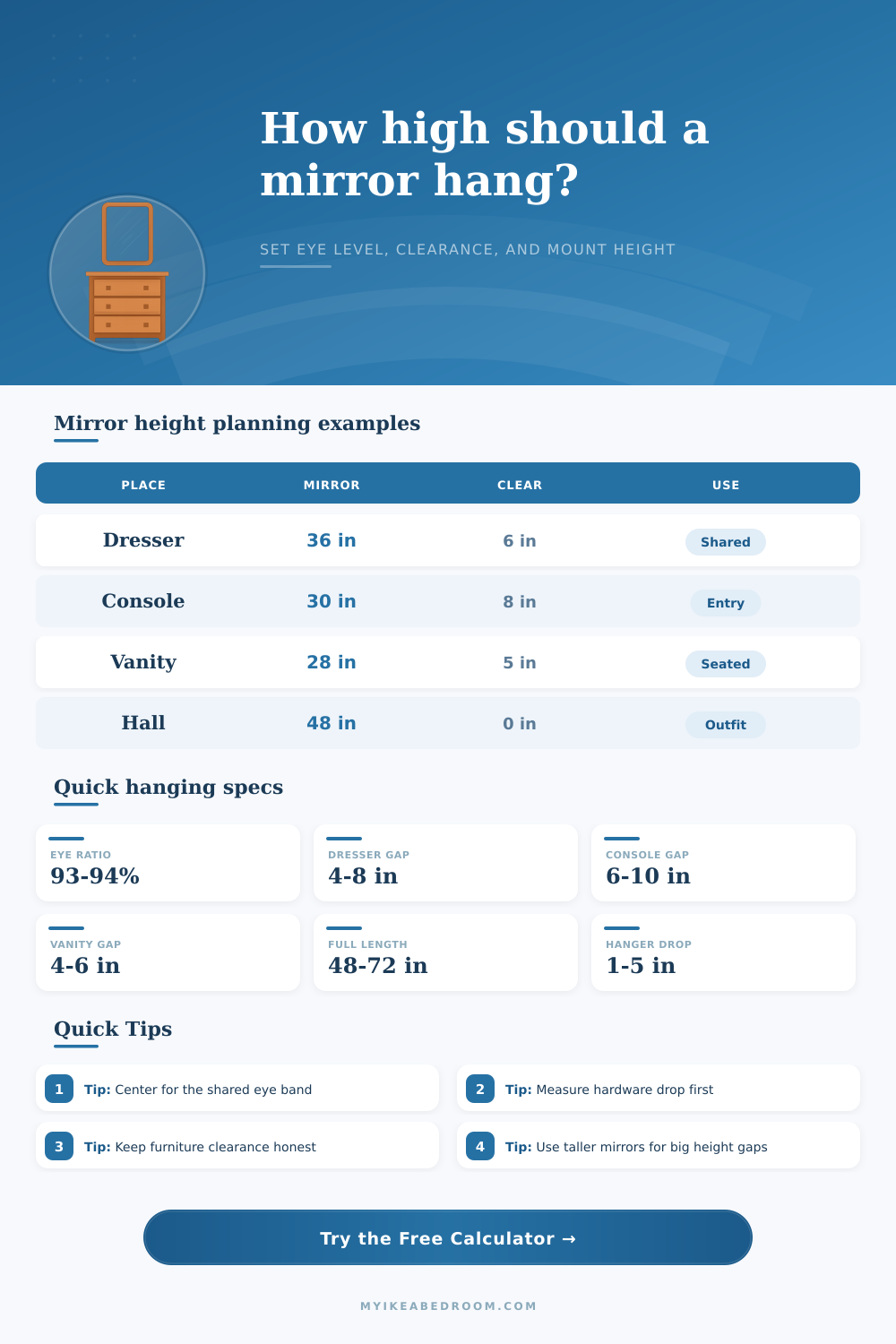
| Bedroom dresser | 30 to 38 in / 76 to 97 cm | 4 to 8 in / 10 to 20 cm | Leaves room for objects while keeping the mirror usable. |
| Entry console | 30 to 34 in / 76 to 86 cm | 6 to 10 in / 15 to 25 cm | Gives a cleaner proportion above narrow tables and keys trays. |
| Bathroom sink ledge | 32 to 36 in / 81 to 91 cm | 4 to 6 in / 10 to 15 cm | Keeps splash clearance without losing seated or shorter-user visibility. |
| Entry bench | 17 to 20 in / 43 to 51 cm | 12 to 24 in / 30 to 61 cm | Bench mirrors often serve both seated and standing checks. |
| Standalone wall | 0 in / 0 cm | 0 in / 0 cm | Bottom edge can be driven entirely by reflection goal and safety. |
| Reflection goal | Useful mirror height | Mounting tendency | Household range note |
|---|---|---|---|
| Face only | 18 to 28 in / 46 to 71 cm | Center near eye level | Small height differences are easy to cover. |
| Head and shoulders | 24 to 36 in / 61 to 91 cm | Center slightly below average eye level | Good everyday bedroom and entry choice. |
| Head to waist | 32 to 44 in / 81 to 112 cm | Lower bottom edge if furniture allows | Furniture top often becomes the limiting constraint. |
| Upper outfit | 40 to 56 in / 102 to 142 cm | Bottom edge matters more | Better for mixed-height households. |
| Full length | 48 to 72 in / 122 to 183 cm | Bottom edge low, top high enough | Short mirrors cannot cover every user fully. |
| Scenario | Mirror size | Furniture top and gap | Household range | Main constraint |
|---|---|---|---|---|
| Dresser shared adults | 30 x 36 in / 76 x 91 cm | 34 in top, 6 in gap | 64 to 72 in / 163 to 183 cm | Balanced standing eye band |
| Entry console | 28 x 30 in / 71 x 76 cm | 32 in top, 8 in gap | 62 to 74 in / 157 to 188 cm | Console clearance sets the low edge |
| Seated vanity | 26 x 28 in / 66 x 71 cm | 30 in top, 5 in gap | 61 to 69 in / 155 to 175 cm | Seated eye level is lower |
| Full-length hall | 20 x 60 in / 51 x 152 cm | No furniture | 60 to 76 in / 152 to 193 cm | Mirror height drives coverage |
| Child room | 22 x 32 in / 56 x 81 cm | 24 in top, 5 in gap | 44 to 60 in / 112 to 152 cm | Lower eye band and growth room |
Best for: shared bedroom grooming.
Start from standing eye level, then use the furniture top and chosen clearance to set the minimum bottom edge.
Best for: quick face and shoulder checks.
A taller household often needs the mirror center higher, while the console gap prevents the mirror from dropping too low.
Best for: makeup, hair, and desk use.
Use seated mode so the calculator does not place the mirror at a standing-only height.
Best for: outfit checks.
The mirror bottom usually needs to sit low; if it is above furniture, full-length coverage becomes difficult.
Mark the hanger, not the mirror top. Wire, D-rings, keyholes, and cleats all place the wall fastener below the top edge by a different amount, so the hardware drop must be measured on the actual mirror.
Let clearance and eye level negotiate. If the furniture gap pushes the mirror above the shortest user's useful view, either reduce the clearance, choose a taller mirror, or move the mirror to a standalone wall.
To determine the correct height for an mirror, there are many specific measurement that must be took into consideration. When many people attempts to purchase a mirror, they will attempt to guess at the height that is necessary for the mirror to be place at an appropriate height for those who will use the mirror. By guessing the height of the mirror, however, people may end up with a mirror that is either too high or too low relative to the users of the mirror.
For instance, if the mirror is too high, the top of the mirror may end up cutting off the user face. Similarly, if the mirror is too low, the bottom of the mirror may end up making it difficult for the person to view there outfit. Each of these factor, though, are just a few of the many factors that must be considered to determine the height at which a mirror should be placed.
How to Hang a Mirror at the Right Height
The calculator provide specific measurements for the hanger mark, the centerline, and the bottom edge of the mirror. To input these measurements, you must enter the height of the shortest user and the tallest user in the house into the calculator. Additionally, the viewing mode, the reflection goal, and the desired clearance above the furniture in the house must also be entered into the calculator.
Based on these different inputs, the calculator can output the measurement for the hanger mark, the centerline, and the bottom edge of the mirror. Furthermore, the reference tables included in the article will allow the user to determine if the measurements calculated by the mirror height calculator are within the normal ranges. Another of the factors that can impact the height of the mirror that is to be hung in the house is the furniture clearance.
For instance, the mirror may need to be hung in a manner that creates some degree of gap between the top of the furniture in the room to which the mirror is to be hung and the bottom edge of the mirror. For instance, a gap of six inches may be desire between the top of the dresser and the bottom of the mirror. Should that clearance, however, be increased to ten inches, the mirror may end up being hung at a height that is not appropriate for the shortest individual in the house.
The mirror height calculator will reveal such conflicts between the desired furnitures and the height of the individuals in the house within the “fit” label for the individual height, preventing any surprises after the mirror is hung on the wall. In addition to the factors related to the individuals in the house, there are also different viewing modes for mirrors that will impact the calculation of the height at which the mirror should be hung. For instance, standing eye level is approximately ninety-three percent of an individual’s total body height, but seated eye level is lower by the height of the individual’s seat and their torso when they are seated.
By selecting seated mode for the mirror (such as for a vanity in the bathroom), the calculator will lower the height of the mirror to reflect the lower eye level when seated. By choosing mixed mode, though, the user can set the height of the mirror to the point that is halfway between the seated eye level of the shorter individual and the standing eye level of the taller individual. This can be beneficial for entry-benches in the house, for instance, as these mirrors may be used both when standing and when seated.
The changes to the calculations for these different viewing modes reflect the changes in the required midpoint spans for the mirror. The type of hardware that is to be used to hang the mirror may also have an impact upon the height at which the mirror should be hung. For instance, picture wire droop more than a D-ring or a keyhole slot that can be used to hang the mirror on the wall.
Thus, if desired, the user may measure the actual height of the hardware that will be used to hang the mirror and input it into the calculator to ensure that any changes in the drop of the hardware will impact the calculations for the height of the mirror. Thus, even with all of the other factors being held constant, the change in the drop of the hardware will impact the required height for the mirrors hanger. Finally, the height range of the individuals in the house will have an impact upon the height of the mirror that is to be purchased.
For instance, if the height of the individual in the house has a range of only eight inches, then a thirty-six inch mirror may be sufficient for all of the individuals in the house. However, should the height of the individuals in the house have a range of sixteen inches, a thirty-six inch mirror may result in some individual only being able to view their forehead while others can only view there chin. The reference tables that are provided for mirrors of different heights will reveal when a taller mirror is the better solution to the problem of insufficient visibility of different portions of the face compared to adjusting the placement of a shorter mirror.
These different tables allow for individuals to try out different combinations of measurements for the individuals in the house prior to purchasing the mirror and drilling a hole in the wall to hang it. It’s going to be alot of work to make sure you got it right.