MDF Weight Capacity Calculator
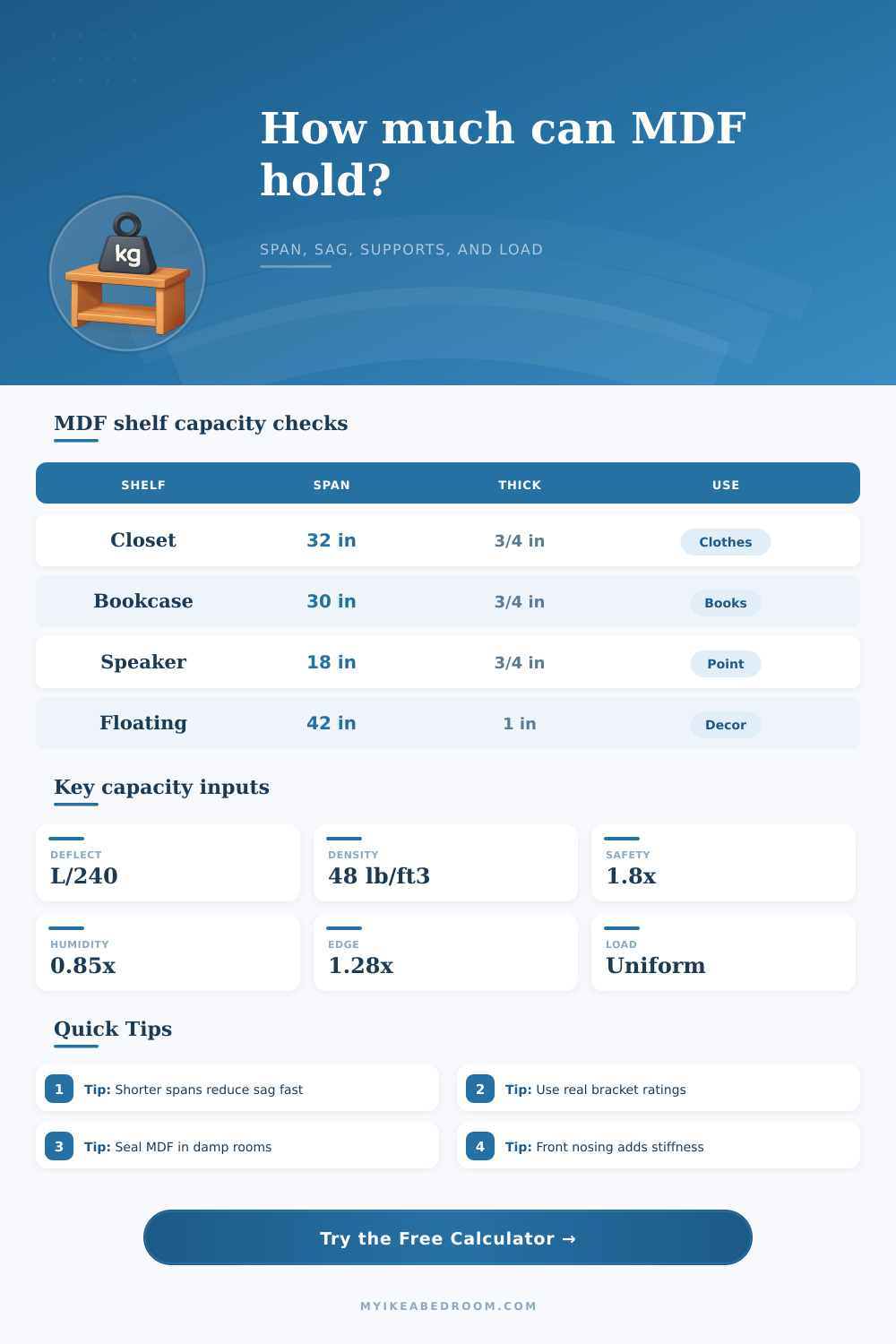
Estimate safe MDF shelf load from span, depth, thickness, MDF grade, support style, load distribution, edge reinforcement, humidity, deflection limit, and safety factor.
Choose a familiar MDF use case, then adjust the dimensions, support rating, load pattern, humidity, and reinforcement to match your project.
| Unsupported span | No edge | 1/4 in edge band | 3/4 in nosing | Planning note |
|---|---|---|---|---|
| 18 in | 95 lb | 112 lb | 132 lb | Usually support-controlled with pins or brackets. |
| 24 in | 53 lb | 63 lb | 74 lb | Good for clothes, bins, and light books. |
| 30 in | 34 lb | 40 lb | 48 lb | Visible sag can appear with book loads. |
| 36 in | 24 lb | 28 lb | 33 lb | Add a center support for heavier storage. |
| 48 in | 13 lb | 16 lb | 19 lb | Long MDF spans need framing or dividers. |
| Load distribution | Factor | Deflection model | Best used for |
|---|---|---|---|
| Evenly distributed | 1.00x | Uniform load | Clothes, linens, evenly spaced books, display objects. |
| Mixed bins and books | 0.84x | Uniform with peaks | Storage boxes, baskets, binders, mixed household loads. |
| Front-heavy shelf load | 0.65x | Uniform plus torsion penalty | Deep pantry shelves and items pulled to the front lip. |
| Single center load | 0.56x | Center point load | One speaker, small appliance, tool box, or heavy bin. |
| Two heavy items near thirds | 0.72x | Equivalent point pair | Two speakers, stacks, or equipment feet on one shelf. |
| Support style | Board factor | Starting supports | Capacity caution |
|---|---|---|---|
| Shelf pins or pegs | 0.72x | 4 pins | Pin hole wear and side-panel material may govern. |
| Side cleats or dados | 1.05x | 2 bearing sides | Good bearing if glued or fastened into strong sides. |
| Wall brackets | 0.90x | 2 or more | Studs, anchors, and bracket rating often govern. |
| Floating rods | 0.55x | 2 or more | Front-edge loads create high leverage. |
| Full front and side frame | 1.35x | 2 sides plus frame | Frame helps if it is continuous and well fastened. |
| Stored items | Typical density | Sag risk | Planning note |
|---|---|---|---|
| Decor and framed photos | 4 to 8 lb/sq ft | Low | Appearance and level brackets matter most. |
| Folded clothes or linens | 8 to 16 lb/sq ft | Moderate | Wide closet shelves benefit from rear cleats. |
| Books and binders | 22 to 40 lb/sq ft | High | Short spans, solid nosing, or dividers help. |
| Speakers or equipment | Point load | Very high | Use the center-load option and verified brackets. |
| Pantry cans or tools | 30 to 55 lb/sq ft | Very high | Support and fastener limits usually control. |
Closet shelves
Rear cleats help MDF carry folded clothing, but long spans still sag if the front edge is unsupported.
For wide closets, a center divider changes the estimate quickly.
Bookcase shelves
Books are dense, so a painted MDF shelf can be deflection-limited before it looks overloaded.
Solid wood nosing can improve stiffness and hide the MDF edge.
Floating shelves
Leverage controls many floating MDF shelves because the front edge is far from the wall support.
Use actual rod, bracket, stud, and anchor ratings for the final check.
Cabinet panels
Side bearing and short spans make cabinet bottoms more predictable than open wall shelves.
Moisture and point loads from appliances still need extra margin.
MDF is a material that are often used to construct closets, bookcases, and floating shelves. MDF is valued for its smooth texture and affordability. Despite the benefits of MDF, MDF does have some limit to its properties; the middle of an MDF shelf is prone to bowing.
The strength of MDF shelves is dependent upon the weight that the shelf will hold, the length of the shelf, the thickness of the MDF, the edge condition of the MDF, and the way that the items to be place upon the shelf will bear upon the shelf. Shelf sag is a problem of stiffness rather than one of breaking. The fine fibers that comprises MDF are likely to bend under a constant load placed upon the MDF shelf.
How to Stop MDF Shelves from Sagging
The longer the span of a shelf, the more pronounced the bend of the MDF will be. For instance, a closet shelf with a twenty-four inch span may feel solid, but a closet shelf with a thirty-six inch span may begin to look tired after placement of items of similar total weight. Shortening the span of a shelf will increase the stiffness of the MDF shelf more effective than increasing the thickness of the MDF.
The thickness of the MDF will impact the stiffness of the shelf. The more inches of thickness that the MDF shelf has, the stiffer the shelf will be. Furthermore, small increases in the thickness of the MDF will lead to large gains in the resistance of the MDF shelf to bending.
Builders often use three-quarter inch MDF as it is available in common sizes. However, you can replace using half inch MDF by using three-quarter inch MDF, which will double the amount of weight that the shelf can hold before the deflection of the shelf becomes visible. The thickness of the MDF can be entered into a calculator to determine whether the cost of using thicker MDF will provide the stiffness required for the shelves that will be construct.
Adding a solid wood nosing to the shelf can increase the strength of the MDF shelf. A painted or taped edge will not increase the strength of the MDF, but adding a solid wood nosing that is glued to the MDF shelf will turn the MDF shelf into a shallow beam. The wood will fight against the tensile and compressive loads that is placed upon the outer fibers of the MDF boards.
Additionally, the bending loads are strongest upon the outer fibers of the MDF boards. By adding a solid wood nosing, the MDF shelf will be able to support more weight before the middle of the MDF begins to dip. A tool can be used to compare the appearance of a shelf with bare MDF edges to the same shelf with a deeper rail or metal angle added to the shelf.
The supports that are used for the MDF shelves will impact the stiffness of the MDF shelves. Shelf pins are common supports for MDF shelves. However, the weight placed upon the shelves will be transferred through small holes in the MDF boards, which may eventually lead to the boards crushing under the weight of the items placed upon the shelves.
Side cleats and rear rails are alternative supports for MDF shelves. Side cleats and rear rails will help to distribute the weight placed upon the MDF shelf, reducing the point stress upon the shelf. Floating brackets is another method of supporting MDF shelves.
However, floating brackets may lead to the front of the MDF shelf being placed a significant distance from the wall anchors. The supports that are to be used can be entered into a calculator, which will calculate the amount of the total load that each support will carry. The humidity within the space that the shelves will be constructed will impact the stiffness of the MDF.
MDF will absorb moisture from the air. As the MDF becomes swollen with moisture, the stiffness of the MDF will decrease. For instance, a shelf that is constructed of MDF that can support heavy items in a dry bedroom may begin to sag in a laundry room or in an unsealed garage.
The humidity within the space can be entered into a calculator to adjust for the reduction in the stiffness of the MDF in damp areas. Additionally, sealing the edges and the faces of the MDF will prevent the MDF shelf from absorbing moisture, which will slow the rate at which the MDF absorbs moisture from the air. The way that the load is placed upon a shelf can have an impact upon the stiffness of the MDF.
Placing a heavy load upon only one portion of a shelf may create a twisting moment upon the MDF shelf that the MDF was not design to resist. Instead, placing heavy items in areas near the middle of the MDF will be better for the shelf than placing those items near the front lip of the shelf. Additionally, items with bins or speakers may be better placed near the middle of the shelf rather than at the front lip.
The type of load that will be placed upon the shelf can be entered into a calculator to determine the impact of the placement of certain items upon the total amount of weight that can be supported by the MDF shelf. A safety factor can be used in the calculations for the MDF shelf prior to completing the project. A safety factor of 1.5 can be used for decorative items placed upon the shelf.
Items that weigh as much as books or tools will require a higher factor of safety. The calculator performs the reductions to the strength of the MDF after the safety factor is applied. A safety factor of 1.5 will provide for the introduction of slight compromises into the construction of the MDF shelf.
For instance, the safety factor can be used to test the placement of a support bracket between studs or the use of a noosing that is too thick for the tools that are available for the project. Such a tool will allow the project to determine if any such changes is required to the project. MDF is not a fragile material if the calculations are followed carefully and accurately.
MDF is, however, a forgiving material if the calculations is incorrect. The best method of determining the limits of the MDF shelves that are to be constructed is to enter the dimensions of the shelves into a calculator. This will ensure that the MDF shelves will be able to hold their weight without sagging.