Mattress Weight Calculator
Estimate a mattress weight from finished width, length, thickness, construction, foam density, latex density, spring density, cover allowance, and moving buffer. Results show pounds, kilograms, volume, and lift guidance.
Choose a common US or EU mattress scenario, then adjust thickness, densities, and allowances for the actual bed.
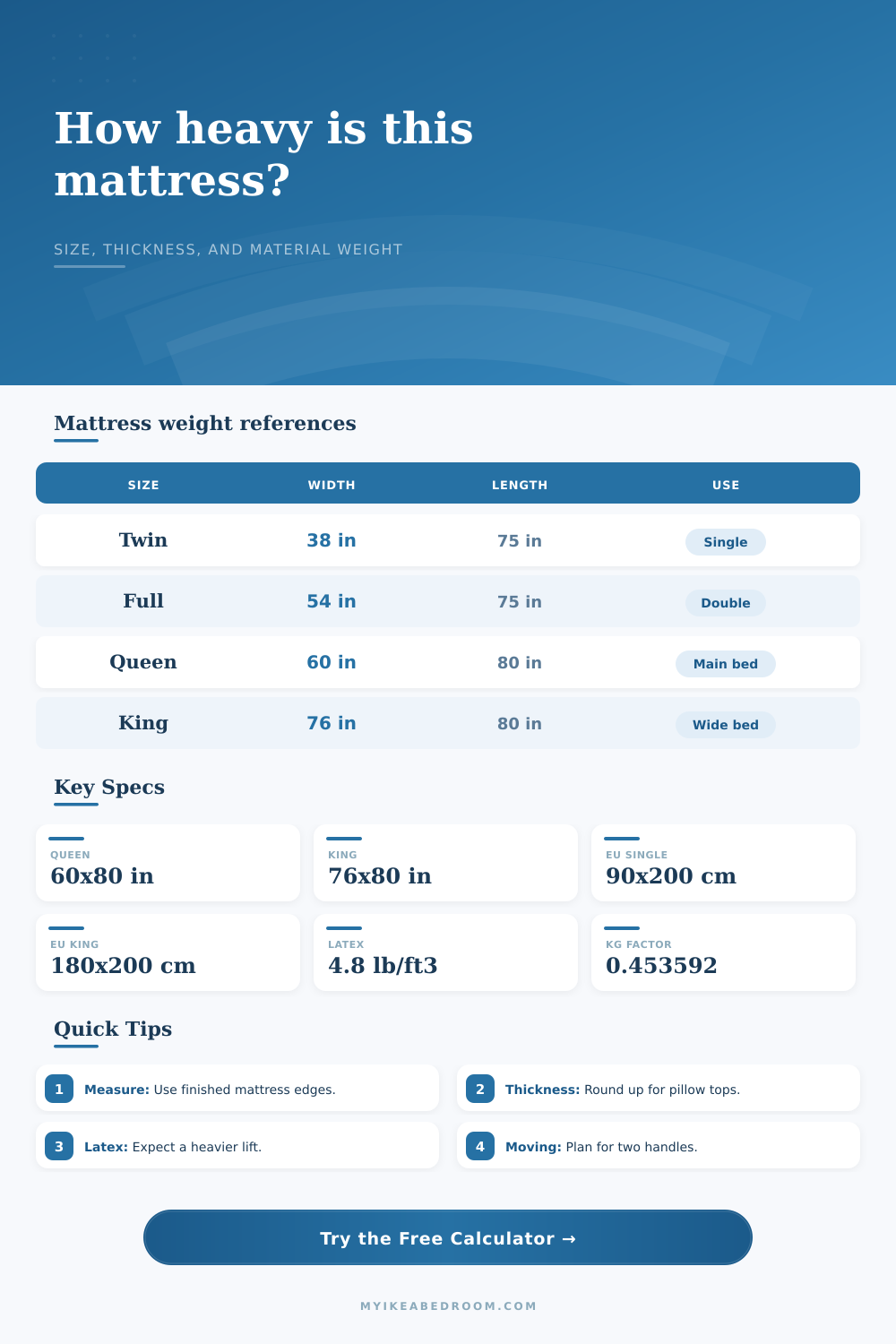
| US size | Width | Length | Notes |
|---|---|---|---|
| Twin | 38 in | 75 in | Single sleeper and narrow guest beds. |
| Twin XL | 38 in | 80 in | Longer single sleeper size. |
| Full | 54 in | 75 in | Wider single or compact double bed. |
| Queen | 60 in | 80 in | Common main bedroom size. |
| King | 76 in | 80 in | Wide paired-sleeper size. |
| Cal King | 72 in | 84 in | Longer king layout for tall sleepers. |
| EU size | Width | Length | Approx inches |
|---|---|---|---|
| EU Single | 90 cm | 200 cm | 35.4 x 78.7 in |
| EU Small Double | 120 cm | 200 cm | 47.2 x 78.7 in |
| EU Double | 140 cm | 200 cm | 55.1 x 78.7 in |
| EU Queen | 160 cm | 200 cm | 63.0 x 78.7 in |
| EU King | 180 cm | 200 cm | 70.9 x 78.7 in |
| Material or core | Typical density | Metric density | Calculator use |
|---|---|---|---|
| Low to medium polyfoam | 1.5 to 2.5 lb/ft³ | 24 to 40 kg/m³ | Budget foam comfort or base layers. |
| Memory foam | 3.0 to 5.0 lb/ft³ | 48 to 80 kg/m³ | Dense comfort layers and all-foam beds. |
| Latex foam | 4.3 to 5.9 lb/ft³ | 69 to 95 kg/m³ | All-latex or latex-over-core mattresses. |
| Pocket spring core | 1.0 to 1.8 lb/ft³ | 16 to 29 kg/m³ | Equivalent density for coil volume. |
| Air core with foam rails | 0.6 to 1.0 lb/ft³ | 10 to 16 kg/m³ | Air chamber plus support perimeter. |
| Thickness | Volume | At 2.0 lb/ft³ | At 4.8 lb/ft³ |
|---|---|---|---|
| 6 in | 16.7 ft³ | 33 lb before cover | 80 lb before cover |
| 8 in | 22.2 ft³ | 44 lb before cover | 107 lb before cover |
| 10 in | 27.8 ft³ | 56 lb before cover | 133 lb before cover |
| 12 in | 33.3 ft³ | 67 lb before cover | 160 lb before cover |
| 14 in | 38.9 ft³ | 78 lb before cover | 187 lb before cover |
Use finished dimensions: Measure the actual mattress edge to edge, because rounded corners and sewn borders can differ from the label size.
Separate the layers: For hybrids, the spring core usually occupies most of the thickness while denser foam or latex sits above it.
Round for moving: Add a handling buffer when planning stairs, vans, or storage because covers and bends make the load feel heavier.
Watch latex: Latex uses much higher density than most foam, so a thinner latex mattress can still weigh more than a thick spring mattress.
If it seems like a lightweight mattress would be simple to move, think again. Its actual weight isn’t determined by its apparent thickness; rather, it’s based off how thick and heavy the materials within it are. A thick mattress can actually weigh less than a thin mattress if the inner layers is dense. Before picking up the bed, find out what it’s made of.
This eliminates any guesswork, the calculator on that page takes into account both the type of material the mattress is made from, and its overall volume. A mattress is typically thought of as just one solid piece of foam, when in reality most mattress these days consist of several layers of varying materials. For example, the top may be a plush memory foam layer for cushioning, with a dense polyfoam or even steel coil base below it.
How to Check Mattress Weight
Different materials weigh differently per cubic foot. This allows you to define the size of your mattress’ comfort layer and support core. From there, it will assigns the appropriate density value to each layer.
Latex is the densest material of the commonly used materials. It’s also very heavy. A fully latex queen mattress can weigh twice as much than a couple of large adult.
Memory foam is denser than traditional polyurethane foam, though it’s less dense than latex. Polyfoam is the least dense by far, which is why budget mattresses tend to be so flimsy when moved around. These densities are clearly presented in the reference tables on the page. You don’t have to memorize any of this information. Just figure out what category your bed falls under.
A core in the spring can be problematic, as it’s largely filled with air. While the coils themselves is very heavy, the spaces between them aren’t. To account for this, the calculator treats the spring part as having one density throughout. So it considers the weight of all the metal, but knows there isn’t anything solid about the core itself. If your bed is a hybrid (springs underneath, foam on top), then the tool breaks up the volume into two sections. It will calculate how much the foam weighs and then include average weight of whatever is under the foam, such as springs. That way it gives you a better estimate than just multiplying by volume alone.
The edges and the cover matter. Weight comes from handles, glue, quilting and fabric. Add some cotton and batting, and a thick quilted top can tack on a few pounds. The percentage allowance in the calculator includes those items.
You can also input a buffer for moving conditions. Lugging a mattress up three flights of stairs is more difficult than lugging it across a flat floor. The buffer provides a percentage addition to the final weight for the awkwardness of lifting. It helps you know what to expect of the effort so that your expectations are realistic.
The weight doesn’t always scale linearly with thickness. For example, just because something is 12 inches thick doesn’t mean it’s double the weight of a 6 inch version. That all comes down to what’s inside. One foot of latex is going to be way more dense than 12″ of polyfoam. The layers matter. We want you to give us exactly what layer types and how many inches each layer are. That way we don’t assume you’re thinking about weight in terms of volume.
Knowing your weights will help you plan. Whether you rent a truck or use movers, knowing how much stuff weighs will ensure you don’t get hit with a weight charge. Don’t get started without checking your measurements first. Enter the exact dimensions of your mattress, what it’s going to be once finished.
Remember: the box is always bigger than the bed itself. Measure across the bed from one side to the other. Enter the thickness including any pillow top. If your bed is a custom size, simply type in its length and width. Everything gets converted into standard units. You’ll recieve the volume (in cubic feet) as well as the weight (in both kg and pounds). This way you can know how much space the bed will take up in your storage unit or van.
Moving a heavy mattress is typically a two-man operation. With the weight number that the calculator spits out, you can plan for a lift. That means dividing the total weight evenly between two people. In a typical two-man lift, this is the amount of weight each person will likely carry. If that sounds like too much, consider renting a dolly or hiring additional helpers.
Don’t go up against the math and see what happens to your back. The facts aren’t there to hurt you; they are there to prevent you from hurting yourself.
You should of known. Knowing what makes up the bed shifts the operation from dangerous guesswork to a calculated effort. You may still have trouble navigating the stairs, but at least you won’t be surprised by an unexpected heft. The math saves you from surprise.