Material Waste Factor Calculator
Estimate how much material to order from base quantity, material waste percentage, cutting complexity, pattern matching, damage allowance, rounding packs, and metric conversions.
▦Material and Project Presets
Choose a realistic starting point, then adjust the quantity, waste factors, and rounding size for your own project.
⚙Waste Factor Inputs
Material Waste Factor Results
▣Waste Factor Material Grid
ℹMaterial Waste Reference Table
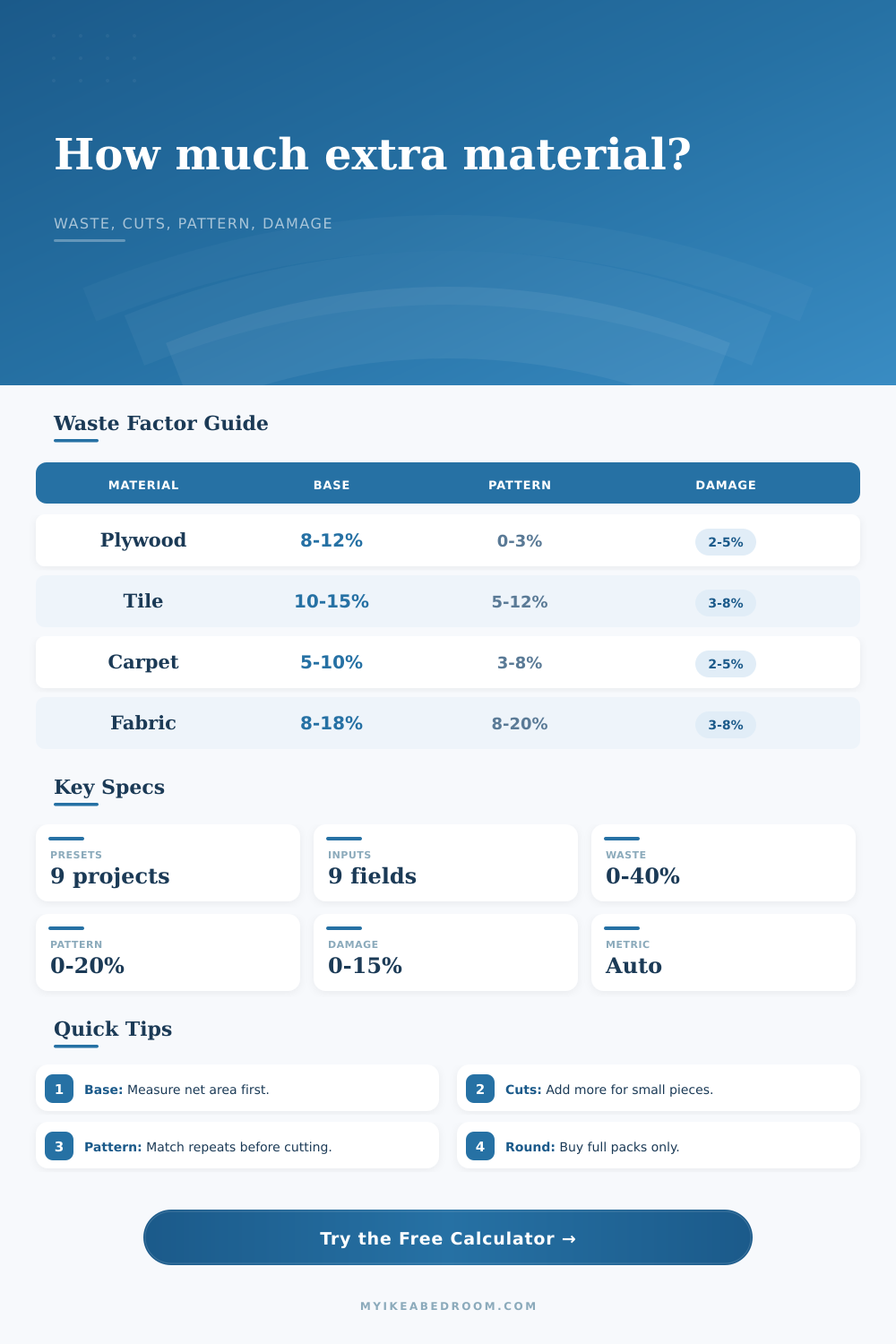
| Material | Typical Base Waste | Pattern Match Add-On | Damage Allowance |
|---|---|---|---|
| Plywood and sheet goods | 8-12% | 0-4% for visible grain | 2-5% for chips or shop errors |
| Tile and stone pieces | 10-15% | 5-12% for diagonal or layout match | 3-8% for breakage |
| Wallpaper and wall covering | 8-15% | 8-20% for repeat matching | 2-5% for trimming or tears |
| Carpet and sheet flooring | 5-10% | 3-8% for nap direction | 2-5% for seams and defects |
| Fabric and upholstery | 8-18% | 8-20% for repeat or stripe alignment | 3-8% for cutting mistakes |
▤Metric Conversion Table
| Quantity Type | Imperial Unit | Metric Unit | Conversion Used |
|---|---|---|---|
| Area material | Square feet | Square meters | 1 sq ft = 0.092903 sq m |
| Linear material | Linear feet | Linear meters | 1 ft = 0.3048 m |
| Liquid finish | Gallons | Liters | 1 gal = 3.78541 L |
| Piece count | Pieces | Pieces | Counts are rounded whole units |
▥Preset Project Breakdown
| Preset | Base Quantity | Main Waste Drivers | Rounding Target |
|---|---|---|---|
| Plywood closet panels | 96 sq ft | Sheet yield, saw cuts, grain face | 32 sq ft sheets |
| Bathroom floor tile | 58 sq ft | Diagonal cuts, breakage, layout | 12 sq ft cartons |
| Wallpaper accent wall | 120 sq ft | Repeat match, trim loss, tears | 56 sq ft rolls |
| Bedroom carpet | 168 sq ft | Seams, nap direction, edge trimming | 12 linear ft roll width |
| Upholstery fabric | 18 linear yd | Pattern repeat and cushion cuts | 1 linear yd increments |
✦Waste Planning Tips
Measure the floor. Check the math. Go to the store. You head home confident, only to find yourself in the aisle wondering why you didn’t remember that a circle generates more waste then a square. You realize you’re actualy three sheets of plywood shy of what you need. It is a rite of passage for every contractor everywhere.
That’s when the budget bleeds and the project stalls, when there’s a difference between theoretical space and real-world space. Once you plug in your starting dimensions, the calculator above will do the math for you, sparing you the guesswork as to how much of a safety net (five percent?) versus a buffer (fifteen percent?) should be built into your fancy layout.
Understanding Construction Waste
The problem: Waste isn’t one value; it’s many. That’s the waste of having to cut shapes out of rectangles of sheet goods. It is the waste of receiving rolls of carpet that tear easy. It is the waste of attempting to align a busy floral wallpaper pattern on a wall and throwing half a roll away because stems don’t quite line up.
And if you think about your waste in terms of one flat value, this amount is waste! Then you are missing the physics of the thing in your hand. So the secret is really knowing what you’re measuring before you sum it all up.
Or take a diagonal tile floor. Ten percent extra for edge cuts seems reasonable if it was a straight run. But when you lay it out on a forty-five degree angle, all those cut-off bits on each wall turns into worthless pieces. With the calculator, you can separate your waste caused by actual material (the tiles) from the waste caused by cutting complexity.
In this case, even though the tiles themselves are solid, their shape make cutting them very difficult so we can instruct the calculator to give us a high score for cutting complexity. In contrast, we’ll keep the material itself as low because the tiles is solid. The reason you want to do this is because wasted cut material is different than broken tile material. One is geometry you can predict; the other is sheer misfortune.
Pattern matching is the thing that burns most homeowners. It seems like such a small aesthetic detail…but it’s hugely material. So if your fabric has a twenty-four inch repeat, you’re not just cutting to length. No! You’ve got to pull out enough additional yardage until you come across two matching points in the pattern.
And that’s typically an additional two to three yards no matter what size adult-sized sofa you’re working on. Pattern matching can double your typical waste allowance for materials like wallpaper or upholstery. You can check out the reference table on the page.
Not accounting for pattern matching means you order just the right amount for those walls. Only to realize that you now need an additional three feet of fabric to complete the final cushion. Before you judge if you should of ordered one or two rolls, account for the pattern allowance first.
And then there’s damage, which is the wildcard. Sheet goods will chip. Tile will crack on the way home. And paint? Well, let’s not talk about that. That three percent might sound minuscule, but it’s enough to absorb the cabinet door you slice open while installing hinges on a big old kitchen remodel.
It’s a little thing. But it adds up. When you’re waiting two weeks for your replacement sheet, it matter. The final feature allows you to enter a separate damage allowance from your cut waste, helping you realize that some loss is just the cost of doing business in a physical world.
The last reality check is that you round to package size. So you might think you need 96.4 square feet of tile. Well, you don’t get to buy.4 square feet of anything. You’ll buy the next whole box. If you’re close to the edge of a box, this rounding can suddenly tack on an extra ten percent to your bill.
With the calculator, you see upfront exactly how many packages you are going to be loading into your truck. This forces a reality check early on, turning abstract square footage into real purchase decisions.
That’s because planning for waste isn’t pessimism; it’s respect for the geometry of the task at hand. Once you learn to treat defects, pattern, and cuts as distinct entities, you no longer buy blindly. You begin to buy strategically.
You’ll measure the floor, sure. You’ll also measure your impending mess. That is how you ensure the material outlasts the design intent.