Log Cabin Quilt Calculator
Plan a log cabin quilt top from finished size, block recipe, center square, log width, sashing, borders, backing allowance, batting allowance, binding strips, and fabric width.
Choose a common quilt plan, then refine the finished top size, block geometry, borders, and yardage assumptions.
| Finished block | Center square | Log width | Rounds | Logs per block |
|---|---|---|---|---|
| 6 in block | 2 in center | 1 in logs | 2 | 8 logs |
| 8 in block | 2 in center | 1 in logs | 3 | 12 logs |
| 10 in block | 2 in center | 1 in logs | 4 | 16 logs |
| 12 in block | 3 in center | 1.5 in logs | 3 | 12 logs |
| Project | Finished target | Block size | Typical grid | Block count |
|---|---|---|---|---|
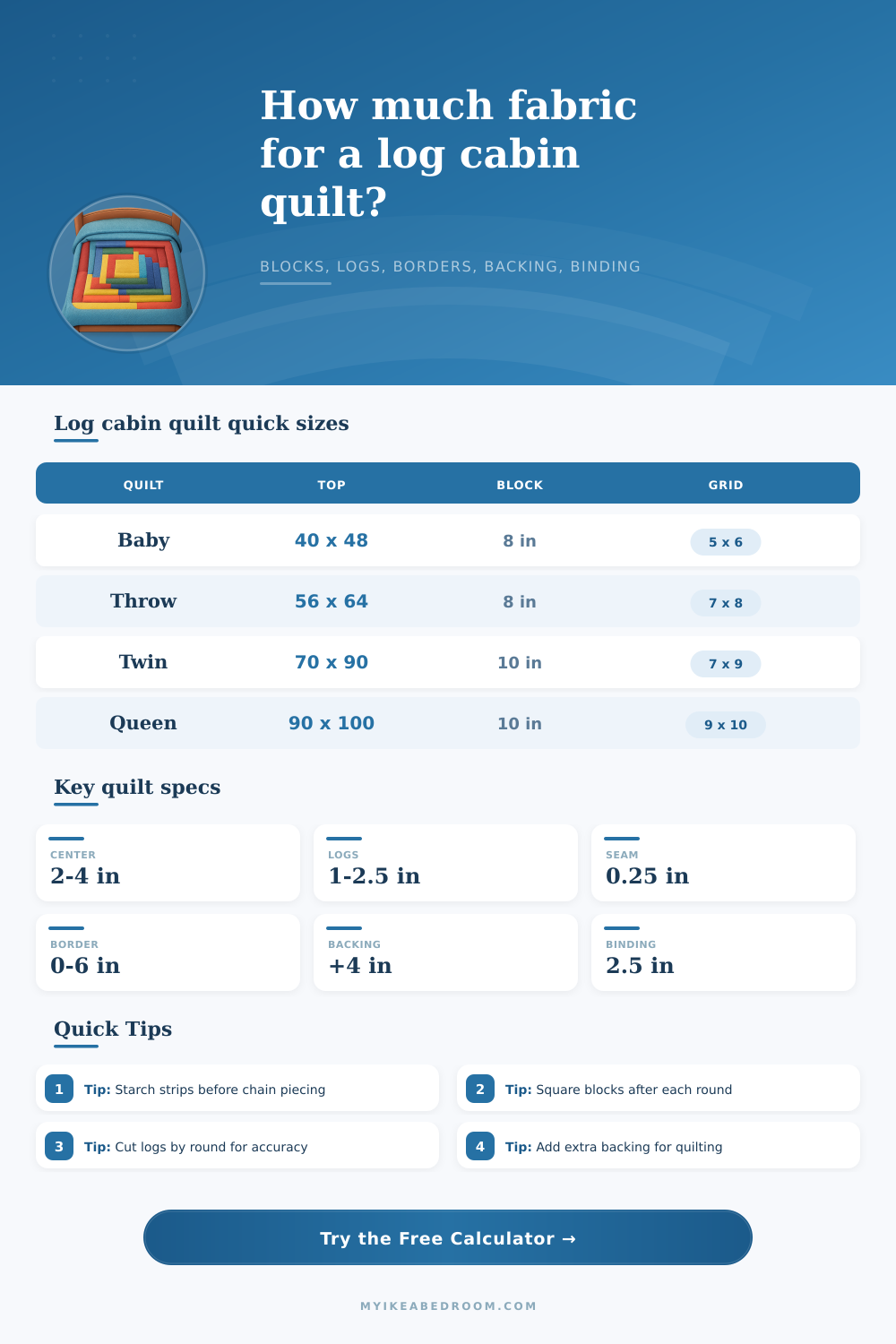
| Baby quilt | 40 x 48 in | 8 in | 5 x 6 | 30 blocks |
| Throw quilt | 56 x 64 in | 8 in | 7 x 8 | 56 blocks |
| Twin quilt | 70 x 90 in | 10 in | 7 x 9 | 63 blocks |
| Queen quilt | 90 x 100 in | 10 in | 9 x 10 | 90 blocks |
| Fabric width | Best use | Backing panels | Binding notes | Allowance |
|---|---|---|---|---|
| 40 to 44 in | Quilt top and binding | Often 2 to 3 | Many short strips | Add 4 in/side |
| 54 in | Small backing | Often 1 to 2 | Fewer joins | Add 4 in/side |
| 90 in | Twin backing | Often 1 | Can cut binding too | Add 4 in/side |
| 108 in | Queen/king backing | Often 1 | Minimal joins | Add 4 in/side |
Best for: balanced light and dark halves.
Uses an even fabric split and works well for barn raising or straight furrows layouts.
Best for: mirrored strips on opposite sides.
The calculator keeps the same round count while planning more even paired yardage.
Best for: strong diagonal movement.
Darker outside rounds get a larger yardage share for a high-contrast cabin setting.
Best for: mixed strip bins and remnants.
Use the total log yardage as a strip-equivalent target across many fabrics.
Square-up note: If the calculated finished block is smaller than your chosen block size, increase log width, add another round, or reduce the target block size before cutting every strip.
Directional print note: Directional logs need more buffer because some pieces cannot rotate; choose the 15% or 20% cutting buffer for one-way designs.
A log cabin block are a square quilt block that contains a center square and strips of fabric, called log. To make the log cabin block, a person start with a small square in the middle of the block. Then, a person adds strips of fabric surrounding the center square until the block reach the desired size.
There is several calculations that a person must make before beginning to create the log cabin block. A person must decide on the finished measurement of the log cabin block and the width of the logs to be used in the quilt. These two measurements determines how many rounds of
How to Make a Log Cabin Block