Log Board Foot Calculator International
Estimate International 1/4-inch log scale from small-end diameter, log length, taper, bark deduction, defect, count, species density, moisture state, trim allowance, and unit system.
Use a preset as a starting point, then adjust measurements for the actual log stack.
Scale breakdown
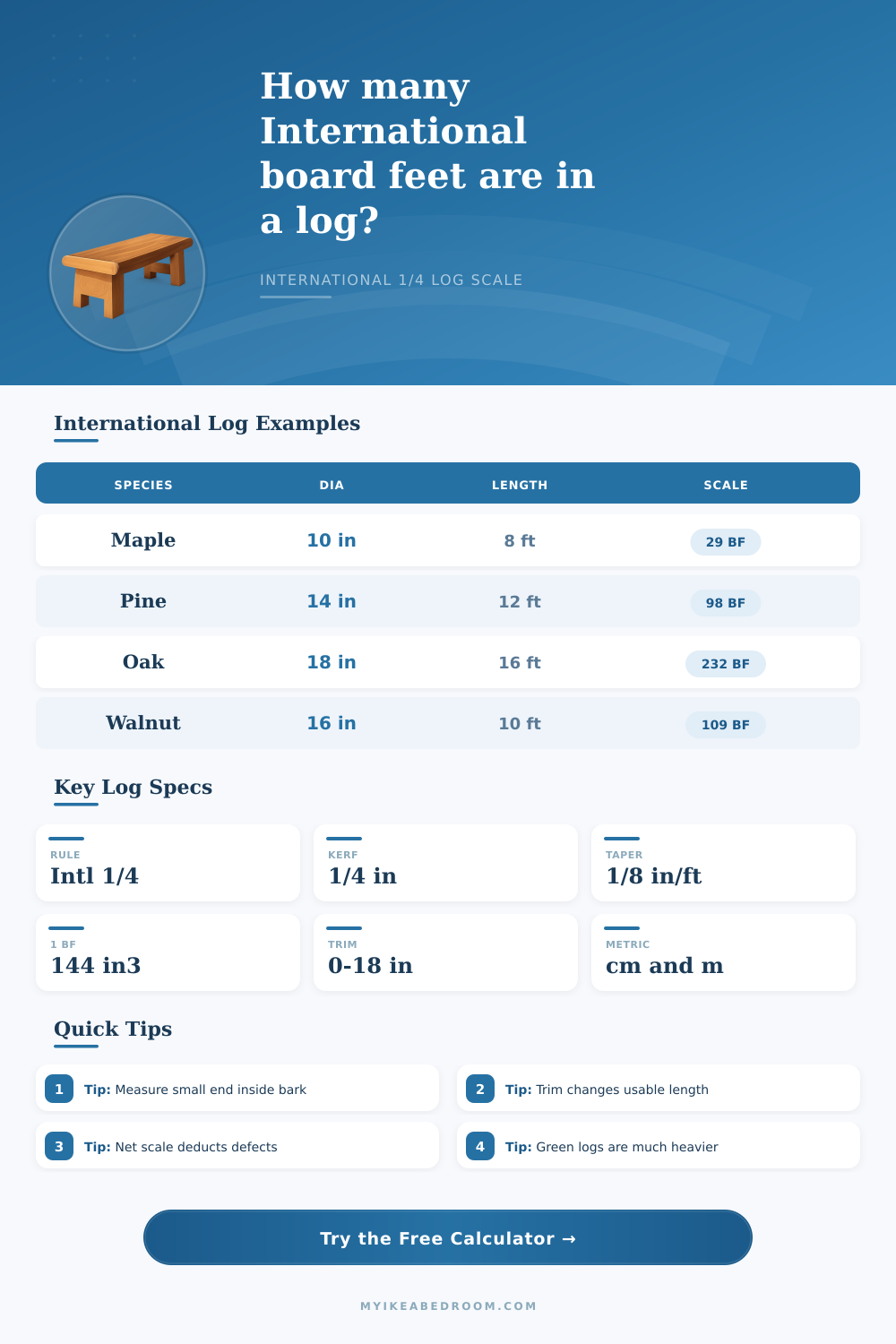
Reference values are rounded International 1/4 board feet for standard taper. The calculator can interpolate and adjust for nonstandard taper, bark deduction, defect, trim, and count.
| Small-end diameter | 8 ft log | 10 ft log | 12 ft log | 14 ft log | 16 ft log |
|---|---|---|---|---|---|
| 8 in | 15 BF | 20 BF | 25 BF | 35 BF | 40 BF |
| 10 in | 30 BF | 35 BF | 45 BF | 55 BF | 65 BF |
| 12 in | 45 BF | 55 BF | 70 BF | 85 BF | 95 BF |
| 14 in | 65 BF | 80 BF | 100 BF | 115 BF | 135 BF |
| 16 in | 85 BF | 110 BF | 130 BF | 155 BF | 180 BF |
| 18 in | 110 BF | 140 BF | 170 BF | 200 BF | 230 BF |
| 20 in | 135 BF | 175 BF | 210 BF | 250 BF | 290 BF |
| Taper class | Approx taper | Large-end effect | Scale adjustment | Use when |
|---|---|---|---|---|
| Slight | 0.06 in/ft | Small swell | Lower than standard | Straight plantation or upper stem logs |
| Standard International | 0.125 in/ft | 1/2 in per 4 ft | Baseline | General International 1/4 comparisons |
| Moderate | 0.18 in/ft | Noticeable swell | Small upward estimate | Mixed hardwood sawlogs with normal butt flare removed |
| Heavy | 0.25 in/ft | Strong swell | Higher estimate | Butt logs or logs with visible form change |
| Severe | 0.35 in/ft | Very strong swell | Flag for review | Flared butt logs, sweep, or irregular log form |
| Deduction type | Input | Applied to | Result effect | Field note |
|---|---|---|---|---|
| Bark | Diameter deduction | Small-end diameter | Changes gross formula | Use only if diameter was measured outside bark |
| Trim | Length deduction | Nominal log length | Changes formula length | Useful for extra bucking length or damaged ends |
| Defect | Percent deduction | Adjusted gross scale | Changes net scale | Use for rot, shake, split, sweep, or stain |
| Log count | Whole logs | Gross and net totals | Multiplies results | Use only for similar logs in one group |
| Moisture state | Weight factor | Best use | Dry output | Green output |
|---|---|---|---|---|
| Kiln-dry reference | 1.00x dry density | Comparing species density | Dry weight card | Not a hauling estimate |
| Air-dried log | 1.18x dry density | Logs stored under cover | Dry weight still shown | Moderate handling weight |
| Green softwood | 1.55x dry density | Fresh pine, spruce, cedar | Dry weight still shown | High handling weight |
| Green hardwood | 1.70x dry density | Fresh oak, maple, ash | Dry weight still shown | Very high handling weight |
International 1/4
Balanced scale. Includes a 1/4-inch kerf allowance and a standard taper assumption.
Often closer to modern sawmill recovery than very old rules, especially across mixed diameters.
Doyle
Conservative small logs. Doyle strongly underestimates smaller diameters.
Useful only where local buyers and sellers specifically quote Doyle scale.
Scribner
Diagram based. Scribner varies by table version and can swing with diameter.
Good for historical comparison, but check local scale rules before mixing tables.
Cubic volume
Mass and transport. Cubic volume is better for weight estimates.
Board feet estimate lumber tally; cubic volume estimates the log body being moved.
The International 1/4 rule is a mathematical formula that can be used to calculate the board footage of a log. The International 1/4 rule is a standard method of calculating board footage because it incorporates a quarter-inch kerf into the calculation. The kerf in this context is the width of the logs that the saw blade will cut.
By incorporating the width of a saw blade into the calculation, the estimate of the board footage of logs becomes more accurate, especially for logs that are cut with moddern bandsaw blades. A calculator can be used to calculate the board footage of a log. This calculator allows an individual to manipulate several variables to arrive at a more precise figure.
How to Use the International 1/4 Rule
The variables that can be manipulated include the thickness of the bark on the log, the trim loss of the log, and the amount of taper that is naturaly present in the log. To use the calculator to determine the board footage of a log, the first step is to calculate the diameter of the log at its small end. The diameter that should be used in the calculation is the diameter of the log inside the bark.
This is the narrowest point of the log. If an individual has the diameter of the log outside of the bark, it is necessary to enter the thickness of the bark into the calculator to account for this variable. It is important to account for the thickness of the bark on the log because the bark will change the volume of the log.
The importance of this variable becomes more prominent as the diameter of the log increase. The length of the log should also be entered into the calculator. However, the length of the log should be the length after accounting for the length that will be lost when squaring the logs; when individuals square the ends of logs, and remove the damaged portions of logs, there will always be some loss in the length of the logs.
The next variable is the taper of the log. The taper of logs is the change in the diameter of the log from end to end. The International 1/4 rule estimates that the taper of logs will be one-eighth inch per foot of the length of the log.
However, you can adjust this value with the calculator according to the taper of the specific log being measured. If the log is more straightly than one-eighth inch of taper per foot of the length of the log, that taper value should be lowered in the calculator. The opposite is true for logs that flare at their ends to a diameter that is greater than one-eighth inch per foot of the length of the log.
The next variable is the amount of defects in the logs. Defects in logs include rot, shake, and sweep. These variables can be accounted for in the calculator by entering the percentage of the log that is defective; this will result in the calculation of the amount of usable lumber that can be cut from that log.
Finally, the calculator can provide an estimate of the weight of the logs. The weight of logs is an important variable to consider when moving logs from one location to another. Based off the dimensions of the logs, the calculator will calculate the weight of the logs by multiplying the volume of the logs by the density of the wood species and the moisture content of the logs.
The moisture factor is necessary to account for the fact that the weight of a log changes depending upon whether the wood is green or kiln dry. For instance, a stack of green oak will weigh more than a stack of dry pine, even if the volume of the oak logs is the same as the volume of the pine logs. Overall, knowing the weight of the load will allow you to avoid overweight fines, as well as to take advantage of the trucks full capacity.
The reference tables show how the International 1/4 rule works at different diameters and lengths. These tables should not be used as a means of measuring the diameter and lengths of the logs that you encounter in the field. Instead, the calculator provides a more specific figure than the table can provide.
The table can help you understand the effect of using different classes of taper on the board footage that can be produced from a log. It is common for individuals to make the mistake of assuming that every log in a pile is an average log. Instead, it is possible for a few logs to contain the majority of the board footage from the pile, while the remainder of the logs in the pile have little board footage when logs with defects are removed from them.
To avoid this mistake, calculate the value of different groups of logs with the calculator instead of calculating the value of all of the logs in the pile with a single average figure. Additionally, it is important for a logger to remember that each sawmill will have a different amount of trim allowance. Including the correct trim allowance in the calculation will ensure that the calculation accurately reflects the logs potential for producing lumber.
The International 1/4 rule is a mathematical rule that was developed to indicate the amount of lumber that can be produced from a log. The rule is based on the understanding that the relationship between the diameter of a log, the length of the log, and the amount of lumber that can be produced from that log is constant. By entering the values for the bark thickness, the trim allowance, the percentage of defects in the log, and the moisture state of the logs, the calculator can provide a specific figure to indicate the amount of lumber that can be produced from that specific log.
Additionally, the calculator can compare the International 1/4 rule to other rules for estimating the lumber yield from logs, such as the Doyle rule or the Scribner rule. The Doyle rule tends to be conservative in relation to small logs, while the Scribner rule changes with the version of the table that is used. For these reasons, the International 1/4 rule is the default selection for the calculator.
You should of used this rule for most jobs.