LED vs Incandescent Savings Calculator
Compare incandescent watts against LED watts to estimate electricity saved, operating savings by rate, watt reduction, and heat load reduction for one lamp or a whole room.
Load a common room pattern, then adjust lamp count, hours, wattage, days used, and electricity rate. The calculator compares energy use only.
LED energy savings results
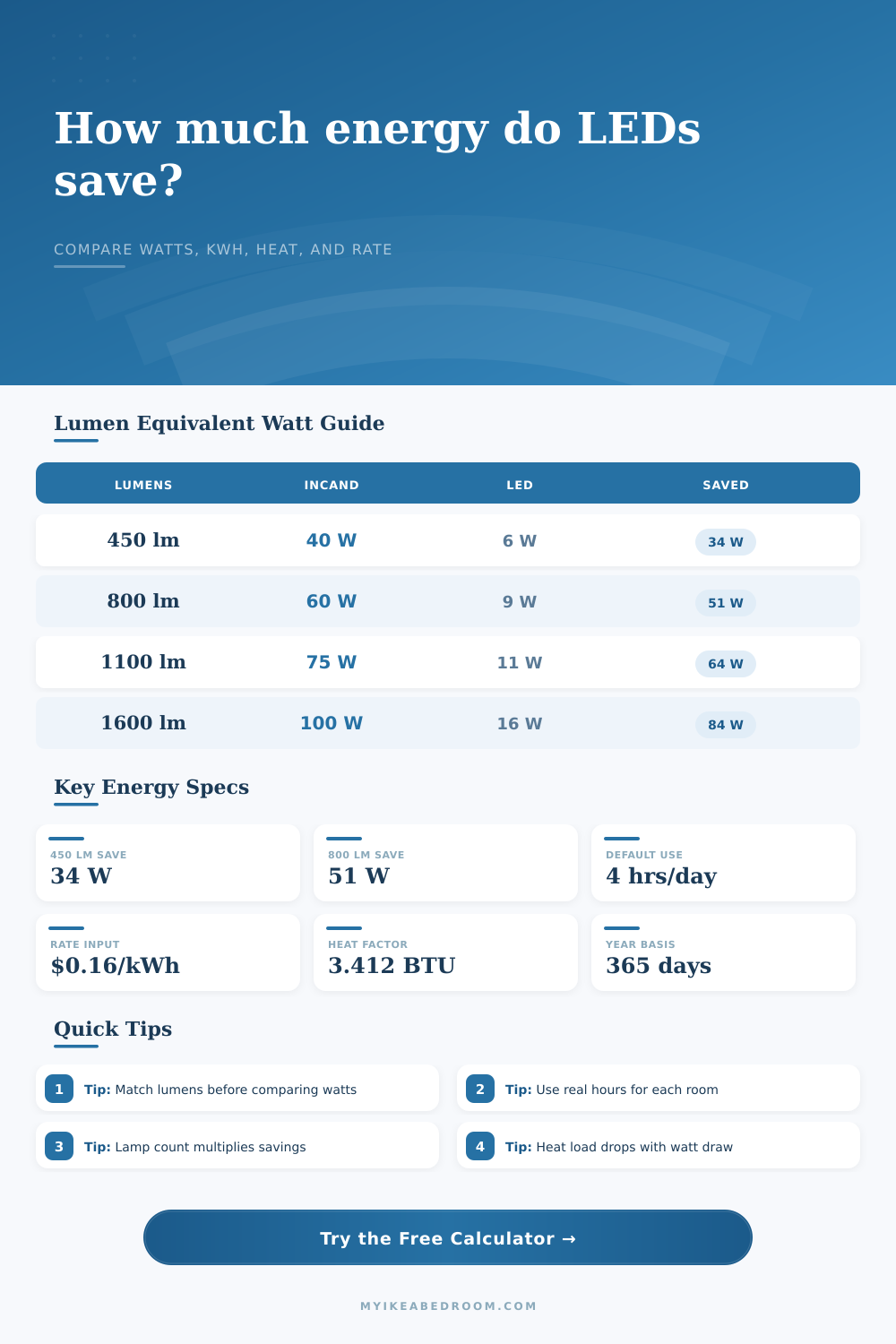
| Light output | Typical incandescent watts | Typical LED watts | Watts saved per lamp | Daily kWh saved at 4 hr |
|---|---|---|---|---|
| 450 lumens | 40 W | 6 W | 34 W | 0.136 kWh |
| 800 lumens | 60 W | 9 W | 51 W | 0.204 kWh |
| 1100 lumens | 75 W | 11 W | 64 W | 0.256 kWh |
| 1600 lumens | 100 W | 16 W | 84 W | 0.336 kWh |
Remember when you would touch an incandescent bulb for 10 minutes and it would be warm? It was hot, almost comfortabley so. What did all that heat represent? All that heat represent waste. Any watt converted into thermal radiation rather than light represents a dollar out of your pocket.
When we transitioned to LEDs, that pattern shifted. To see the true savings though, we have to dig deeper then the sticker price; we need to examine our day-to-day behavior. You can run this math yourself with calculator up top.
How to Save Money with LED Lights
In the real world, it’s helpful to understand what inputs represent. You might look at a nine-watt LED and compare its wattage to that of a sixty-watt incandescent. You’ll notice that the LED appear to be dim. But we’re measuring light output here not energy consumption. An LED that is a ninety-watt equivalent put out about the same amount of light as a sixty-watt bulb while using much less power. If you want an equivalent light level, match lumens first then compare watts. That way, you won’t sacrifice brightness in the name of efficiency.
Then there’s this: how many lamps do you use? That’s where the multiplication really kicks in. Saving just fifty-one watts per bulb doesn’t sound like much. But add a dining pendant, a ceiling fixture in the bedroom and four lamp in the living room and it adds up fast. The calculator lets you change number of lamps accordingly… Which is important because every watt you save count towards your energy bill. Replacing a single bulb won’t make a dent in your wallet; swapping out all light in your home will.
It is equally (if not more) significant: how many hours will you spend using them? In some cases it could be more important than the wattage. If I leave my reading lamp on for three hours each night, that’s going to save me significantly more energy over time compared to 15-minute-a-day closet light. To factor in these differences, the calculator asks how often you’ll use it during the week and what average number of hours is per day. That’s a subtle change but it turns a hypothetical savings calculation into a practical cost-savings prediction. Working in the garage for eight hours a day are different from keeping lights on there for an hour every Saturday. Get the accuracy right, and you won’t oversell just how much money you might save.
Then there is price of electricity. Depending on where you live that ranges from a dime per kilowatt-hour to twenty cents or more. That’s why we have you enter your real-world electricity cost to turn those energy savings into dollars you can spend. Otherwise, it’s all just some abstraction of power units. When you put in your real-dollar-per-kilowatt price, it starts showing you money. And specifically, it projects the annual operating savings. It shows you exactly how much lower your bill will be over twelve months.
It also doesn’t put the secondary savings on the bill. And it shows up as summer comfort. An incandescent bulb is basically an inefficient heater. It dumps heat into your house. Your air conditioning has to compensate by working harder to keep you comfortabley. LED replacement bulbs knocks out much of that heat load. The calculator gives an estimate of the resulting hourly BTU reduction. You don’t see it. But your HVAC sees it. You’re not cycling your air conditioner quite so much, it lasts longer. And saves more money on your cooling bills.
There’s also a table of common lumens equivalents at the bottom of the page that makes choosing LEDs based off what your current lightbulbs are like easy. Want a hundred-watt flood, or is a forty-watt dimmer more your speed? No problem. Check the lumen table and know exactly what wattage will get you to where you want to go. No guessing required.
But it’s really all about changing habits around the LED switch. These bulbs will outlast traditional ones. They consume fewer resource. And learning just how much those habits cost you is where the true savings lie. Plug some numbers into the equation for your residence and the choice pretty much makes itself.
Your hand no longer feels warm. Instead, you are left with nothing but cold efficiency and empty pockets.