💡 LED Strip Wattage Calculator
Calculate total power draw, amperage, and power supply size for your LED strip lighting project
| Strip Type | W/m | W/ft | 5ft / 1.5m | 10ft / 3m | 16ft / 5m | 33ft / 10m |
|---|
| Total Load | Min PSU (no buffer) | PSU with 20% Buffer | Recommended PSU |
|---|---|---|---|
| Up to 10W | 10W | 12W | 15W or 30W PSU |
| 10W – 25W | 25W | 30W | 30W or 60W PSU |
| 25W – 40W | 40W | 48W | 60W PSU |
| 40W – 80W | 80W | 96W | 100W PSU |
| 80W – 150W | 150W | 180W | 200W PSU |
| 150W – 250W | 250W | 300W | 320W PSU |
| 250W – 400W | 400W | 480W | 500W PSU |
| Wattage | Amps @ 12V | Amps @ 24V | Amps @ 48V | Wire Gauge Rec. |
|---|---|---|---|---|
| 10W | 0.83 A | 0.42 A | 0.21 A | 22 AWG |
| 25W | 2.08 A | 1.04 A | 0.52 A | 20 AWG |
| 50W | 4.17 A | 2.08 A | 1.04 A | 18 AWG |
| 100W | 8.33 A | 4.17 A | 2.08 A | 16 AWG |
| 200W | 16.67 A | 8.33 A | 4.17 A | 14 AWG |
| 400W | 33.33 A | 16.67 A | 8.33 A | 12 AWG |
| Project | Length | Strip Type | Total Watts | Min PSU |
|---|---|---|---|---|
| Under Cabinet | 10 ft / 3m | 2835 High Density | ~43W | 60W |
| TV Backlight | 6 ft / 1.8m | 5050 RGB | ~26W | 30W |
| Bedroom Cove | 40 ft / 12m | 2835 Standard | ~115W | 150W |
| Stair Lighting | 20 ft / 6m | COB LED | ~61W | 80W |
| Full Room Perimeter | 50 ft / 15m | 2835 High Density | ~216W | 320W |
| Outdoor Deck | 30 ft / 9m | 5050 RGBW | ~173W | 200W |
| Garage Shop | 40 ft / 12m | High Power COB | ~288W | 320W |
LED strips requires the proper power supply to meet there power requirements. If the power supply has to low of a wattage rating for the LED strips, the LED strips will either flicker or not turn on at all. In order to avoid these issue, you must calculate the total wattage of the LED strips before determining the appropriate power supply.
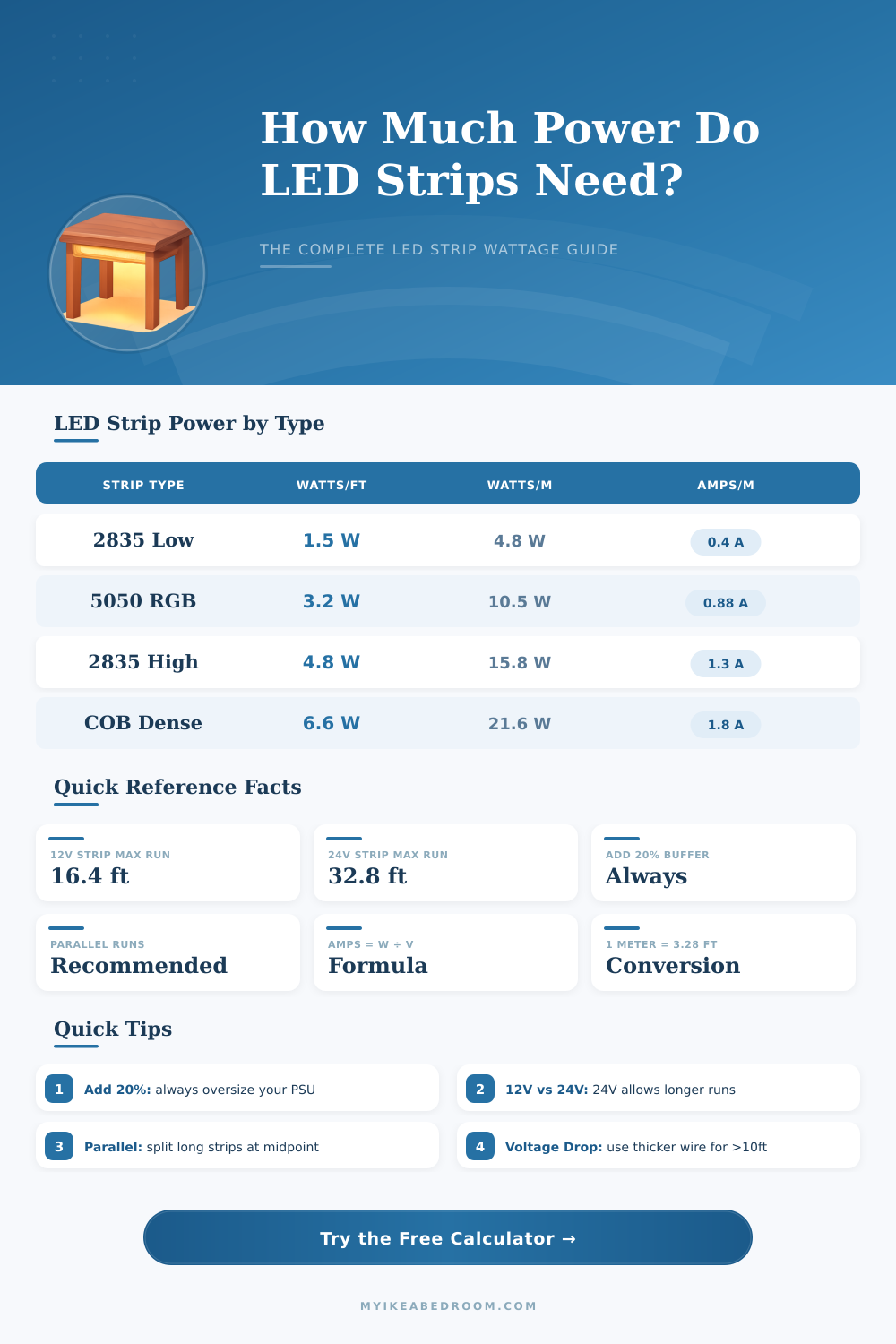
Different type of LED strips contain different amount of power. The power requirements of LED strips can differ depending on the size of the LEDs that the manufacturer include in the LED strip. For instance, LED strips that contain 2835 LEDs may require only 5 watt per meter of LED strip, but high density LED strips or RGB strips can consume 15 to 24 watts per meter of strip.
How to Pick the Right Power Supply for LED Strips
RGB LED strips require more power than other LED strips because each bulb on an RGB strip contain three color chips rather then one. In order to determine the total power consumption of the LED strips, it is important to know the wattage per meter of you LED strips. In addition to the wattage of the strips, other factors that will impact how the power move through the LED strips are the length of the strip and the voltage of the strip.
After 16 feet of an 12-volt LED strip, the voltage may drop to the point that the LEDs at the end of the strip will appear to be dim. If 24-volt LED strips are use, however, the voltage will drop after 32 feet of strip. In order to prevent these LED strips from dimming, it is possible to use parallel runs of LED strips or to provide power to the strip from both end of the strip.
Providing power from both sides of the strip will ensure that the strip remain even throughout the length of the strip. In addition to the power requirements of the LED strips, another consideration is the operation of the power supply itself. If the power supply is expected to provide all of the power that is required by the LED strips, the power supply will generate a great deal of heat while performing its function.
Too much heat can shorten the life of the power supply. One way to prevent this from happening is to provide a 20 percent buffer in the wattage of the power supply. For instance, if the LED strips require 48 watts, a 60-watt power supply will provide the necessary buffer.
This buffer will ensure that the power supply dont overheat and that the power supply has a longer lifespan. Another consideration with LED strips is the amperage that will flow through the LED strips. You can determine the amperage by divide the wattage by the voltage.
For instance, 100 watts divided by 12 volts will result in a value of 8.3 amps, meaning that for a 12-volt system with a 100-watt load, the amperage will be over 8 amps. High amperage load require thicker wires in order to prevent the wires from overheating. For 24 volts, however, the amperage will be halved.
Thus, a 24-volt system will require smaller, thinner wires then a 12-volt system of the same wattage. Matching the amperage of the power supply and wires with those of the LED strips will prevent the wires from overheating. Many projects require specific type of power supplies.
A 10-foot strip of high density LED strips for under-cabinet lighting, for instance, may require 40 to 50 watts of power, meaning that a 60-watt power supply will be appropriate. For bedroom cove lighting, however, the load may be greater than 100 watts, meaning that a 150-watt power supply may be necessary. In all cases, it is best to consult the specification sheet for the LED strips to determine the wattage per meter of the strips.
These specifications are the most accurate way to calculate the power need of the strips. In addition to the power supplies themselves, it is also important to consider the addition of dimmers and controllers to the project. Dimmers and controllers can add 10 to 20 percent to the power load of the LED strips.
Finally, it is important to consider the temperature of the area in which the LED strips will be installed. Matching the power supply with the wattage of the LED strips and providing a buffer for the power supply will ensure that the strips will function correct and the power supply will remain safe.