LED Strip Resistor Calculator
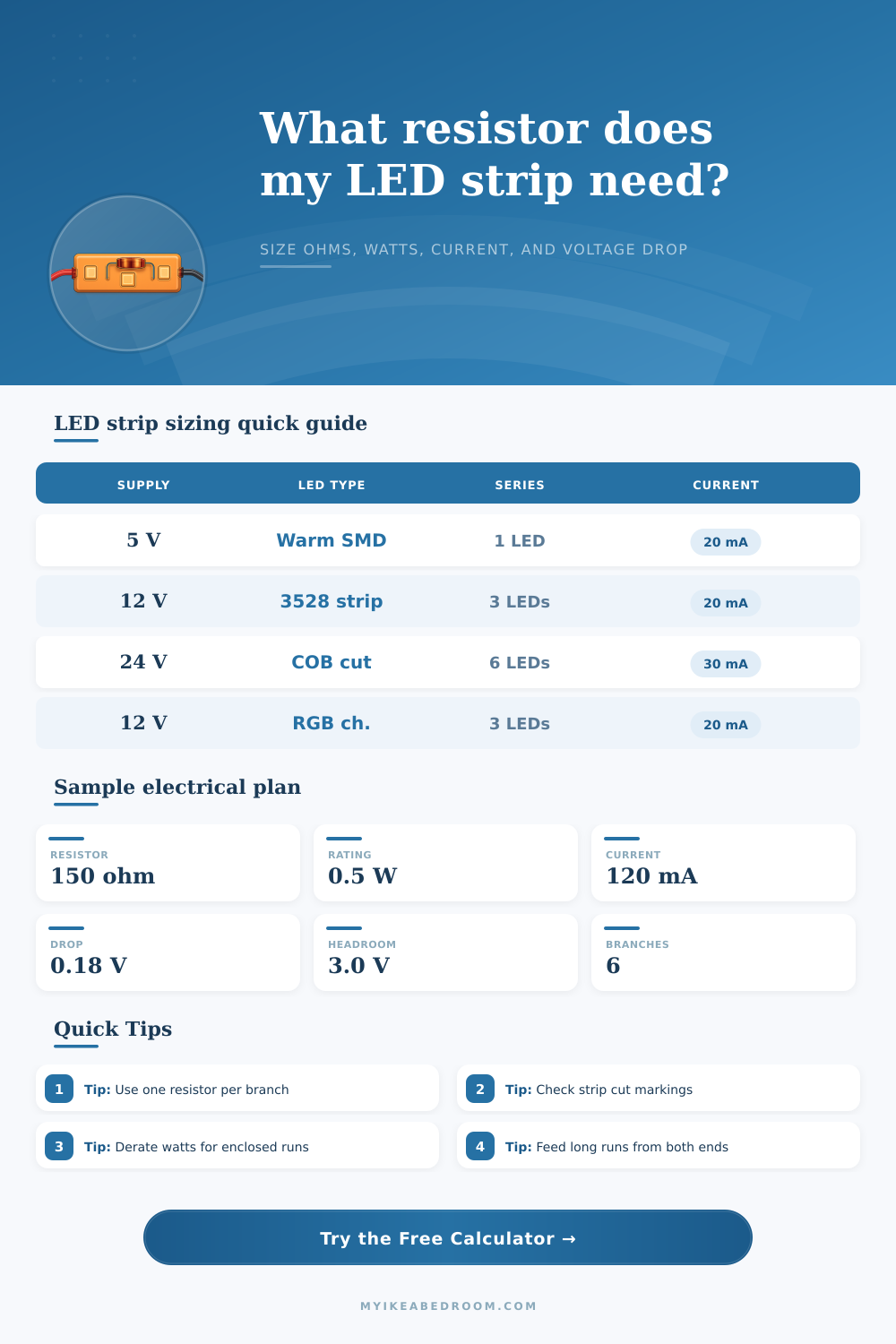
Size the resistor value, resistor wattage, total strip current, wire voltage drop, and remaining voltage headroom for low-voltage LED strip segments, COB cuts, channel repeats, and custom cabinet lighting runs.
Load a typical strip or channel condition, then adjust voltage, current, cut groups, wire run, and safety factor for your exact build.
An LED is a component that require a specific amount of electrical current to function correct. Many people treats an LED like a simple light bulb, but this does not account for the fact that the LED will pull as much current from the power supply as it can provide unless a resistor are used. If a resistor is not use to limit the current to the LED, the LED will recieve too much current, which can cause the LED to overheat and eventually fail.
A resistor must be used to limit the current drawn by the LED so that it dont draw too much electricity from the power supply. Not all LED have the same voltage requirements. For example, the voltage requirement for a red LED is not the same than the voltage requirement for a blue LED.
How to Use Resistors with LED Strips
Additionally, the voltage requirement for a blue LED is not the same as the voltage requirement for an white LED. If using LED strips, the LEDs is arranged in series-stacks. When cutting an LED strip, it is important to make the cut at the copper cut marks to ensure that the LEDs remains in series-stacks.
In addition to ensuring that the cuts are at the correct marks, you must account for the voltage of the series stack of LEDs and the total current of the branch in the creation of the LED strip circuit. The copper wire in an LED circuit can also impact the electrical current in the circuit. Copper wire has resistance.
Additionally, if the copper wire in a circuit is very long, the resistance of the copper wire will create a voltage drop that will impact the LED strip. If using very long copper wires to connect an LED strip to a power supply, the voltage drop will occur due to the resistance of the copper wire. As a result, the LEDs will be more dimmer than the desired brightness, and the resistor will function in an incorrect way.
Resistors work by managing the electricity in a circuit and convert excess voltage to heat. For this reason, you must consider the wattage of the resistor. If you use a resistor of low wattage in an LED strip circuit, the resistor will become very hot due to the high electrical current of the LED strip.
If a resistor overheats, it may melt the solder or warp the plastic on the LED strip. In order to prevent these issue, you should purchase a resistor of higher wattage than that which is calculated for the LED strip. This is especially true for LED strips placed in sealed cabinets where the heat generated by the LED strip cannot escape the cabinet.
The value of the resistor to be used in an LED strip circuit should be set to a value within the E24 series. Resistors are only available in specific values. If the calculated value of the resistor for an LED strip is not available in the E24 series, the next highest value should be use.
Using a higher value of resistor will make the LED strip circuits light source slightly dimmer. Additionally, using a lower value of the resistor allow too much current to pass through the LED, which is a safety hazard. It is better to use a slightly higher resistor value to reduce the brightness of the LED strip to allow too much current to pass through the LED.
For RGB LED strips, each color of LED require its own resistor. The red, green, and blue colors of LED strips all has different voltage requirements. Because of this difference in voltage, the red and blue channels of an RGB LED strip cannot share a single resistor.
Using a single resistor for all three color allows for the red channel to draw more current from the power supply than the green and blue channels of the LED strip. Lastly, COB LED strips is different than other LED strips. The LED chips on a COB LED strip are very densely packed.
With this high concentration of LEDs, the strip produce a great deal of heat. To combat this heat production, you may use a center feed or dual end-feed on a COB LED strip. Using a center feed or dual end-feed ensures that the LEDs at the end of the strip have the same brightness as the LEDs at the beginning of the strip.
The voltage of the power supply should be measure while it is under load. Many power supplies will advertise that there voltage output is 12 volts. However, when the LEDs are turned on, the voltage may drop.
If you make the voltage calculation for the LED strip using a voltage that is too low for the power supply, the resistor calculations for the LED strip will be incorrect. Therefore, you should use the voltage of the power supply under load in all calculation to determine the appropriate value of the resistor for the LED strip.