LED driver watts, amps, and feed planning
LED Strip Power Supply Calculator
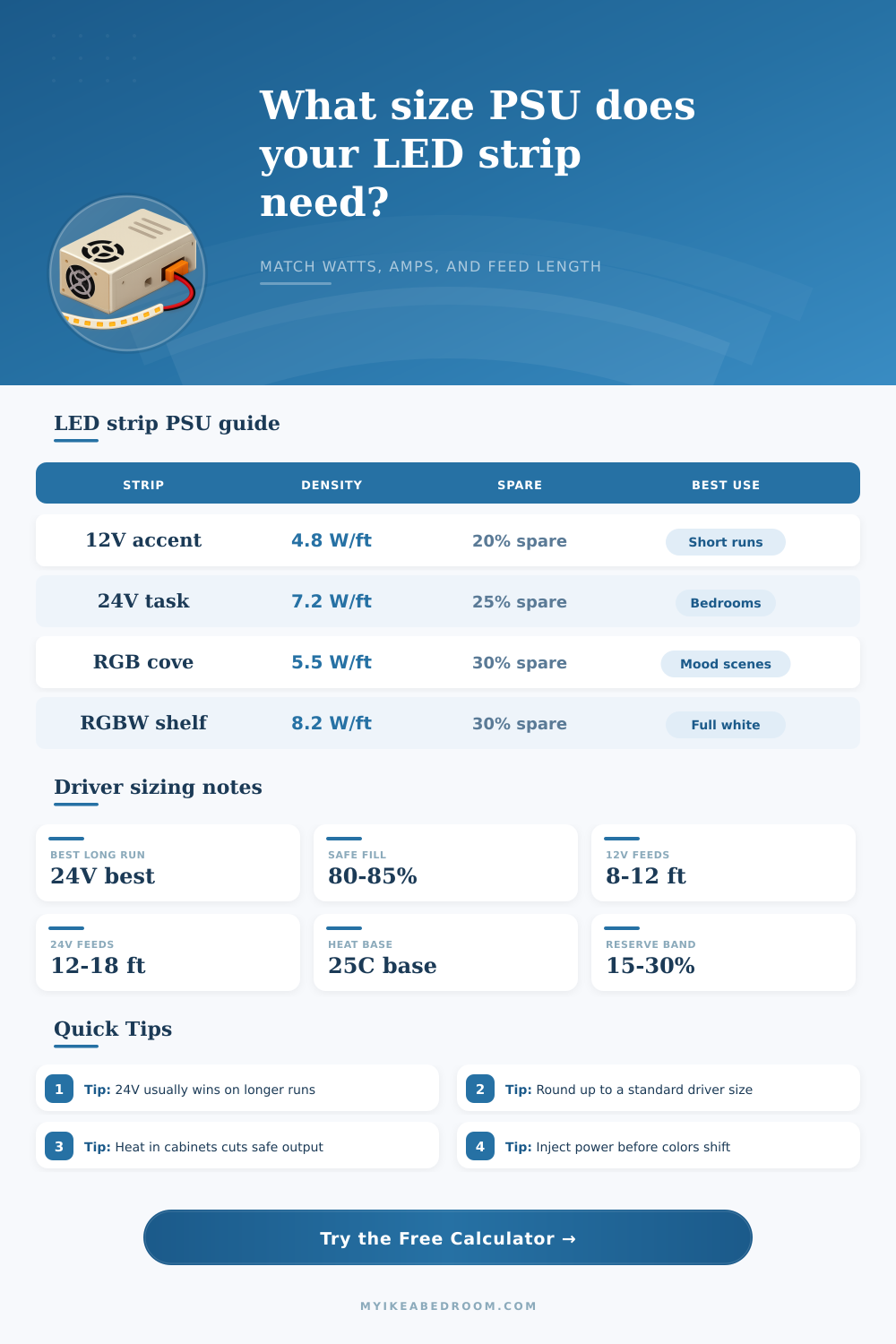
Size a power supply for headboards, shelves, closets, tray ceilings, media walls, and under-bed glow by combining strip watt density, controller reserve, voltage-drop stress, and thermal headroom.
Each preset fills a real room-lighting scenario and immediately recalculates supply size so short 12V accent runs, long 24V cove lines, and RGBW closet installs do not all get the same blanket PSU recommendation.
Full breakdown
Formula appears after you enter strip watts, run length, control reserve, and driver location.
| Family | Default voltage | Nominal density | Typical use |
|---|---|---|---|
| Eco single-color | 12 V | 2.9 W/ft | Under-bed, toe-kick, soft headboard accent |
| Task single-color | 24 V | 4.8 W/ft | Wardrobe rails, desks, floating shelves |
| COB task strip | 24 V | 7.2 W/ft | Vanity borders and clean task-light lines |
| Tunable white | 24 V | 6.1 W/ft | Bedrooms that shift from warm night light to cool work light |
| RGB accent | 24 V | 5.5 W/ft | Media walls and mood coves |
| RGBW high output | 24 V | 8.2 W/ft | Closets and coves that need both color and usable white |
| Driver size | Usable at 85% | Usable at 80% | Current at 24 V |
|---|---|---|---|
| 60 W | 51 W | 48 W | 2.5 A |
| 96 W | 81.6 W | 76.8 W | 4.0 A |
| 120 W | 102 W | 96 W | 5.0 A |
| 150 W | 127.5 W | 120 W | 6.25 A |
| 240 W | 204 W | 192 W | 10.0 A |
| 300 W | 255 W | 240 W | 12.5 A |
| Topology | Drop relief | Typical 12 V feed | Typical 24 V feed |
|---|---|---|---|
| Single-end feed | Baseline | 8-10 ft | 12-14 ft |
| Dual-end feed | Better balance | 10-12 ft | 14-16 ft |
| Center feed | Strong balance | 12-14 ft | 16-18 ft |
| Injected segments | Best control | 14+ ft | 18+ ft |
| Scenario | Strip setup | Likely PSU | Reason |
|---|---|---|---|
| Headboard glow | 8 ft at 2.9 W/ft | 36-45 W | Short run with light reserve needs |
| Wardrobe rail | 14 ft at 4.8 W/ft | 96 W | Task brightness plus practical driver headroom |
| Vanity COB border | 16 ft at 7.2 W/ft | 150-180 W | High density strip and mirror use call for reserve |
| RGB media wall | 20 ft at 5.5 W/ft | 150 W | Color control reserve and feed management matter |
| RGBW closet | 24 ft at 8.2 W/ft | 300 W | White channel plus hidden mounting drives the size upward |
LED strip lights can experience a variety of issue, such as dimming at the end of the strip, color shifting, or even flickering. Most of the time, however, LED strip lights wont be the source of these issues. Instead, the power supply that is use to power the LED strip lights may be incorrectly sized to the LED strip lights.
Dimming issues are typically cause by voltage drop, which occurs when the electricity that powers the LED strip lights must travel over a long distance to reach the strip. Additionally, heat buildup within the LED strip lights or within the power supply that controls the LED strip lights can also cause LED strip lights to function poorly. In order to avoid these issues, it is important to make sure that the wattage of the power supply correctly match to the length of the LED strip light, as well as to consider how the power will be delivered to the strip lights.
Prevent Dimming and Color Shift in LED Strip Lights
The way in which the power supply is connected to the LED strip lights is referred to as an topology of the LED strip lights. With a single-end feed topology, power is provided to the LED strip lights at only one end of the strip. Using this type of topology for powering the LED strip lights can cause the voltage to drop more quick along the strip than if a dual-end feed topology was being used.
A dual-end feed topology allow for the power supply to be connected to the LED strip lights at both ends of the strip, which helps to maintain a consistent voltage along the strip. Consistent voltage is important in that if the voltage drop along the strip, the colors of the LED strip lights may shift, particularly warm white LED strip lights, which may begin to appearing pinkish along the far end of the strip lights. The power demands of the LED strip lights will depend upon the type of controller that is use to control the color of the strip lights.
RGB controllers will require more power than simple on-off switches to control the colors of the LED strip lights. Additionally, tunable white LED strip lights will require extra power capacity within the power supply for the same reason that RGB colors require extra power; to shift colors. The wattage of the LED strip lights and the controller must be calculated to determine how much power will be draw at the highest scene of color that the LED strip lights display.
The voltage that is used for the LED strip lights will also impact the current of the power supply that are necessary for the LED strip lights. Using a 24-volt system instead of a 12-volt system will cut the amperage in half. Amperage that is reduced is beneficial to the LED strip lights in that less amperage will cause the voltage drop and heat issues in the LED strip lights.
Using a 12-volt system is only beneficial for very short runs of LED strip lights. For longer runs of LED strip lights, however, a 24-volt system will be able to handle the voltage drop along those strips of LED lights. Heat can also be an issue for LED strip lights and the power supply for those lights.
If the power supply is placed in an open area, it can provide power to the LED strip lights at a higher percentage of its capacity because the open area allows for the power supply to exhaust heat created by the LED strip lights. If the power supply is placed within a closed area, like a cove or an insulated chase, it will have to provide power at a lower percentage of its capacity because the LED strip lights will heat the air within that space. In these areas, it is best to use only 70% of the power supply for a strip of LED lights in an enclosed area, or to use up to 85% of the power supply in an open area.
Included within the power supply of LED strip lights is a reserve margin for the LED strip lights. The reserve margin indicates the wattage of power that is not being used by the LED strip lights at any given time. For standard LED strip lights, 20% of the power supply should be included as a reserve margin.
For LED strip lights with RGBW features, however, 30% of the power supply should be used as a reserve margin. This reserve margin ensure that there is headway for the power supply to handle peaks in the power demands of the LED strip lights, which ensure the longevity of the power supply. Finally, within planning the LED strip lights and power supply for those lights, the power supply and topology must be planned in a systematic way in order to ensure that the LED strip lights create an even glow.
By calculating the wattage of the LED strip lights, determining how much heat the area will create, and adding in the reserve margin for the LED strip lights, it is possible to plan a power supply and topology that will allow the LED strip lights to function without dimming lights or shifting colors. Thus, by planning the power supply for the LED strip lights correctly, the LED strip lights will function proper.