Laundry Detergent Dosage Calculator
Estimate a measured detergent dose from washer type, load weight, capacity, soil level, water hardness, detergent concentration, and cap size.
🧺Real Laundry Presets
⚙Dosage Inputs
Dose = label dose × load factor × washer factor × soil factor × hardness factor ÷ concentration
Recommended Dose
📏Detergent Factor Grid
💧Washer And Rinse Reference
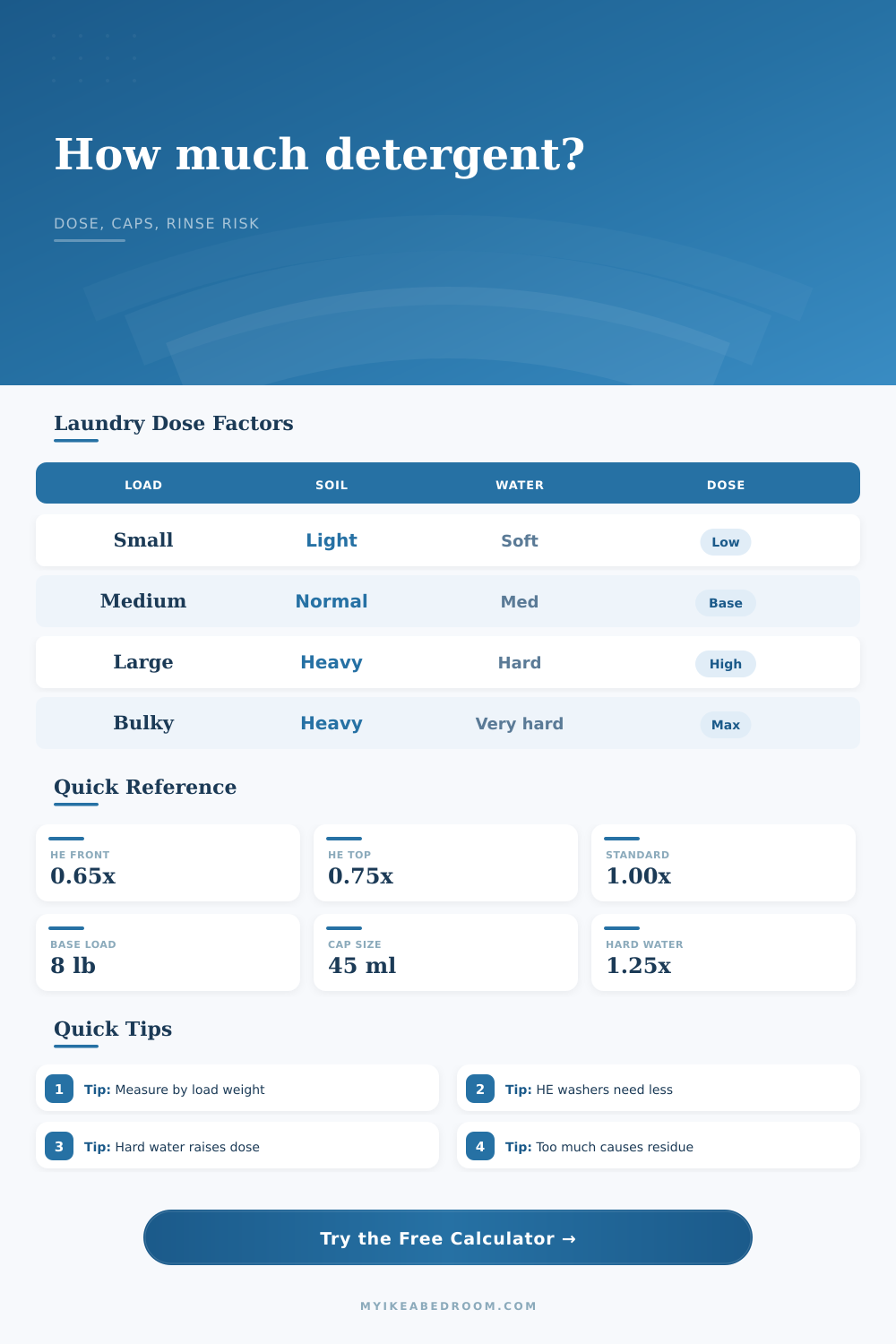
| Washer type | Dose factor | Best load ratio | Rinse note |
|---|---|---|---|
| HE front loader | 0.65x | 45% to 80% | Lowest water use; avoid filling above dose line. |
| HE top loader | 0.75x | 45% to 85% | Moderate water use; extra rinse helps bulky cotton. |
| Standard top loader | 1.00x | 40% to 85% | More wash water allows the full label baseline. |
| Compact HE washer | 0.55x | 45% to 75% | Small drums are sensitive to foam and residue. |
| Large capacity HE washer | 0.82x | 45% to 88% | Large loads need enough detergent but still rinse like HE. |
🧪Soil, Hardness, And Concentration Table
| Condition | Low factor | Normal factor | High factor |
|---|---|---|---|
| Soil level | Light 0.75x | Normal 1.00x | Heavy 1.20x, extra 1.35x |
| Water hardness | Soft 0.90x | Moderate 1.00x | Hard 1.18x, very hard 1.35x |
| Concentration | 1x uses full ml | 2x uses half ml | 3x to 4x uses less ml |
| Load ratio | Under 35% trims dose | 45% to 80% ideal | Over 90% raises rinse risk |
🧴Capful Conversion Table
| Dose ml | 30 ml cap | 45 ml cap | 60 ml cap |
|---|---|---|---|
| 15 ml | 1/2 cap | 1/3 cap | 1/4 cap |
| 25 ml | 5/6 cap | 5/9 cap | 5/12 cap |
| 40 ml | 1 1/3 caps | 8/9 cap | 2/3 cap |
| 60 ml | 2 caps | 1 1/3 caps | 1 cap |
| 80 ml | 2 2/3 caps | 1 3/4 caps | 1 1/3 caps |
📋Common Load Examples
| Laundry load | Typical weight | Common soil | Dosage cue |
|---|---|---|---|
| Delicate shirts | 3 to 5 lb | Light | Low dose; avoid residue on knits. |
| Daily clothes | 7 to 9 lb | Normal | Use medium-load baseline with washer factor. |
| Towels | 10 to 13 lb | Heavy | Raise for soil, watch drum crowding. |
| Queen bedding | 12 to 15 lb | Normal to heavy | Bulky fabric traps suds; consider extra rinse. |
| Workwear | 8 to 12 lb | Extra heavy | Soil factor matters more than cap brim filling. |
✨Dosage Tips
Everyone dumps laundry detergent into their machine to the point of emptiness on the cap. More is better, right? It’s got to clean my clothes better!
No! The suds don’t make it any more effective at cleaning. They just provide a thick layer of cushioning between your clothes and the water. This captures dirt which causes your clothes to be musty-smelling and stiff.
Why You Should Use Less Detergent
The calculator on top does the math for you. You enter in details of your wash (load size, washer type) and it spits out how much to use without you having to guess at conversions or coefficients.
Your machine is source of the problem. Front-loaders is more efficient washers than old-school top loaders. They require fewer gallons of water. Fewer gallons means the soap are less diluted. You don’t have to use as much detergent to get clothes clean. That’s why the tool includes a reduction factor for HE machines.
Fill that cap all the way up like it’s meant for an outdated machine, and you’ll be drowning your clothes in suds. This results in poor rinsing. Clothes end up covered in residue. This residue irritate sensitive skin.
This is the reason. The calculator asks what kind of washer you own first. Everything else flows from there.
How much is too much? Surprisingly, it’s not about how many items there are but rather how much they weigh and how dirty they are. Most detergent labels says “medium” for their load size. For them, that’s eight pounds. What’s a medium load for you? Twelve pounds if you have a few dirty jeans and a towel or two. Four pounds if you’re doing a quick turn-around on a couple of shirts.
With the calculator, you can add the true dry weight of your clothes. That accuracy will help you not make one of the most common mistakes. A small load of light-wear items isn’t like the extra-heavy workout-bag kind of load.
To take it one step farther, we’ve got a Soil Level Selector. Some loads need power of active ingredients, such as sports and garden-dirt type soils. Other loads with lighter wear just need a good rinse.
Hardness is something you don’t see. It destroys loads. Hard water has something called calcium & magnesium ions. These ions latches onto detergent. They cancel out detergent’s cleaning action. This happens before it ever gets to the laundry load. So if you’re on hard water, you actualy need more detergent. This makes up for chemical interference.
Depending on where you live, that means the tool will increase amount automatically. It won’t add fragrance or anything. That’s not the point. It just ensures there is enough active cleaning agents left to get the job done. These agents remove the grime.
People who have soft water can afford to go easy on the detergent. This is good news for the planet, and your wallet.
And then there is one last factor: Concentration. Moddern detergents are very concentrated. In fact, they can be twice to four times as strong as those used decades ago. There is a big drop in the milliliter count. They have the same cleaning power. It takes only a small capful of that 4x concentrate to do the job that a full bottle of standard liquid does.
When the calculator calculates how much detergent you need, it take into account the concentration level of your detergent. That avoids a common mistake people make with their concentrated formulas. They treat them just as if they were standard formulas. If you pay for potency, you shouldn’t use more volume, but rather less.
This tells you how many milliliters were used. Then it will tell you how many capfulls that is. And it’ll even give you a rinse risk score.
That’s the part I find so helpful. Does your load have a high risk of residue? Because if it does, then it means either your clothes are super dirty (splitting up the load will solve this) or else your hard water doesn’t like the amount of detergent you’re using (you might want to pick an additional rinse cycle).
Don’t try to add more soap! Adding more soap in a high-risk situation only makes the issue worse. All you do is create a sticky residue which attracts additional dirt on your next wash.
It’s the correct measurement. A couple more seconds. It keeps your clothes longer. It saves you money. It makes towels fluffy. It helps colors last longer.
For those with different types of washers, here is a table comparing measurements. It’s a sanity check to see if you measured right (or wrong).
Washing laundry is a matter of balancing things. Use enough soap to get them clean. Do not use so much soap that it won’t rinse off. Get that right and it becomes a habit instead of a chore.
It is efficient. Your clothes will thank you for being precise. And your wallet will too.