Latch Hook Rug Yarn Calculator
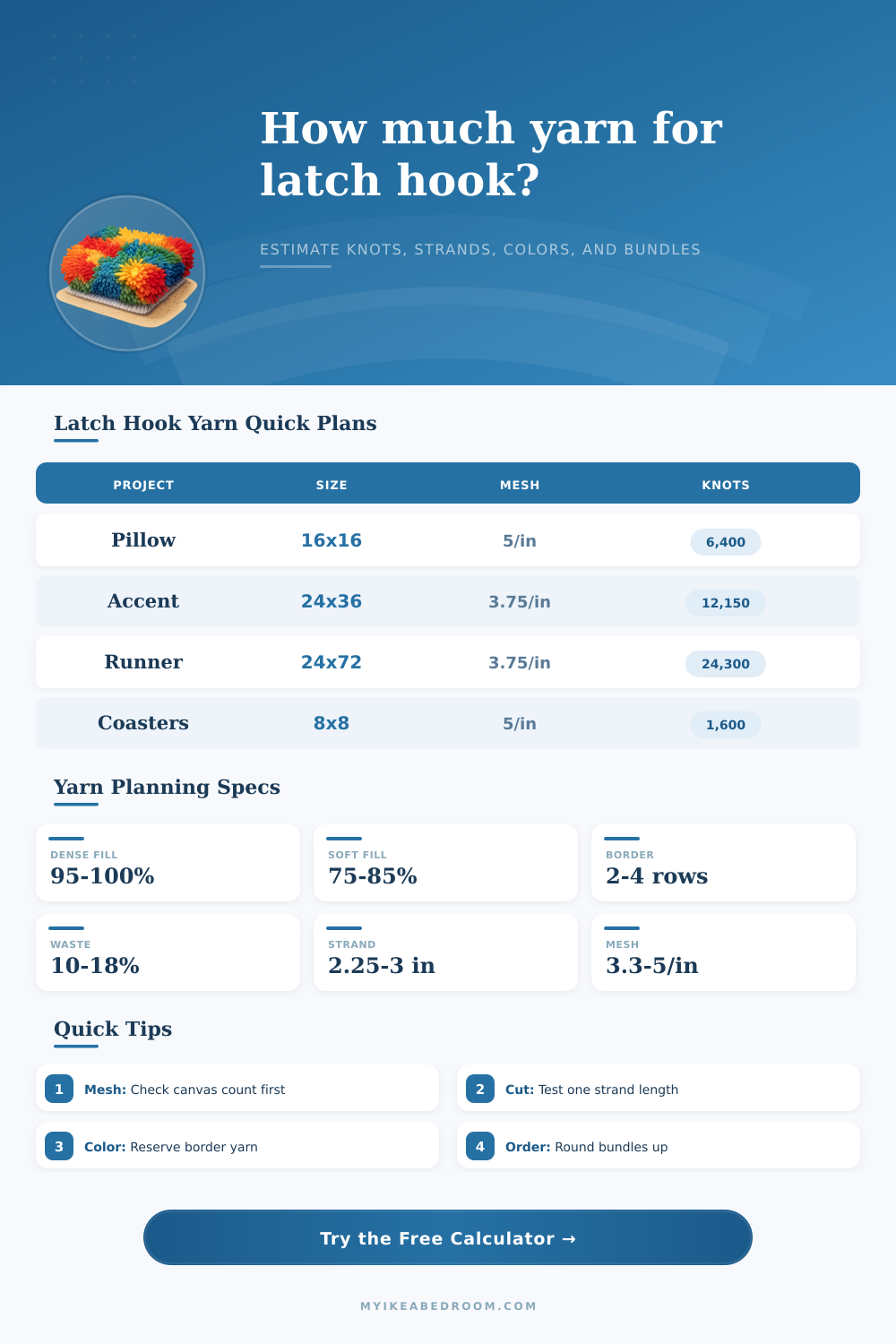
Estimate canvas knots, cut yarn pieces, total strand length, color split, bundle count, border reserve, and pile coverage for wall rugs, accent rugs, pillow fronts, runners, coasters, and kids room mats.
Load a common project, then adjust the canvas mesh, strand length, color count, pile density, border rows, waste, and bundle size.
Pre-cut rug yarn
Use for: fastest setup and even pile.
Bundle counts map cleanly to pieces because the strand length is fixed.
Acrylic worsted
Use for: washable bedroom accents.
Cut with a gauge card and add waste for fuzzy or split strands.
Wool rug yarn
Use for: fuller pile and warm texture.
Often looks dense at a slightly lower interior fill percentage.
Cotton blend
Use for: crisp colors and low fuzz.
Heavier strands may need a larger mesh or shorter pile height.
Chunky yarn
Use for: bold wall rugs and soft mats.
Reduce pile density if knots crowd the canvas openings.
Chenille yarn
Use for: plush decorative fronts.
Cut gently and keep extra waste because ends shed while trimming.
T-shirt yarn
Use for: coarse mesh experiments.
Best on low mesh counts because each strip fills more area.
Mixed scraps
Use for: color fields and stash projects.
Sort by strand thickness so the pile coverage stays consistent.
| Canvas mesh | Knots per sq in | Best project fit | Yarn planning note |
|---|---|---|---|
| 3.3 mesh | About 11 | Chunky kids rugs, wall panels, bold mats | Each knot covers more area, so total strand count drops. |
| 3.75 mesh | About 14 | Common accent rugs, runners, bath mat sizes | Good balance between speed, coverage, and detail. |
| 4.0 mesh | 16 | Small room rugs and dense motif panels | Yarn count rises quickly as area grows. |
| 5.0 mesh | 25 | Pillow fronts, coasters, small wall art | Higher detail, but many more pieces to cut. |
| Pile density | Coverage look | Best use | Calculator behavior |
|---|---|---|---|
| 60% to 70% | Open and airy | Wall pieces, experimental textures, chunky yarn | Interior holes are skipped while full border rows remain filled. |
| 75% to 85% | Soft partial fill | Kids rugs, pet mats, casual bedroom accents | Uses less yarn but still protects the project outline. |
| 90% to 95% | Nearly full | Pillow fronts, decorative runners, large motifs | Good for colorwork where small gaps are acceptable. |
| 100% | Fully packed | Accent rugs, bath mats, dense picture panels | Every counted canvas position becomes one cut strand. |
| Cut strand length | Approx pile height | Typical feel | Planning note |
|---|---|---|---|
| 2 in / 5 cm | About 0.8 in / 2 cm | Short, tidy, lower bulk | Good for pillows, small panels, and detailed motifs. |
| 2.5 in / 6.4 cm | About 1.05 in / 2.7 cm | Classic latch hook pile | Common starting point for rug yarn and pre-cut packs. |
| 3 in / 7.6 cm | About 1.25 in / 3.2 cm | Plush and forgiving | Add waste because uneven trimming is more visible. |
| 3.5 in / 8.9 cm | About 1.45 in / 3.7 cm | Long shag look | Best on open designs or sturdy canvas with strong edging. |
| Bundle length | At 2.5 in strands | Color planning use | Rounding rule |
|---|---|---|---|
| 40 yd / 37 m | About 576 pieces | Small accent colors and test packs | Round each color up if color blocks are separate. |
| 60 yd / 55 m | About 864 pieces | Pillow fronts, wall panels, and coasters | Useful when many colors share the same design. |
| 80 yd / 73 m | About 1,152 pieces | Accent rugs and medium mats | Common all-purpose planning size. |
| 120 yd / 110 m | About 1,728 pieces | Background colors and larger runners | Best for dominant colors after reading the chart. |
A common mistake in latch hooking is underestimating quantity of yarn needed. You grab some old canvas or pick a kit, then choose some skeins that look sufficient. Then you’re half way into the second row of the outer border and out of yarn. Why? Because counting knots isn’t intuitive math. You have to consider the number of holes to cover, strand length, the mesh density, and the amount of waste to trim off at the end. Once you decide on pile height and size of canvas, the calculator above does all those calculations for you. No more guesswork as you attempt to picture a rug you haven’t made yet.
Several variables can cause mistakes: mesh count, pile density, strand length, waste, and yarn type. Mesh counts comes from the amount of knots per inch on a canvas. For example, a normal 3.75 mesh seems rough, but there are actualy fourteen possible knot positions every inch. Times that against the surface area of your runner and it doesn’t take long to realize there’s a lot of cutting to do. Want something with finer details? Go to a 5 mesh canvas. Now you’ve got nice clean images and softer colors blending together, but you’re going to have to work for it. There is more yarn per inch which means there are more individual strands to cut out and you will spend more time at the hook. Depending on what mesh you put in, the tool will calculate the total holes to cut. Before picking up a single strand of yarn, it will tell you how many pieces to cut out.
How to Plan Your Latch Hooking Project
You should also consider pile density. A common misperception among new weavers is that in order to have a proper rug all of the holes need to be filled. Not true! If you fill just 75% of the holes inside your frame, it will feel softer. This is great for bedroom mats or wall hangings where the mat doesn’t need to withstand heavy traffic areas. Less yarn equals less material needed while still allowing the mat to appear complete. And if there are gaps, it allows the design to breathe as well. You can increase or decrease the percentage on the calculator to control both the cost of the project and what final textile feels like.
Next, consider the length of your strands. Your pile height is determined by how long each strand is. Pulling a two-and-a-half-inch strand through the canvas, looping it around, and pulling it tight will give you that classic one inch of pile. It’s plenty cushy, but not too big to be fussy. That is why it is common for most rug floors. If you want something shaggier, then you’ll need a longer strand which requires more yarn knotted per inch to fill out the increased length. Plus, the excess length takes up more vertical space inside the holes in the canvas. Fewer rows can fits within the visual frame. What is the effect? The pile looks longer from above and shorter from below. A shorter strand creates a denser, tighter pile. For example, pillow fronts typically use a two-inch cut. The resulting density create a smooth surface like carpet.
Waste is a silent budget killer in yarn crafts. There will always be leftover bits, whether because you cut them off or they unravel at a knot. If you’re working with multiple colors, changing colors can require adjustments. There will always be leftover bits, whether because you cut them off or they unravel at a knot. If you’re working with multiple colors, a color change could of required tweaking. Fifteen to twenty percent added to your total estimate more than compensates for all this waste. This way, there’s no mad scramble because you only have two rows left on that border and ran out of red yarn. Wasting isn’t being pessimistic; it’s just practicing good project management.
The material requirements will also depend off the type of yarn selected. Pre-cut packs are convenient because length is uniform, making bundle calculations straightforward. Skein yarns (both cotton and wool) must be measured and cut to size, adding an element of variance. Furthermore, if you’re using wool, the pile will appear denser even when filled less due to its fullness. There’s more variation depending on what you use: some fiber types (like cotton blends) might need to be cut shorter to sit properly in finer meshes; while others (such as wool) create a fuller pile that looks dense even at lower fill percentages. Knowing how your chosen materials behave allows you to tweak those variables until your prediction matches actual results, instead of perfect circumstances.
In short: Latch hooking is half preparation and half execution. The prep saves you from buying too much yarn or not enough. This way, you will know exactly how many packs of how many colors you need to purchase. And it makes a seemingly hard craft, something you can work on in little bits, a doable weekend project or even just a nice way to spend an afternoon once a month. If you’ve got your numbers sorted out at the beginning, then you’re not worrying about the logistics, only the satisfaction of the act of hooking itself. It is just you and some yarn, and every color has plenty of length to make it all the way across.