Landscape Lighting Wattage Calculator
Estimate total fixture watts, adjusted transformer load, low-voltage amps, zone balance, spare capacity, driver losses, runtime energy, and a practical transformer capacity band.
Choose a typical outdoor lighting mix, then edit fixture counts, watts, voltage, load factor, spare capacity, driver efficiency, zones, and runtime.
Path lights
The calculator highlights the largest wattage group.
Balanced
Compares adjusted watts with the selected capacity rule.
0 W/zone
Shows the average zone load and fixture count.
0 kWh/day
Uses adjusted load after driver efficiency.
| Fixture type | Low output | Common range | Higher output |
|---|---|---|---|
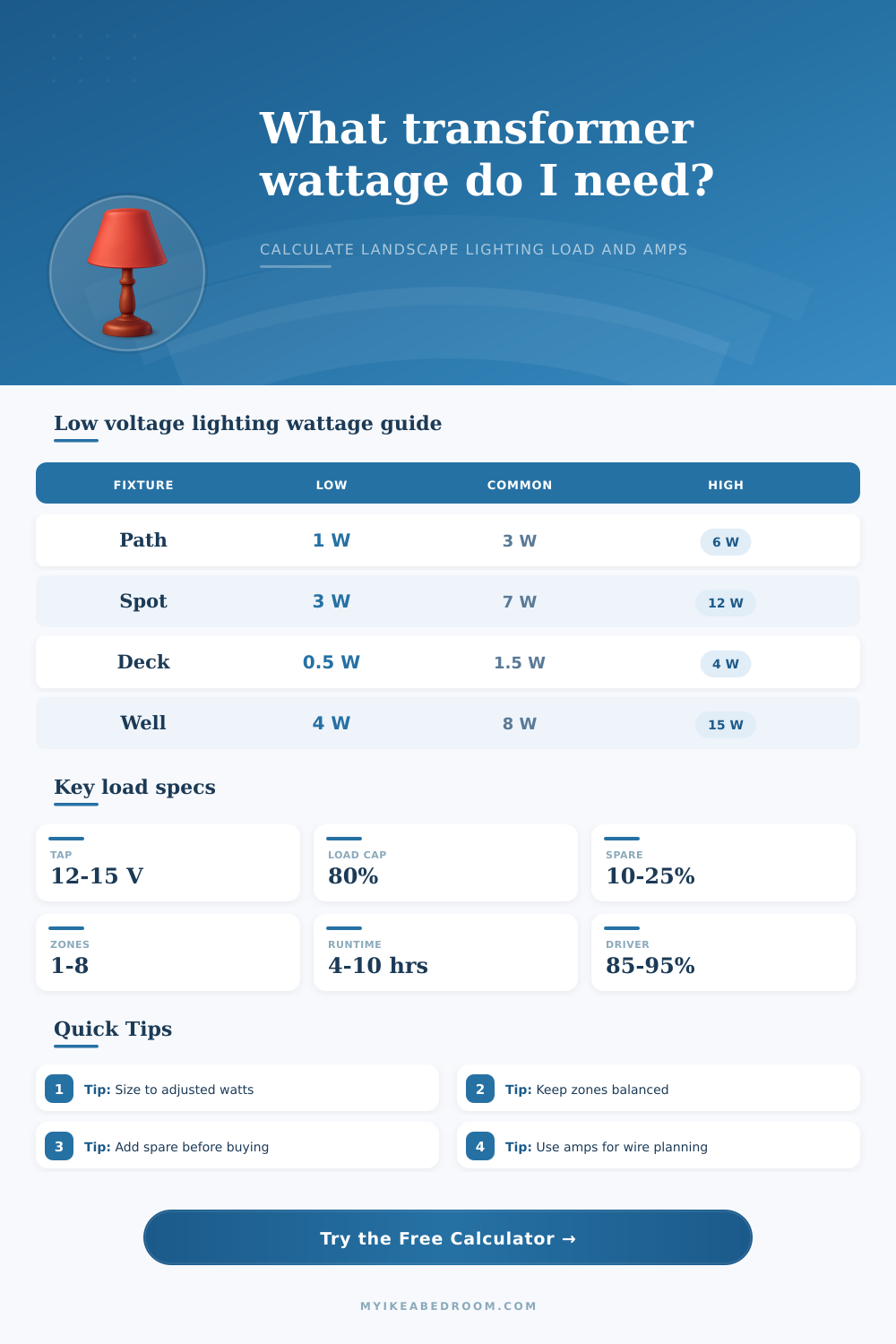
| Path and garden marker | 1 to 2 W | 2.5 to 4 W | 5 to 7 W |
| Spotlight or tree uplight | 3 to 5 W | 6 to 8 W | 10 to 15 W |
| Deck, stair, and rail light | 0.5 to 1 W | 1.2 to 2.5 W | 3 to 4 W |
| Wall wash or wide accent | 3 to 5 W | 5 to 9 W | 10 to 15 W |
| Well light or hardscape light | 4 to 6 W | 7 to 10 W | 12 to 18 W |
| Nameplate size | 75% band | 80% band | 90% band |
|---|---|---|---|
| 60 W transformer | 45 W | 48 W | 54 W |
| 100 W transformer | 75 W | 80 W | 90 W |
| 150 W transformer | 112.5 W | 120 W | 135 W |
| 200 W transformer | 150 W | 160 W | 180 W |
| 300 W transformer | 225 W | 240 W | 270 W |
| Adjusted load | 12 V amps | 15 V amps | 24 V amps |
|---|---|---|---|
| 30 W | 2.5 A | 2.0 A | 1.25 A |
| 60 W | 5.0 A | 4.0 A | 2.5 A |
| 100 W | 8.3 A | 6.7 A | 4.2 A |
| 150 W | 12.5 A | 10.0 A | 6.3 A |
| 240 W | 20.0 A | 16.0 A | 10.0 A |
| Layout pattern | Typical fixtures | Usual watts | Planning note |
|---|---|---|---|
| Small path system | 8 to 12 path lights | 20 to 45 W | Often one or two zones |
| Deck stair circuit | 10 to 20 step lights | 12 to 45 W | Low watts but many points |
| Mixed garden accents | Path plus uplights | 60 to 140 W | Balance path and spot groups |
| Large yard zones | 30 plus fixtures | 140 to 300 W | Split into multiple zones |
| LED retrofit | Existing cable reuse | 30 to 120 W | Check lower current after swap |
Capacity tip: Size the transformer from adjusted watts plus spare capacity, then compare that result with the practical 75%, 80%, or 90% load band you selected.
Zone tip: If one zone carries most of the spotlights, use the max zone watts as a wiring clue instead of relying only on the system average.
When you are planning your landscape lighting system, there are several electrical factors that you must account for in order to ensure that your landscape lighting system works correct. A person may desire to create a landscape lighting system that light a path, lights a tree, or lights a deck. However, before a person creates such a system, they must have an understanding of the electrical requirements of that system.
While the landscape lighting system will rely upon wattage to determine the number of light that can be added to the system, wattage isnt the only factor that must be considered. A person must understand all of the electrical aspects of the system, including but not limited to the factors that relate to the fixture that will be used and the power that the landscape lighting system will provide to those fixtures. Low voltage lighting system will typically run on 12, 15, or 24 volts.
How to Plan Power for Landscape Lighting
Low voltage lighting systems are generaly considered to be safer to install than other types of lighting systems. In addition, low voltage lighting systems typically allow for the use of thinner cable to carry the electricity to the light fixtures. Each fixture within the lighting system will consume some of the power that the transformer supplies.
While a single path light may use three watt of power, the total wattage for all of the path lights in the system may reach to a high number. The total wattage of the lighting system is a factor that must be considered when purchasing the lighting system. An online calculator will allow a person to enter the number of fixtures and the wattage of each fixture to determine the total wattage of the system prior to purchase.
The transformer that will supply power to each of the fixtures will have a maximum capacity to the wattage of the lights that is listed on the nameplate of the transformer. The total wattage of the lighting system should not reach to the maximum wattage capacity of the transformer. Many electricians will recommend that only 80 percent of the capacity of the transformer is used.
If a transformer is used at 100 percent of its capacity, the transformer will generate heat that could shorten the life of the transformer. Furthermore, if a transformer is used at 100 percent of its capacity, there will be no room in the transformer for the addition of more light fixtures to the system. Depending on the plans for the lighting system, either a 15 percent spare capacity for the transformer or a 25 percent spare capacity can be used.
Another factor to consider in the planning of the lighting system is the efficiency of the drivers. Each transformer and each LED driver will lose some of the power that is supplied to the lights. For instance, if the LED driver has an efficiency of 90 percent, the transformer will have to supply 111 watts to allow the lights to recieve 100 watts of power.
The difference in wattage is lost as heat. Calculators can provide for the efficiency of each light fixture so that the total wattage of the system includes that lost power. Although the power lost to efficiency is typically low in small lighting systems, the amount of power that is lost due to inefficiency becomes more high in systems that use many hundreds of watts.
Another factor to consider in the planning stage is the division of the lighting system into multiple zones. Each zone will have power supplied to it by a separate cable. By dividing the system into zones, a person can control the lights within each zone separately.
For instance, a person may control the lights along the path to stay on later than other zones within the lighting system. An online calculator can help to determine the average wattage of each zone within the system. If one zone uses more watts than the others, the cable for that zone will have to be thicker or a separate transformer will be used for that zone.
The runtime of the lights is another electrical factor that should be considered. The runtime is the length of time that the lighting system will be on each night. Transformers that are used for longer runtimes will produce more heat over time than those that are used for shorter runtimes.
The runtime of the lighting system can help to determine how much spare capacity that should be left in the transformer. Additionally, the runtime of the lighting system will determine the amount of energy that the system will use each day. The capacity of the transformer will determine the load limit of the transformer.
Many people make mistake when they are planning their landscape lighting system. One of the most common mistake is to use the maximum wattage of the transformer as the total wattage that will be used by the lights. Another of the most common mistake is to not consider the power that the LED drivers draw even when the lights are at a low wattage setting.
Additionally, many people will add lights to an existing lighting system without considering the total wattage that the system will use. If an excessive amount of lights are added, the transformer may overheat during warm months. A calculator will help to avoid this mistake.
Voltage drop is another factor in the lighting system that a wattage calculator cannot account for. Voltage drop occurs when the electrical current travels through the cables to the light fixtures. If the length of the cables is too great, the lights at the end of the cable may be significantly dimmer than the lights at the start of the cable.
In order to avoid voltage drop, many landscape lighting designers will limit the length of the cables to 100 or 150 feet. In some cases, different voltage taps can be used on the transformer. Although the wattage calculator does not account for voltage drop, the amp draw that the lighting system will require is necessary to use a voltage drop table.
In order to plan a landscape lighting system, the number of light fixtures and the wattage of each light fixture can be entered into a calculator. Using the wattage of each zone, the total wattage of the system can be determined. In addition to entering the wattage of each light fixture, the percentage of spare capacity that will be used for the transformer can be entered into the calculator.
Based off these entries, the lighting designer and the person that will install the lighting system can determine if the number of light fixtures is to high for the system or if a larger transformer should be used. For these reasons, using a landscape lighting system calculator will remove the guesswork of the electrical calculations that must be made prior to installation of the lights.