Landscape Lighting Transformer Calculator
Size a low-voltage outdoor lighting transformer from fixture wattage groups, control load, LED inrush factor, derating, spare capacity, tap voltage, zone count, wire gauge, and voltage drop.
Load a common lighting system, then adjust fixture groups, voltage, transformer derating, spare capacity, zone count, wire run, tap voltage, control load, and LED inrush factor.
0%
Enter a transformer size to compare.
0 W
Usable capacity after derating.
12 V
Far end voltage estimate.
0 W
Heaviest planned zone.
| Rated size | Usable at 80% | Best for adjusted load | Planning note |
|---|---|---|---|
| 60 W / 60 VA | 48 W | Up to about 40 W | Small deck, steps, or short path |
| 100 W / 100 VA | 80 W | 40 to 70 W | Simple path lighting system |
| 150 W / 150 VA | 120 W | 70 to 105 W | Path plus small accent group |
| 200 W / 200 VA | 160 W | 105 to 140 W | Mixed yard with moderate spare |
| 300 W / 300 VA | 240 W | 140 to 215 W | Multi-zone residential layout |
| 600 W / 600 VA | 480 W | 215 to 430 W | Large multi-zone LED system |
| 900 W / 900 VA | 720 W | 430 to 645 W | Large property with several runs |
| 1200 W / 1200 VA | 960 W | 645 to 860 W | Very large layout, verify circuits |
| Transformer plan | Derating input | Spare input | What it means |
|---|---|---|---|
| Tight retrofit | 10% | 5% | Works when fixture count is final and runs are short |
| Common LED plan | 20% | 10 to 15% | Good everyday setting for most residential LED systems |
| Expandable yard | 20% | 20 to 25% | Leaves room for later path or accent fixtures |
| Warm enclosure | 25 to 30% | 10 to 20% | Useful when the transformer location has poor airflow |
| Unknown drivers | 20% | 15 to 25% | Pairs well with a higher LED inrush factor |
| Wire gauge | Ohms per 1000 ft | Typical use | Drop planning note |
|---|---|---|---|
| 18 AWG | 6.385 | Very small short leads | Use only for light loads and short distances |
| 16 AWG | 4.016 | Small path zones | Watch drop above 50 ft with heavier loads |
| 14 AWG | 2.525 | Common short to medium runs | Good for moderate LED zones |
| 12 AWG | 1.588 | Common main runs | Lower drop for mixed fixture zones |
| 10 AWG | 0.999 | Longer or heavier runs | Useful before raising tap voltage |
| 8 AWG | 0.628 | Long high-load feeders | Large cable, best for demanding zones |
| Tap | Use when | Far-end target | Planning note |
|---|---|---|---|
| 12 V | Short runs and balanced zones | About 11 to 12 V | Default for most close transformer locations |
| 13 V | Mild voltage drop | About 11.5 to 12.2 V | Useful when far fixtures are slightly dim |
| 14 V | Longer mixed zones | About 11.8 to 12.5 V | Check near fixtures so they are not over-volted |
| 15 V | Long run with planned drop | About 12 to 13 V | Best after splitting zones and sizing wire |
| 24 V | 24 V fixtures and drivers | About 22 to 24 V | Do not use with fixtures rated for 12 V only |
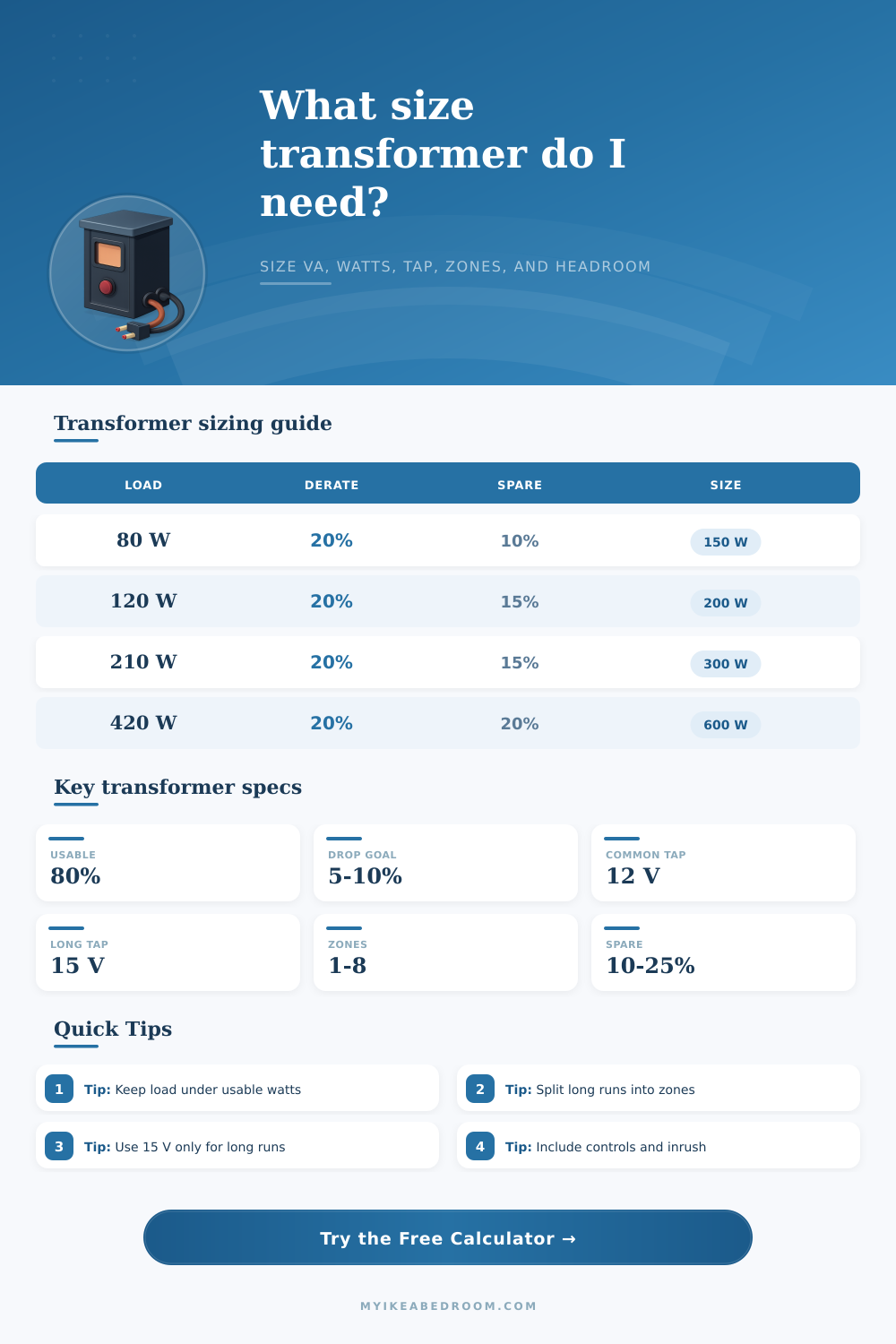
Derating tip: Size the transformer from adjusted load, then apply derating and spare capacity. This keeps the recommended transformer from running at its full nameplate rating.
Tap tip: Raise tap voltage only to offset measured or estimated drop on long runs. If one zone is heavy, splitting the zone or using larger wire is usually cleaner.
Choosing a transformer for a landscape lighting system is a necessary step in an installation of such a lighting system. The transformer must supply the correct amount of power to each light fixture that are included in the landscape lighting system. If the transformer that is chosen for the landscape lighting system is too small to supply the necessary power to each of the light fixtures, the lights will dim or flicker.
If the transformer for the landscape lighting system is of the incorrect size for the landscape lighting system, the voltage in the system may be too low to allow the light fixtures to function proper. Low voltage landscape lighting systems typically use either 12 volts or 24 volts to power each of the light in the system. Each foot of wire used in the landscape lighting system creates resistance in the system.
How to Choose the Right Transformer for Garden Lights
Electrical resistance in the system create a drop in the voltage that is distributed to the light fixtures in the system. The farther the light fixtures are from the transformer that power the lights in the system, the more that the voltage drops due to the resistance in the wires. Thus, an individual must consider the distance between the transformer and the most distant light fixture, the gauge of the wire that is use in the system, and the tap voltage of the transformer when choosing the appropriate transformer.
An individual cant simply add the wattages of each of the light fixtures in the system to determine the size of the transformer to be used. The wattage of the fixtures in the system dont account for the voltage drop that may occur in the system. An individual using a transformer calculator must enter the wattage of the fixtures, the inrush factor, and the control load of the system.
The wattage of the fixtures is the power that each fixture use. The inrush factor is the amount of power that the LED drivers of the fixtures initially radiate; this initial inrush of power into the system may cause the transformer to trip if the transformer is near its capability. Control devices, such as timers and photocells, create a load upon the system that must also be accounted for in the calculation made with the transformer calculator.
The transformer should not be operated at the full nameplate rating of the transformer. The transformer will provide more power and will last longer if it is operated at a derated and spare capacity. When a transformer is derated, it means that the transformer will include some of the transformer’s capability in the system to allow for the even distribution of heat created by the light fixtures.
Published wattages may not equal the actual wattages that the light fixtures draw. Spare capacity means that the individual will choose a transformer that is larger than the one needed for the current system to allow for the addition of new lights in the future. If there is spare capacity provided for the transformer, it will be easier for the individual to purchase the additional lights needed without having to replace the transformer altogether.
Zone planning is one of the most important aspect in the creation of a landscape lighting system. By dividing the lights into zones, the voltage drop that occurs in the system due to distance from the transformer can be reduced. If a person places all of the light fixtures along a single wire run, the voltage drop at the end of the wire will be very high.
However, if a person splits the fixtures into two or three separate wire runs, the current that travels along each wire will be less, resulting in a lesser voltage drop along each wire run. Using a calculator, a person can test various numbers of light zones to determine how splitting the fixtures will affect the voltage levels of each zone within the landscape lighting installation. The gauge of the wire that is used in the installation will also affect the voltage drop along the landscape lighting system.
Using thicker wire will reduce the voltage drop along the system. For example, using 12 gauge wire instead of 16 gauge wire will reduce the voltage drop by more than half over a 90-foot run of wire. Additionally, using thicker wire is often more cost-effective than using a larger transformer, as the thicker wire will reduce the resistance and the amount of heat created along the connections.
A person must measure the length of the wire that will be used in the installation. The route of the wire does not necessarily follow the same path as the layout of the area to be lighted. Trees, irrigation lines, and buildings may force the wire to take a longer route to these objects.
Additionally, the heat that is created by the transformer may affect the performance of the transformer. A transformer placed in the sun will become hotter than a transformer placed in the shade. Therefore, the length of the cable run must be measured, as well as the additional length for wire connections and allowances for future adjustments.
Not all light fixtures are created equally. Some fixtures can operate at a lower voltage than others. For example, a path light may require a low voltage to function properly, but an uplight may not be able to function properly with too low a voltage.
To avoid this issue, a person can group the light fixtures of each type and enter them into the circuit calculator separately to observe each type of fixture’s reaction to the voltage in the installation. Once the installation is complete, a person can use a voltage meter to measure the voltage at the most distant fixture in each zone. The voltage at the most distant fixture should be within one or two volts of the target voltage.
If the voltage of the most distant fixture in each zone is too low, then the wire run must be shortened, the gauge of the wire can be increased, the number of zones can be increased, or the tap voltage can be increased. The voltage of the transformer must be chosen in such a way that the lights will function as the designer intended for the landscape lighting system for many year. Its actualy a complex process and you should of checked the spec sheet first.
The furnitures in the garden area should be kept away from teh lights. Its important to avoid any moddern mistakes during the setup. Youll find that the voltage drop is more problematic then people realize.