Lampshade Size for Base Calculator
Calculate shade width, shade height, top taper, bottom drop, fitter position, and base balance from the lamp base dimensions you can actually measure.
Choose a real lamp base setup, then tune the base width, lamp height, socket line, shade style, and current shade measurements.
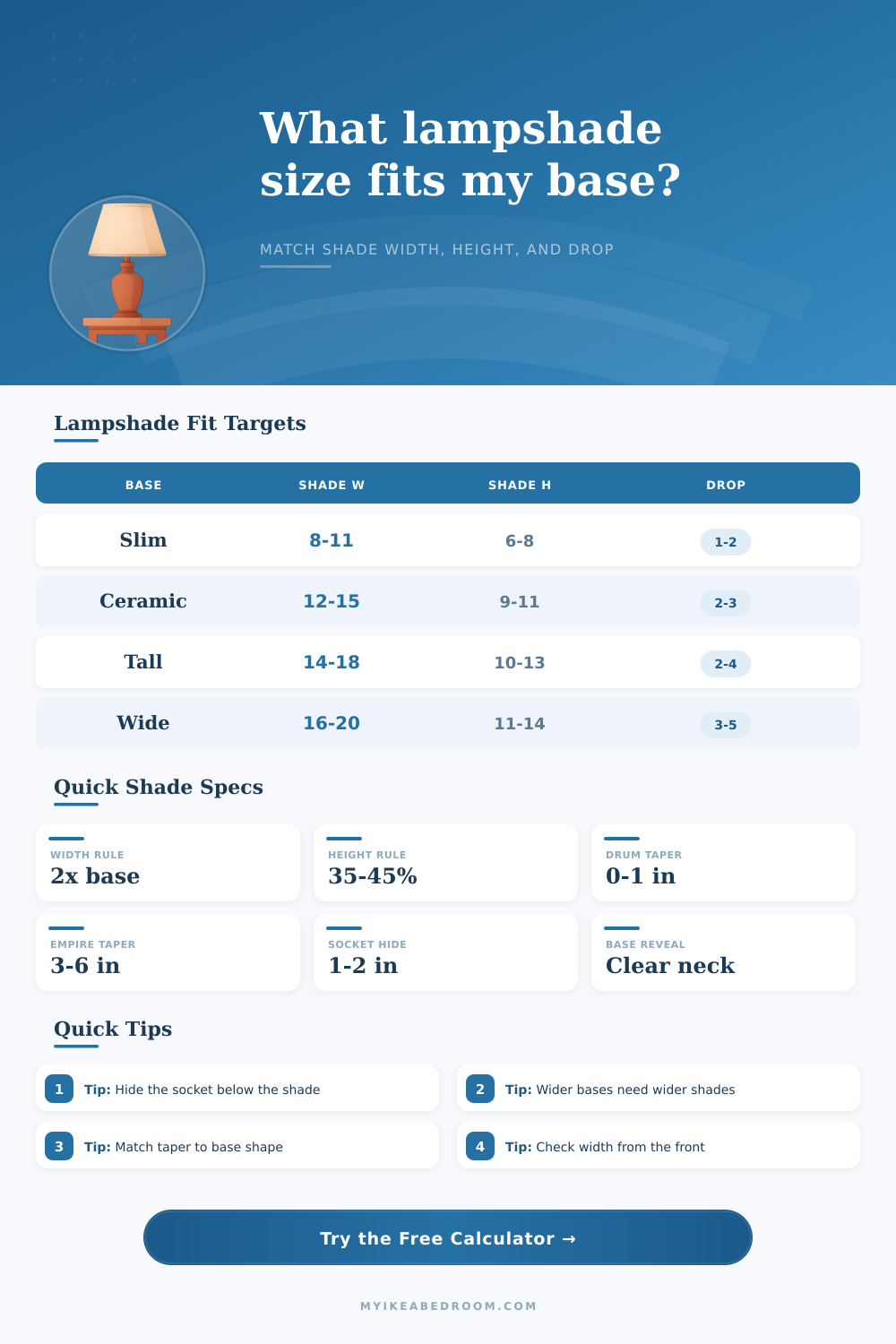
| Base style | Width multiplier | Height share | Best shade shape |
|---|---|---|---|
| Slim candlestick or column | 1.55 to 1.85 times widest base | 34 to 40 percent of base height | Empire, small drum, or oval shade. |
| Medium ceramic or wood base | 1.85 to 2.15 times widest base | 36 to 44 percent of base height | Empire, drum, bell, or soft rectangle. |
| Wide urn or heavy stone base | 2.10 to 2.45 times widest base | 38 to 48 percent of base height | Bell, empire, or larger drum shade. |
| Open tripod or cage base | 1.65 to 1.95 times widest base | 32 to 40 percent of base height | Shallow drum or rectangular shade. |
| Shade shape | Top width relation | Visual effect | When to use it |
|---|---|---|---|
| Drum | Top is 90 to 100 percent of bottom | Clean, modern, and visually wide. | Column, glass, tripod, and square bases. |
| Empire | Top is 55 to 75 percent of bottom | Classic taper that narrows the lamp silhouette. | Ceramic, urn, bedside, and traditional bases. |
| Bell | Top is 45 to 65 percent of bottom | Soft curve with a grounded lower edge. | Curved bases and heavier table lamps. |
| Rectangle or oval | Top is 70 to 95 percent of bottom | Fits shallow tables and bases with a front/back face. | Square block, console, desk, and narrow-depth lamps. |
| Measured base | Likely shade bottom | Likely shade height | Fitter note |
|---|---|---|---|
| 5 inch slim base, 15 inch shoulder height | 8 to 10 inches | 6 to 8 inches | Short harp keeps socket hidden. |
| 7 inch ceramic base, 18 inch shoulder height | 12 to 15 inches | 8 to 11 inches | Medium harp balances most bedside lamps. |
| 9 inch urn base, 20 inch shoulder height | 17 to 21 inches | 10 to 13 inches | Check neck clearance before widening shade. |
| 11 inch stone base, 22 inch shoulder height | 23 to 27 inches | 12 to 15 inches | Use broad shade only on deep tabletops. |
| Hardware condition | Target bottom drop | Shade bottom line | Result |
|---|---|---|---|
| Standard socket and harp saddle | 1 to 2 inches below socket top | Just below visible socket shell | Hides hardware without burying the neck. |
| Tall socket or visible switch | 2 to 3 inches below socket top | Lower shade bottom | Reduces glare and covers bright hardware. |
| Decorative neck worth showing | 0.5 to 1.5 inches below socket top | Higher shade bottom | Keeps the lamp stem and neck visible. |
| Low glare room or nursery | 2.5 to 4 inches below socket top | Deep shade drop | Blocks bulb view from lower seated angles. |
Best for: base balance.
Starts from the widest base measurement, then expands or narrows the shade range for visual weight and shape.
Best for: tall bases.
Uses base shoulder height to set shade height so the lamp does not look top-heavy or undersized.
Best for: glare control.
Compares socket top, shade bottom, drop target, and harp height before choosing hardware.
Best for: testing a shade.
Scores the current shade against recommended width, height, taper, and socket coverage ranges.
Measure the base where it is visually widest. A narrow foot under a broad ceramic body should not drive the shade size; the shade needs to balance the part your eye reads as the base.
Check the shade bottom line from seated eye height. If the bulb or socket is visible, increase drop, use a taller shade, or switch to a lower harp before changing the whole lamp.
When choosing an lamp shade for a lamp, the individual has to measure the lamp base to ensure that the lamp shade is proportionally to the lamp base. The lamp shade has to be the correct size relative to the lamp base; if the shade is too small, the lamp base will look top-heavy, and if the shade is too large in comparison to the base, the base will look small or even dissapears altogether. A calculator can be use to determine the dimensions of the lamp shade that will best suit the lamp base.
The calculator takes into account the measurement of the lamp base to calculate the dimensions of the shade. To use the calculator to determine the dimensions of the shade that will best suit the lamp base, the user must measure three differently parts of the lamp base. The first is the width of the lamp base, the second is the height of the lamp base from the table to the socket of the base, and the third is the width of the neck of the base below the socket.
How to Measure a Lamp Base to Choose the Right Shade
Each of these measurement is necessary to calculate the size of the shade. The width of the base relate to the width of the shade; the wider the base, the wider the shade will need to be to look good on the lamp base. The height of the shade is another critically measurement for the shade.
The shade should be of a height that covers the socket of the base; a shade that is too low will leave the lamp base exposed, and one that is too high may make the shade appear stretched on the base. The user can use the height of the base to calculate the height of the shade that will suit the base best. The third dimension is the shape of the shade.
For instance, if the lamp base have a drum shade, the shade will have a wide and flat top; for an empire shade, the shade will have a different shape. In general, heavy base will have lamp shades with an extra width at the bottom of the shade to support the heavy base. Tripod bases will have a narrower shade because the tripod base allow for the shade to be seen through the base.
The calculator calculates the width of the shade by taking into account the base’s visual weight. The drop of the shade is another measurement of the shade that is essential in determine how the shade will look on the lamp base. The drop of the shade is the measurement of how far the shade will sit below the socket of the base.
This will determine how much of the base will be seen. For instance, if the drop of the shade is deep, most of the decorative hardware of the base will be hidden, but if the drop is shallow, the decorative neck of the base will be seen. The drop of the shade will affect the amount of light that will emanate from the shade to the room.
Many mistake can occur when trying to measure the lamp base. For instance, the user can measure the wrong part of the base. One mistake would be to measure the foot of the base only.
A shade with this measurement would be too small for the base. Another error is to ignore the height of the base and the width of the base to choose the height of the shade. The user can avoid these mistakes by using the calculator to determine the dimensions of the shade that will suit the lamp base.
By measuring the base and entering the measurements into the calculator, the user can ensure that the shade will look intentional and the lamp will look balance.