Lamp heat and bulb safety planner
Lamp Wattage Limit Calculator
Check a fixture's wattage label against bulb type, bulb count, equivalent watts, actual watts, socket rating, shade clearance, enclosed globes, ambient temperature, total amps, and a practical heat risk score.
| Bulb type | Common equivalent | Typical actual watts | Heat planning note |
|---|---|---|---|
| LED A19 | 40, 60, 75, 100 W equivalent | 5 to 17 W | Usually safest by wattage, but check enclosed-fixture rating. |
| Smart LED A19 | 60 to 100 W equivalent | 8 to 14 W | Electronics dislike trapped heat in tight glass globes. |
| CFL spiral | 40 to 100 W equivalent | 9 to 23 W | Lower watts than incandescent but the ballast base needs air. |
| Incandescent | 25 to 100 W actual | 25 to 100 W | Nearly all input becomes local heat near shade and socket. |
| Halogen capsule or PAR | 35 to 100 W equivalent | 20 to 75 W | Small bright source can overheat nearby shade material. |
| Socket type | Planning cap used | Common lamp use | Calculator behavior |
|---|---|---|---|
| E26 medium | 150 W per socket | Table, floor, pendant, and utility lamps | Fixture label usually controls before socket cap. |
| E27 medium | 150 W per socket | Medium screw fixtures in many regions | Use the lower of label and socket planning cap. |
| E12 candelabra | 60 W per socket | Chandeliers, sconces, small lamps | Small socket pushes risk up when actual watts climb. |
| E14 small Edison | 60 W per socket | Compact lamps and decorative fixtures | Similar caution profile to candelabra sockets. |
| GU10 or G9 | 50 W per socket | Spot lamps and compact capsules | Close housings add heat pressure quickly. |
| Integrated LED | 25 W module cap | Built-in lamp heads and strips | Use fixture manual rating when available. |
| Fixture condition | Multiplier | Why it matters | Best calculator setting |
|---|---|---|---|
| Open shade with 3 in or more clearance | 0.85 to 0.95x | Air carries heat away from bulb and socket. | Open fixture, normal or cool ambient. |
| Semi-enclosed fabric shade | 1.05 to 1.18x | Shade traps warm air while still venting upward. | Semi-enclosed, normal ambient. |
| Glass globe or sealed diffuser | 1.25 to 1.45x | Heat accumulates around bulb electronics and socket. | Enclosed fixture and rated LED note. |
| Recessed can or tight housing | 1.25 to 1.55x | Small cavity and ceiling heat reduce cooling. | Recessed setting plus warm ambient. |
| Paper or plastic shade near bulb | 1.20 to 1.60x | Low clearance raises material temperature. | Condition set to paper or plastic. |
| Common fixture | Typical label | Practical LED actual watts | Watch point |
|---|---|---|---|
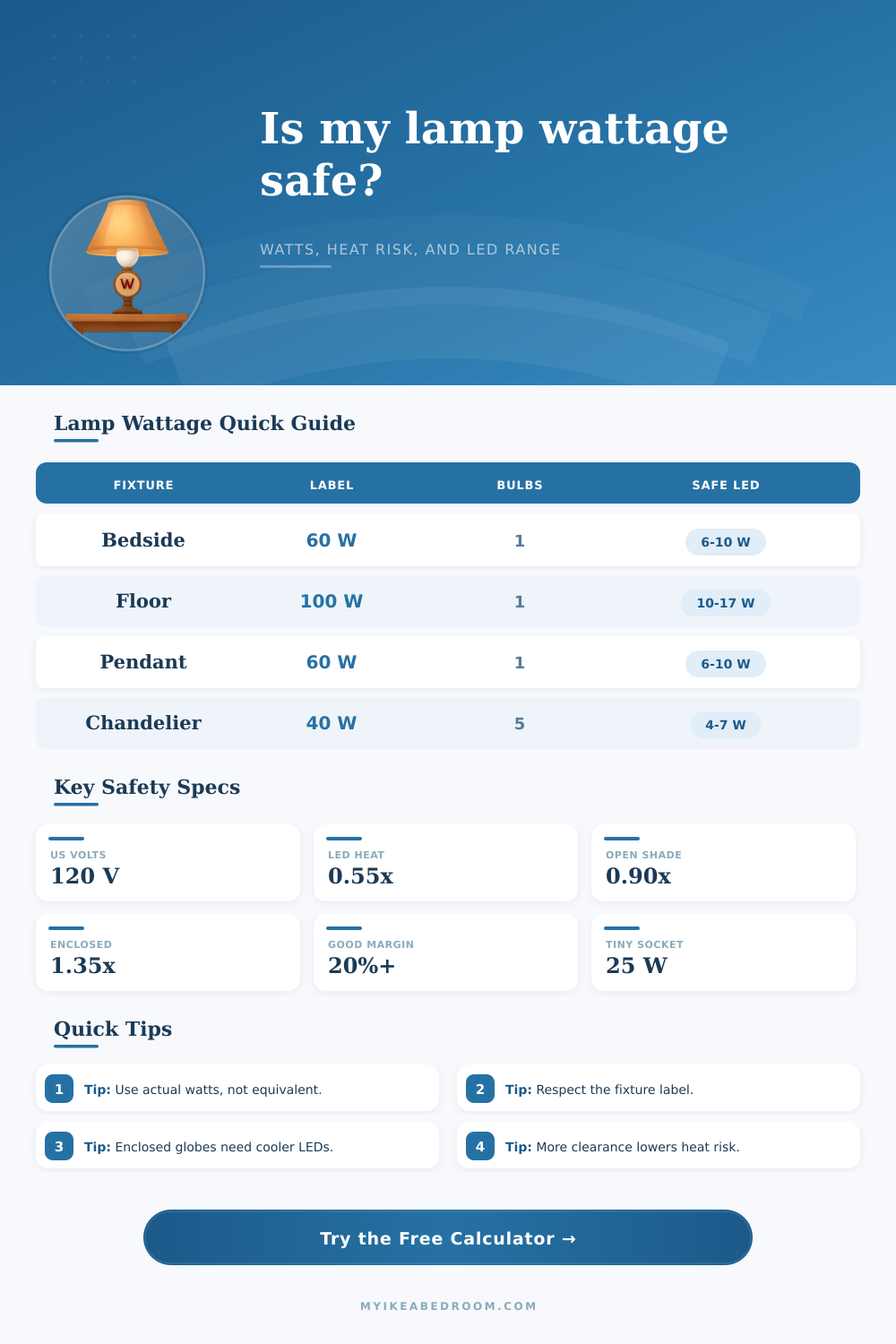
| Bedside table lamp | 40 to 60 W | 6 to 10 W LED | Keep bulb below shade top and away from liner. |
| Floor lamp shade | 60 to 150 W | 10 to 17 W LED | Large shades vent well, but torchiere bowls trap heat. |
| Pendant shade | 40 to 60 W | 6 to 10 W LED | Heat collects at the canopy and shade neck. |
| Vanity bar | 40 to 60 W per socket | 4 to 9 W LED each | Multiple bulbs add up even when each is modest. |
| Chandelier arm | 25 to 40 W per socket | 3 to 6 W LED each | Candelabra shades are small and close to flame tips. |
| Clip lamp | 25 to 60 W | 4 to 8 W LED | Small metal shades can become hot to touch. |
You see a light bulb in a package labeled “sixty watt equivalent.” Next to that is the package for a lamp shade which has sixty watts maximum wrote on its label. Homeowners is often confused by this difference. They purchase a bright LED bulb that provides the same amount of light as a sixty watt incandescent, yet actualy uses only eight true watts of electricity at the wall.
It sounds like cheating the system…until you remember: It’s all about the heat. That’s what matters; it’s not about your lumens. It’s about keeping the socket and wiring from overheating, and that’s why there’s a number on the fixture label. Knowing that save more lamps than people will admit.
Why Wattage Matters for Lamp Safety
Looking back at our calculator above, you’ll notice that it distinguishes between actual watts and equivalent watts. Equivalent watts right away, and this is important: Electricity doesn’t know what it looks like, it only knows how much of it you’re using. It also determines how hot things gets.
For example, an old incandescent bulb radiates almost all of its energy as heat until it finaly gets around to giving you some light. That’s why those shades was like stoves. Moddern LEDs run cooler. But that doesn’t mean they don’t have their own limits on how warm they can go.
This tool takes the marketing speak out of equation and lets you visualize the difference between physical load vs. Perceived brightness. It shows you how much electrical demand a given product require and then how far below capacity your fixture is.
Think also about the shape of your lamp. Is it a fabric-shaded bedside table lamp? Or is it an open-top floor lamp? Does the fixture hold its bulb in a tightly closed glass globe? To reflect those variables, you can enter ventilation types and clearance distances into the calculator, which will then recalibrate risk score.
Why are there tighter limits on enclosed fixtures, even if they contain cool-running LED? Because with no airflow, that trapped air just gets hotter, and that heat builds up around the insulation of the wire, eventually cooking the spot where the hot wire make contact with the socket. The math factors in how readily that heat spreads out into the room different than building up.
The other important factor that’s not really spoken about much is socket size. Because small sockets like those used for candelabras or hanging lamps (clip lights) can’t get rid of heat nearly as well, they is less thermally tolerant than standard medium base sockets. That is spelled out nicely in the chart on the page, where it details that physically smaller connections requires greater care.
Yes, you may reason a single 10 watt LED would be no big deal in any light, but five stacked closely together in a cramped chandelier pose a cumulative issue from one bulb in an expansive floor lamp. We also tend to forget about our room’s ambient temperature. Is it a hot attic? Or is it a cool basement? That will affect how hard your lamp has to work.
The calculator takes all of this into account and adjusts the heat multiplier accordingly. It’s a little thing, but if you’re getting up near the limit, it can make a big difference. Think of it as your remaining thermal budget. This is what’s left over once we take into account existing warmth of the room itself.
Additionally, consider the technology of the bulb. A smart bulb has circuitry and a driver which produce some amount of heat… Often, actualy, significantly more than a regular LED. All smart bulbs appear the same on the exterior but can vary greatly in how much heat they can tolerate being trapped inside. Placing a smart bulb in an enclosed fixture without knowing its particular rating will be a gamble for how long it last.
With this tool, you’re weighing those nuances against your setup so as not to sacrifice efficiency for fragility. So what is the point? That being safe with lamps is a matter of acknowledging the limitations of the materials from which they’re made. Plastic sockets melts. Wiring insulation breaks down. And paper burns. It does not happen immediately, which is why it is so easy to overlook them until it is too late. But by spending a few minutes crunching some numbers, you’ll stretch out the lifespan of your light fixture while keeping yourself lit safely. Go figure: all that reading between the lines over on the actual wattage should of paid off.