Kitchen Trash Can Size Calculator
Estimate the kitchen trash can capacity you need from household size, daily gallons, cooking frequency, collection interval, recycling, composting, bag fullness, and common can sizes.
🏠Kitchen and household presets
📏Trash can sizing inputs
Enter waste generation in gallons per person per day. The result shows both US gallons and liters, then matches the nearest common can size.
Kitchen trash can size result
⚙Formula and conversion cards
🗑Common can sizes
📊Trash can reference tables
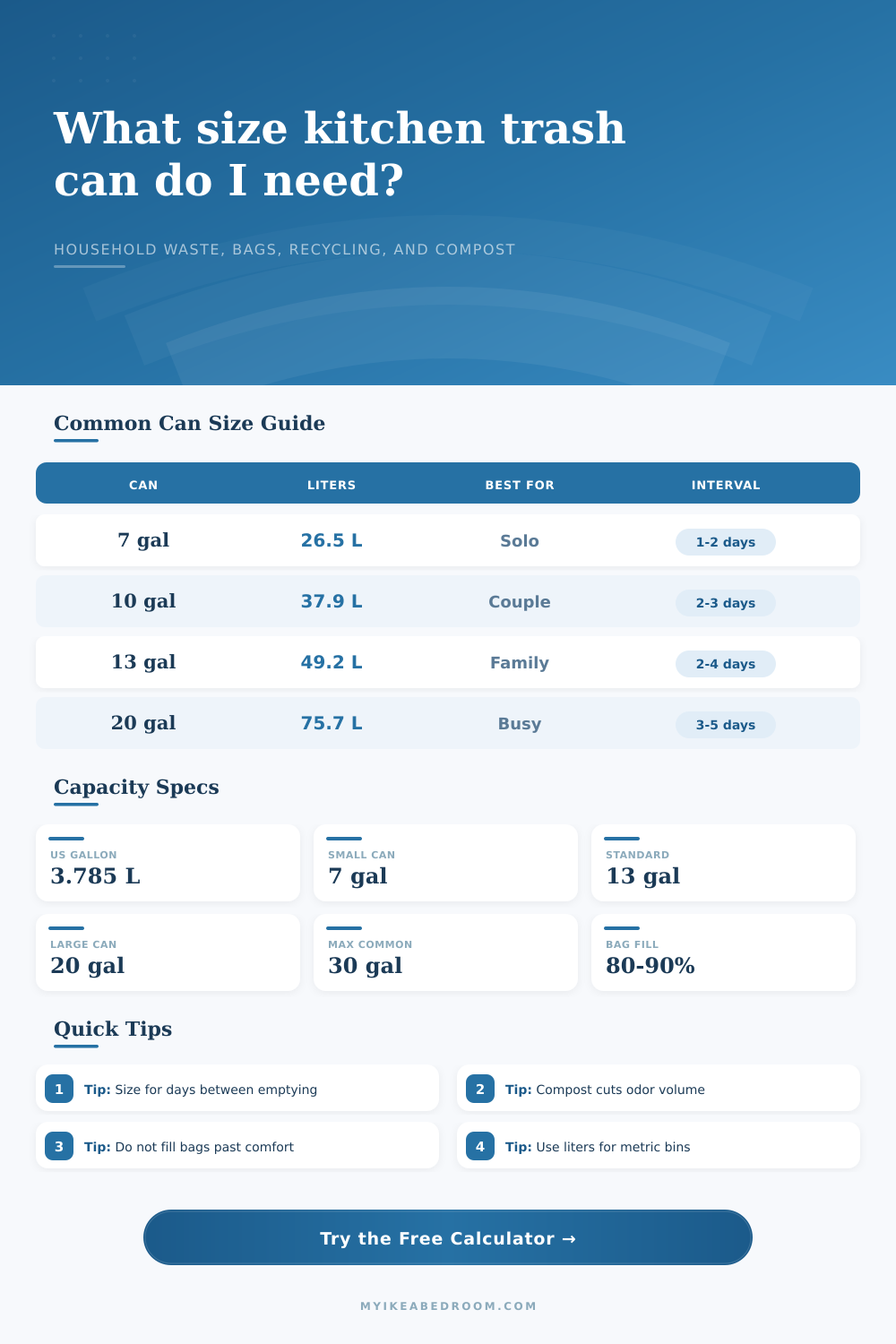
| Common can size | Liter equivalent | Useful kitchen pattern | Planning note |
|---|---|---|---|
| 7 gal | 26.5 L | Solo household, small apartment, under-sink can | Works best with daily or every-other-day emptying. |
| 10 gal | 37.9 L | One to two people with moderate kitchen waste | Often fits slim spaces better than a standard 13 gal can. |
| 13 gal | 49.2 L | Typical family kitchen and common tall kitchen liner | Good midpoint for three to four people with mixed cooking. |
| 20 gal | 75.7 L | Busy kitchen, shared home, or longer collection interval | Choose when 13 gal fills before the planned emptying day. |
| 30 gal | 113.6 L | Very large household, utility room, or overflow plan | May be better as a nearby secondary can than a main kitchen can. |
| Nominal can size | 65% comfortable fill | 85% normal fill | 95% packed fill |
|---|---|---|---|
| 7 gal / 26.5 L | 4.6 gal / 17 L usable | 6.0 gal / 23 L usable | 6.7 gal / 25 L usable |
| 10 gal / 37.9 L | 6.5 gal / 25 L usable | 8.5 gal / 32 L usable | 9.5 gal / 36 L usable |
| 13 gal / 49.2 L | 8.5 gal / 32 L usable | 11.1 gal / 42 L usable | 12.4 gal / 47 L usable |
| 20 gal / 75.7 L | 13.0 gal / 49 L usable | 17.0 gal / 64 L usable | 19.0 gal / 72 L usable |
| 30 gal / 113.6 L | 19.5 gal / 74 L usable | 25.5 gal / 97 L usable | 28.5 gal / 108 L usable |
| Household | Before diversion | After 40% diversion | Likely can size at 85% fill |
|---|---|---|---|
| 1 person, 2 days | 1.0 gal / 3.8 L | 0.6 gal / 2.3 L | 7 gal is ample for ordinary use. |
| 2 people, 3 days | 3.0 gal / 11.4 L | 1.8 gal / 6.8 L | 7 or 10 gal depending on bulk. |
| 4 people, 3 days | 6.0 gal / 22.7 L | 3.6 gal / 13.6 L | 10 or 13 gal after buffer. |
| 5 people, 4 days | 10.0 gal / 37.9 L | 6.0 gal / 22.7 L | 13 gal, or 20 gal for packaging. |
| 6 people, 5 days | 15.0 gal / 56.8 L | 9.0 gal / 34.1 L | 20 gal or multiple smaller cans. |
| Preset | Key assumptions | Computed need | Common can match |
|---|---|---|---|
| Solo light cook | 1 person, 0.35 gal/day, 2 day interval, 45% diverted | About 0.5 gal usable trash storage | 7 gal compact can |
| Couple daily meals | 2 people, daily cooking, 3 day interval, 35% diverted | About 2.7 gal required capacity | 7 gal or 10 gal slim can |
| Family weeknight | 4 people, daily cooking, 3 day interval, 40% diverted | About 5.7 gal required capacity | 10 gal or 13 gal standard can |
| Takeout packaging | 3 people, high packaging, 3 day interval, 25% diverted | About 8.6 gal required capacity | 13 gal standard can |
| Large busy kitchen | 6 people, heavy cooking, 4 day interval, 35% diverted | About 22 gal required capacity | 30 gal or split cans |
💡Kitchen trash can sizing tips
The kitchen trash can is full! It’s time to stop cooking to handle that stinky bag. Why does this get on your nerves? It happened because you didn’t account for your waste. Most of us just guess. That’s what the calculator prevents. When it turns your habits into an exact capacity, it stops you from guessing. Knowing why that number means anything help keep your kitchen tidy.
Most people focus on cabinet space. Few people think about how much stuff you’re going to generate as waste. Two people who make gourmet meals will have more waste then one person livig alone in an apartment, but they’ll still buy the same size bin based off gut instinct.
Find the Right Trash Can Size for You
This tool gets at it by asking how often you cook. Why? Cooking generates vegetable scraps, which are compostable. Eating takeout results in big, bulky waste items that don’t fit well in bins. For example, while a compost bucket might hold five pounds, it may only hold two pounds of cardboard. The tool makes this difference clear. So instead of getting a container that is stuffed within a day, you get a bigger one.
Frequency of dumping also matters. Do you hate taking out the trash? Then you want more capacity. The calculator has an option for collection frequency. Feed that in. It will adjust for volume needed. Want to go from a three day collection cycle up to five days? Bump up the can size. Do you empty the can every day instead of once a week? Shrink the cans volume to match (like going from a ten-gallon can down to a seven-gallon one). This is a matter of time versus space. The table makes this clear. For a typical family, a 13 gallon can is the sweet spot in the middle. For someone who lives alone and empties their bin regularly, a 7 gallon can would work.
It all depends on diversion. How much less trash would there be if you recycled boxes and composted food scraps? Add the percentages of your recyclables and compost. We know not all garbage ends up in the landfill. Most folks overestimate their trash output. They neglect to factor in what they’re separating. A smaller one could fit just fine, if you compost. That leaves more valuable floor space for storage and cleanliness.
The comfort metric is how full bag is. If a can is 95 percent full, it’s tough to get tied shut. It tears easily. That’s why the calculator factors in an extra cushion so you can handle the bag comfortabley. It recommends leaving some slack in the bag. When you pick up a bag of groceries, it won’t rip open. It also factors in those pesky big bags of produce or a giant pizza box that seem to pop out of nowhere.
The size selection isn’t simply “what fits inside the cabinet”. It is also about asking, “what matches my routine?” Do you cook a lot? You’ll want larger capacity. Do you divert some of that waste? Then smaller is fine. Plug in your habits. Let the calculator do the math for you. No more guessing at conversions and coefficients. Get an answer back for recommended size in both liters and gallons. It also compares the result against common can sizes. Is a normal 13 gallon can enough? Or should you go with a 20 gallon version?
You don’t want overflow. You want your system to work well for you. So make it match how much waste you generate. Make it match your waste and routine. Your can should fit into your life. Your can isn’t the largest can. Your can is the right can. This is the can that lets you stop thinking about the trash and start thinking about what’s next: cooking! That’s where the magic happens.