Jelly Roll Quilt Calculator
Estimate jelly roll strips, roll count, rows, blocks, reserve strips, borders, seam loss, and finished quilt top yield for common strip-pieced layouts.
Choose a common quilt plan, then adjust strip width, usable WOF, reserve strips, borders, layout waste, and seam allowance.
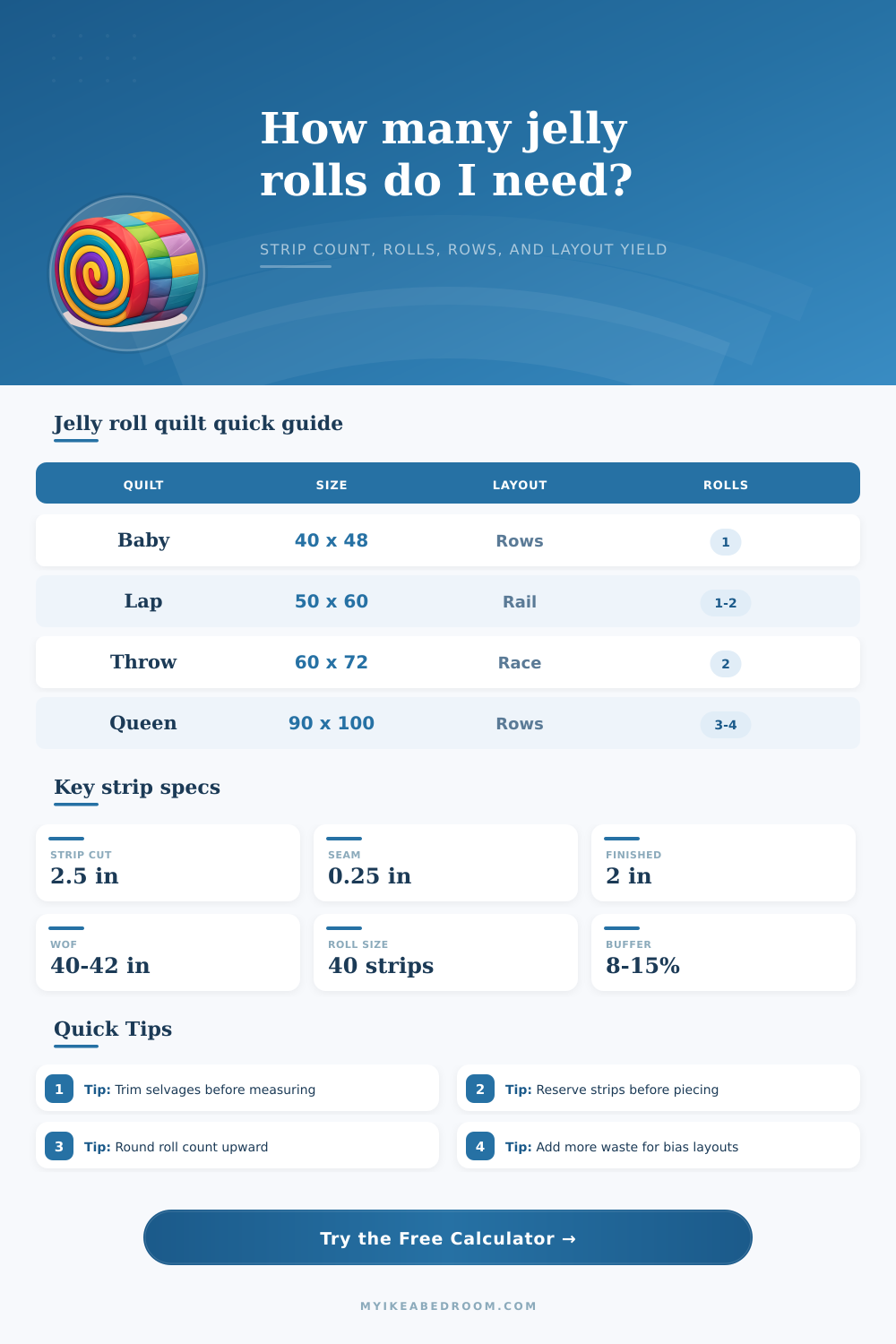
| Quilt plan | Finished size | Layout approach | Typical roll need |
|---|---|---|---|
| Baby quilt | 40 x 48 in | Straight rows | 1 full roll plus reserve |
| Crib quilt | 45 x 54 in | Jelly roll race | 1 full roll, little leftover |
| Lap quilt | 50 x 60 in | Rail fence blocks | 1 to 2 rolls by block waste |
| Throw quilt | 60 x 72 in | Horizontal rows | 2 rolls with accent reserve |
| Twin quilt | 70 x 90 in | Vertical columns | 2 to 3 rolls by width |
| Queen quilt | 90 x 100 in | Strip rows with border | 3 to 4 rolls by border size |
| King quilt | 108 x 108 in | Braid panels | 4 or more rolls |
| Strip cut width | 1/4 in seam finish | Scant seam finish | Good layout use |
|---|---|---|---|
| 1.5 in honey bun | 1 in | About 1.05 in | Mini rows and dense coins |
| 2 in narrow roll | 1.5 in | About 1.55 in | Small blocks and borders |
| 2.5 in jelly roll | 2 in | About 2.05 in | Rows, race, rail fence |
| 3 in wide strip | 2.5 in | About 2.55 in | Fast throws and large blocks |
| Bundle type | Strip count | Approx usable length | Best planning note |
|---|---|---|---|
| Mini roll | 20 strips | 800 in at 40 in WOF | Small runners, accents, borders |
| Standard roll | 40 strips | 1600 in at 40 in WOF | Baby, crib, and many lap quilts |
| Large roll | 42 strips | 1680 in at 40 in WOF | More print variety and reserve |
| Two-roll plan | 80 strips | 3200 in at 40 in WOF | Throws and strip-row twins |
| Layout | Strip math driver | Waste behavior | Best fit |
|---|---|---|---|
| Straight rows | Rows times quilt width | Low waste if seams are staggered | Fast baby and throw quilts |
| Jelly roll race | Total long-strip area | Medium waste from diagonal joins | Quick lap and crib quilts |
| Rail fence | Blocks times strips per block | Medium waste from subcut squaring | Structured lap and bed quilts |
| Braid panels | Panel area plus angled ends | High waste from bias-like cuts | Decorative throws and runners |
| Stacked coins | Column area plus sashing plans | Medium waste from short pieces | Scrappy wall and kids quilts |
Best for: calm color order and fast sewing.
The calculator counts finished strip rows and enough WOF segments to cover the quilt width.
Best for: one long chain of strips.
Strip count is area-based, with extra allowance for repeated long-strip joins.
Best for: block rotation and controlled movement.
Block trim size and strips per block drive the strip-inch estimate.
Best for: angled strip drama.
The calculator adds a larger waste factor for angled ends and panel trimming.
Measure usable WOF: Some precut strips lose more length after selvage trimming. Enter the clean length you will actually sew into the quilt.
Reserve first: Pull binding, accent, or border strips from the roll before chain piecing so the calculator's leftover count stays realistic.
Use more buffer for blocks: Rail fence, log cabin, coins, and braid layouts need extra strips because subcuts must be squared before assembly.
Check finished width: A 2.5 in jelly roll strip usually finishes at 2 in with 1/4 in seams, but scant seams can change the final top size.
Jelly roll quilts are quilts that utilize fabric strips that are purchased in rolls. There are a variety of reasons why jelly roll quilts is popular with quilt makers. For instance, jelly roll quilts allow a person to sew quick to create the quilt.
Additionally, the quilts tend to exhibit the appearance of being handmade. A jelly roll consist of a variety of fabric strips, each strip being two and a half inches wide. When a person presses the strips together along there seams, each strip becomes two inches wide, since each side of the strip utilize a quarter-inch seam.
How to Calculate How Many Jelly Rolls You Need
These two-inch strips are the basis of jelly roll quilt designs. For instance, if a person choose a horizontal layout for the jelly roll quilt, the calculator will determine the number of rows by dividing the length of the quilt by the two-inch measurement of each strip. If the person chooses a vertical layout for the quilt, the calculator will mathematicaly determine the number of columns of strips by dividing the width of the quilt by the two-inch strips.
A person must account for the way in which the strips is joined together. For instance, if strips are joined end to end, the seam that joins the two strips of fabric will consume some of the fabric. Additionally, joins that are made diagonally will consume more fabric then straight joins.
Therefore, each quilt design that is based upon jelly rolls will require a buffer percentage to account for these loss of fabric. Additionally, designs that include many folds, such as jelly roll race quilts, will require the buffer percentage to account for the fabric that is consume by each fold. For quilts with block-based layouts, such as rail fence, log cabin, or stacked coin designs, the jelly roll strips will have to be cut into shorter strip of fabric.
Each of these types of layouts require strips of fabric to be cut into shorter pieces. Because cutting the strips into shorter pieces create waste (fabric that has to be squared up to create a perfect strip), the calculator will incorporate a waste factor for these types of layouts. The reserve strips field can be used to account for the amount of strips of fabric needed for the binding of the quilt.
Binding the quilt will require some additional fabric strips of the same width as the quilt. The size of the quilt will indicate the number of jelly rolls of fabric that are required to make the quilt. For instance, a quilt that is made for a baby may only require one roll of fabric.
A quilt that is to be made for a queen-sized bed will require more jelly rolls of fabric, since the queen quilt is much larger in size. Reference tables that are provided with the calculator can provide a general idea of the number of jelly rolls of fabric that may be required based off the size of the quilt that is to be made. Some types of jelly roll strips may contain creases due to the way in which the fabric is wound in a roll.
Additionally, the length of some strips may be less after they are pressed with an iron or after the cotton fabric is cut. For instance, a strip may measure 40 inches on the cutting mat, but be less than 40 inches after pressed and sewn into the quilt. Therefore, a field is provided for entering the usable length of each strip of jelly roll fabric.
The layout of a quilt will impact the amount of waste that is created in the process of making the quilt. For instance, straight rows of fabric will have very little effort required to sew them together. Fabric in the form of rail fence or braid panels may require more effort to sew than straight rows.
Additionally, panels in the form of braid panels will require additional strips of jelly roll fabric because the strips will be cut at angles, creating triangular scraps of fabric that cannot be used for any part of the quilt other than the scraps themselves. Therefore, the person using the calculator will adjust the waste factor according to the type of layout that is to be made. The person making the jelly roll quilt will have to decide how much buffer to incorporate into the calculation of the number of jelly rolls of fabric that are required.
A zero percent buffer will indicate that the maker will not make any allowance for fabric loss. Many people will incorporate eight percent to account for potential loss of fabric due to sewing errors. While unused strips of jelly roll fabric can be stored in a persons sewing stash, it isnt easy to find more fabric once a person has started sewing with it.
The fields for entering the finished size of the quilt will account for any borders that will be sewn to the quilt. If a person chooses to include borders in the quilt, the calculator will subtract the border width from the size of the quilt. This allows the maker to ensure that the number of rolls of fabric that are purchased will not be bought in excess for the borders that will be sewn to the quilt.
If the strips of fabric are to cover the entire quilt, the border width will be zero. Overall, this calculator will provide a realistic start to the jelly roll quilt project of a maker, accounting for any losses of fabric that may occur during the making of the quilt.